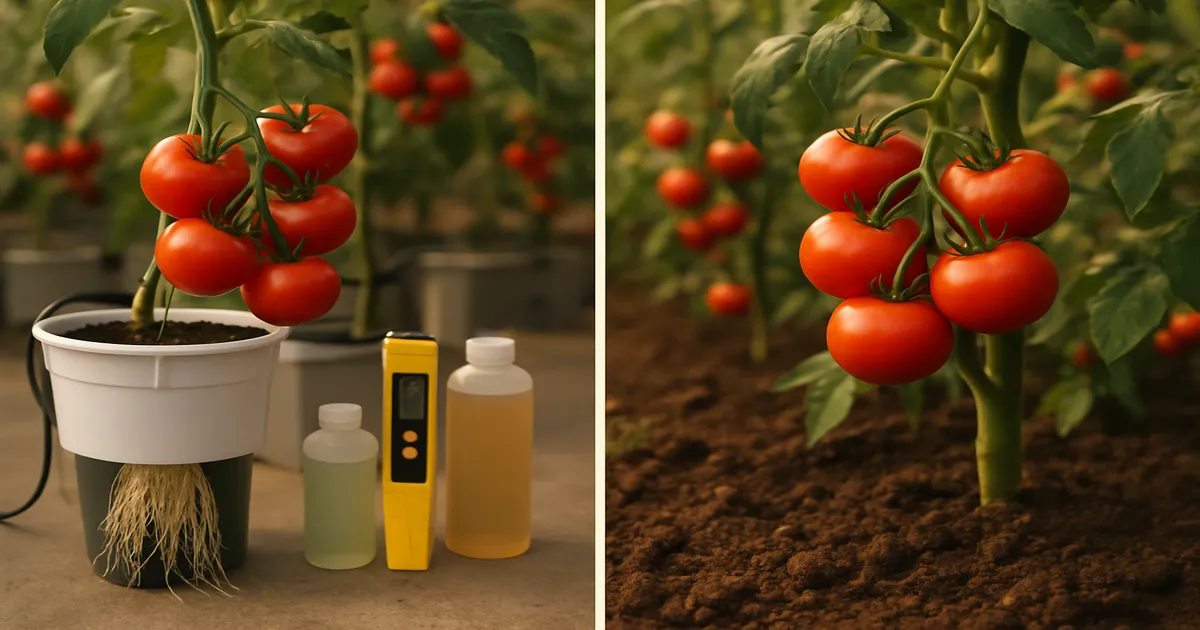
Quick Answer: Hydroponic tomatoes yield 2–5× more per square foot, grow 20–30% faster, and use up to 90% less water than soil-grown tomatoes — but they cost more to set up and require closer attention. Soil growing is more forgiving, supports richer flavor complexity through the soil food web, and has a much lower barrier to entry. Which wins depends entirely on your goals, budget, and how much you enjoy tinkering.
Choosing between hydroponic tomatoes vs soil grown isn’t really about which method is “better” — it’s about which one fits your situation. A backyard gardener chasing heirloom flavor and a commercial greenhouse operator chasing year-round yield are playing completely different games. This guide breaks down both methods honestly, covering yield, taste, nutrients, cost, and sustainability — so you can make the call with confidence.
Hydroponic Tomatoes vs Soil Grown: At a Glance
| Factor | Hydroponics | Soil Growing |
|---|---|---|
| Yield per plant | 40–50 lbs/year (continuous harvest) | 10–15 lbs/season |
| Growth speed | 20–30% faster to maturity | Standard seasonal timeline |
| Water use | Up to 90% less (recirculating) | High water demand |
| Flavor ceiling | Excellent with good management | Often higher complexity (heirlooms) |
| Startup cost | Medium–High | Low–Medium |
| Management complexity | High — daily monitoring | Low–Medium |
| Beginner friendliness | Moderate learning curve | Very forgiving |
Which Method Is Right for You?
- Choose hydroponics if you want maximum yield, year-round production, indoor growing, or you’re exploring commercial scale. The $1.5 billion global hydroponic tomato market didn’t get there by accident.
- Choose soil growing if you’re a beginner, growing outdoors seasonally, prioritizing flavor above all, or working with a tight startup budget.
- Not sure? Start with soil. Learn how tomatoes grow. Then experiment with a simple Dutch Bucket or DWC system once you understand the plant’s needs.
Yield and Growth Rate: How the Two Methods Compare
How Much Do Hydroponic Tomatoes Yield vs Soil?
The yield gap is real and substantial. In a well-managed continuous-harvest hydroponic setup — a commercial greenhouse with trained vines and Dutch Bucket systems, for example — a single indeterminate tomato plant can produce 40–50 lbs per year. In soil, even under ideal outdoor conditions with excellent fertility, 10–15 lbs per plant per season is a realistic expectation.
That’s not a knock on soil. It’s simply what happens when you remove every bottleneck between the plant and its food.
Why Hydroponic Tomatoes Grow Faster
When nutrients are dissolved in solution and delivered directly to the root zone at optimal pH, plants spend almost no energy foraging for food. Add controlled temperature, optimized lighting, and consistent moisture, and you’ve eliminated most of the variables that slow a tomato down. The result is maturity 20–30% faster than soil-grown counterparts — meaningful when you’re running multiple crop cycles per year.
Soil’s Yield Potential Under Ideal Conditions
Soil can close the gap more than people realize. Rich, biologically active soil teeming with mycorrhizal fungi, beneficial bacteria, and earthworms creates a dynamic nutrient cycle that hydroponics mimics but doesn’t fully replicate. An experienced organic grower with excellent compost, proper drainage, and a long growing season can produce impressive harvests — just not at the same per-square-foot density or frequency as a dialed-in hydroponic system.
Taste and Flavor: Do Hydroponic Tomatoes Really Taste Different?
Why Soil-Grown Tomatoes Often Win Blind Taste Tests
Honest answer: in blind taste tests, heirloom tomatoes grown in rich, biologically active soil frequently win on flavor complexity. The soil food web — mycorrhizal fungi, bacteria, decomposing organic matter — produces a diverse array of secondary compounds that influence aroma, acidity, and sweetness in ways that science hasn’t fully mapped yet. A sun-ripened Brandywine from a well-amended garden bed is genuinely hard to beat.
How Hydroponic Tomatoes Can Match Soil on Brix Score
That said, “hydroponic tomatoes taste bland” is an oversimplification. Flavor in any tomato is driven by Brix score (sugar content), acid balance, and aromatic compounds — all of which are manageable in hydroponics. Well-formulated, calcium-rich nutrient solutions, careful harvest timing, and smart variety selection can produce hydroponic tomatoes that score excellently on Brix.
One commercial technique worth knowing is stress ripening: by raising EC to 3,500–5,000 PPM (7.0–10.0 EC) during peak fruiting, growers deliberately stress the plant, forcing it to concentrate sugars in the fruit. The tomatoes get smaller but significantly sweeter. Home growers can experiment cautiously at the upper end of the fruiting EC range (2,000–3,500 PPM / 4.0–7.0 EC) without risking serious nutrient burn. The bottom line: a poorly managed soil garden will produce bland tomatoes just as surely as a neglected hydroponic system. Management matters more than method.
Choosing the Right System for Hydroponic Tomatoes vs Soil Growing
Dutch Bucket (Bato Bucket): The Most Popular Hydroponic Choice
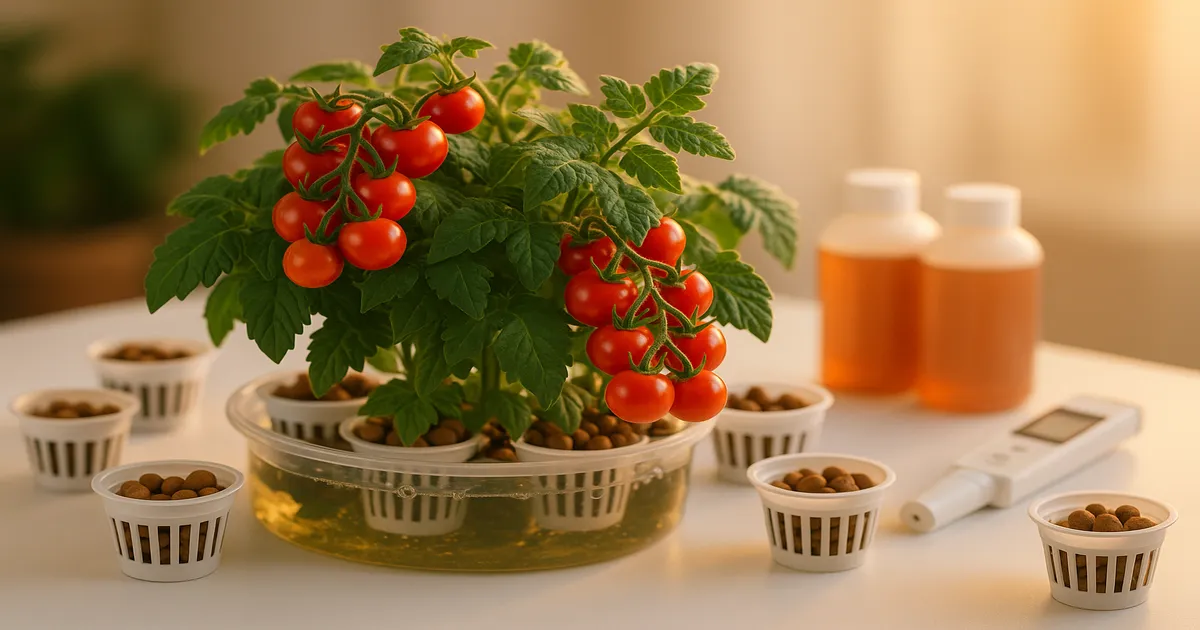
For good reason. Dutch Buckets hold a growing medium — usually perlite or clay pebbles — in individual containers connected to a shared recirculating or drain-to-waste system. They’re perfectly suited to indeterminate vining tomatoes: you can train long vines, manage multiple plants independently, and scale up simply by adding more buckets. This is the dominant system in commercial greenhouse tomato production worldwide.
DWC, NFT, Drip, and Ebb & Flow: Quick Comparison
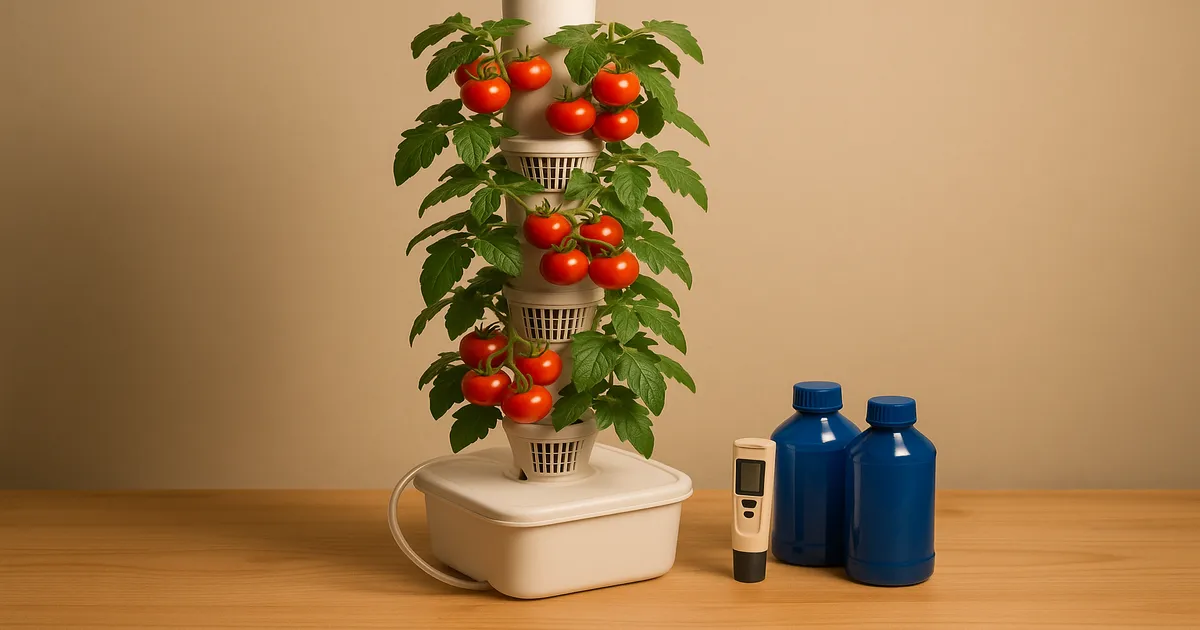
- DWC (Deep Water Culture): Roots suspended in oxygenated nutrient solution. Fast growth, simple setup, great for home growers. Requires a reliable air pump — a quality unit like the EcoPlus 728450 Commercial Air Pump keeps dissolved oxygen levels stable and roots healthy. Needs frequent monitoring.
- Kratky Method: Passive DWC with no pump or electricity. The easiest entry point for beginners, though it works better for smaller fruiting crops than large indeterminate tomatoes.
- NFT (Nutrient Film Technique): A thin film of solution flows continuously over roots. Space-efficient and popular commercially, but tomatoes’ large root mass can clog channels over time.
- Drip Systems: Precise, scalable, and widely used. Nutrient solution drips to the base of each plant and works well at any scale.
- Ebb & Flow: Periodic flooding of a grow tray. Versatile for hobbyists but less practical for large vining tomatoes.
Soil Growing Formats: In-Ground, Raised Beds, and Containers
In-ground beds offer the most root space and biological diversity but require good native soil or significant amendment. Raised beds give you control over soil composition, drainage, and warmth — a great middle ground. Containers are flexible and portable but dry out quickly and need more frequent feeding. For tomatoes, aim for at least 5 gallons of container volume per plant, and 15–20 gallons for indeterminate varieties.
Nutrient Management: Hydroponic Recipes vs Soil Feeding
pH Targets for Hydroponic vs Soil Tomatoes
Hydroponic tomatoes thrive at pH 5.8–6.3, with 6.0 as the sweet spot. Soil-grown tomatoes prefer pH 6.0–6.8, centered around 6.5. The lower hydroponic target keeps all macro and micronutrients soluble — iron in particular precipitates out above pH 6.5, causing deficiencies even when it’s present in the formula.
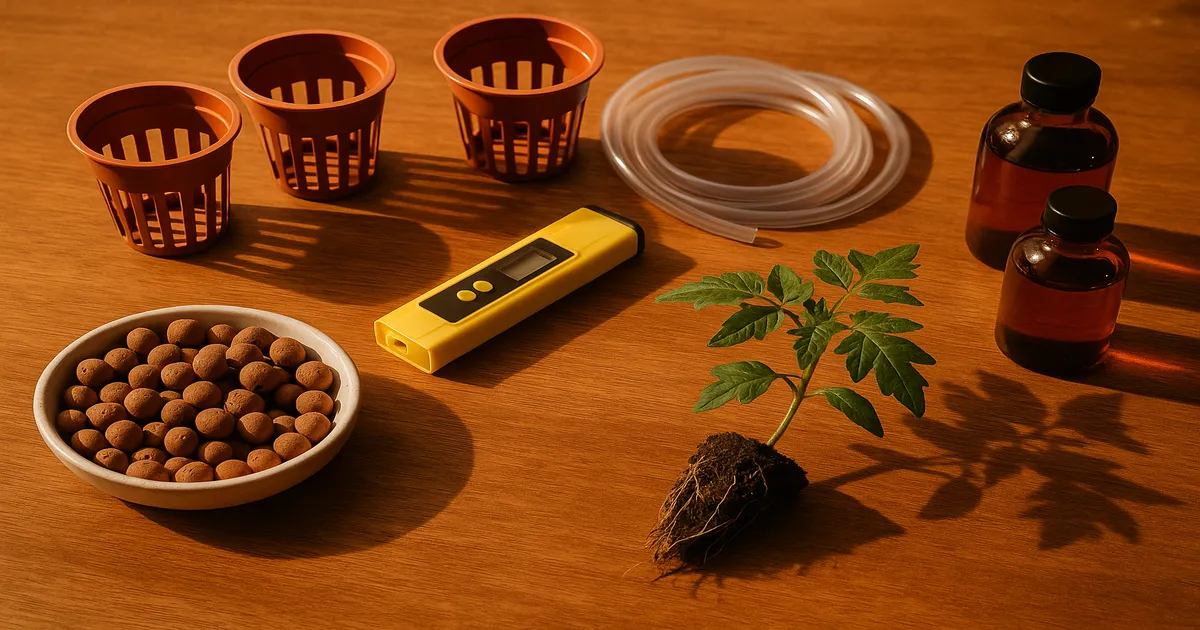
A reliable digital pH meter is essential for hydroponic growing. The Apera PC60 and Bluelab pH Pen are both solid choices. Calibrate with pH 4.0 and 7.0 buffer solutions every one to two weeks, and replace the electrode every 12–18 months. For EC, the Bluelab Truncheon is a reliable workhorse that needs no calibration.
One important note on PPM readings: North American meters typically use the 0.5 conversion factor (EC 1.0 = 500 PPM), while European meters use the 0.7 factor (EC 1.0 = 700 PPM). Always confirm which scale your meter uses before comparing numbers.
EC and PPM Targets by Growth Stage
| Growth Stage | PPM (0.5 scale) | EC |
|---|---|---|
| Seedling / Germination | 400–600 | 0.8–1.2 |
| Early Vegetative | 800–1,000 | 1.6–2.0 |
| Late Vegetative | 1,200–1,600 | 2.4–3.2 |
| Early Flowering | 1,600–2,000 | 3.2–4.0 |
| Fruiting / Ripening | 2,000–3,500 | 4.0–7.0 |
Key Macronutrients: N-P-K, Calcium, and Magnesium
Nitrogen drives vegetative growth. Target 150–250 PPM N during veg, dropping to 100–150 PPM during fruiting to avoid leafy growth at the expense of fruit. Calcium nitrate is the preferred nitrogen source — avoid ammonium-heavy fertilizers, which destabilize pH and can damage roots at warmer temperatures.
Potassium is the star of fruiting. Shift your K:N ratio from roughly 1:1 during vegetative growth to 2:1 or 3:1 once fruit is setting, targeting 200–400 PPM K. Calcium (150–200 PPM) is non-negotiable — deficiency causes Blossom End Rot, the most frustrating and preventable tomato problem there is. Magnesium (50–75 PPM, supplied as Epsom salt) keeps chlorophyll functioning; deficiency shows up as interveinal yellowing on older leaves.
DIY Hydroponic Nutrient Recipe for Tomatoes
This two-part system is formulated per 100 gallons (~380 liters). Always add Part A and Part B separately to your reservoir — never mix the concentrates directly.
Part A (Calcium Nitrate Solution):
- Calcium Nitrate [Ca(NO₃)₂·4H₂O]: 950 g
- Iron EDTA (13% Fe): 40 g
Part B (Base Nutrient Solution):
- Potassium Nitrate [KNO₃]: 610 g
- Monopotassium Phosphate [KH₂PO₄]: 260 g
- Magnesium Sulfate [MgSO₄·7H₂O]: 490 g
- Potassium Sulfate [K₂SO₄]: 130 g
Micronutrient Mix (add to Part B):
- Manganese Sulfate: 4 g
- Boric Acid: 3 g
- Zinc Sulfate: 0.4 g
- Copper Sulfate: 0.15 g
- Sodium Molybdate: 0.1 g
This formula approximates a modified Hoagland’s solution — the research baseline that most professional hydroponic nutrient formulas are derived from. If you’d rather start with a pre-mixed option, MasterBlend 4-18-38 used alongside calcium nitrate and Epsom salt is a popular and cost-effective alternative.
Soil Feeding Strategies
Start with a balanced slow-release fertilizer (10-10-10 NPK) at planting. During fruiting, side-dress with calcium nitrate (about 1 tablespoon per plant every 2–3 weeks) to prevent Blossom End Rot. A foliar spray of Epsom salt (1 tbsp per gallon of water) addresses magnesium deficiency faster than any soil amendment. For organic growers, compost and worm castings build long-term fertility; fish emulsion feeds quickly; bone meal adds phosphorus; kelp meal supplies potassium and trace minerals.
Lighting for Indoor Hydroponic Tomatoes
Tomatoes are full-sun plants. Indoors, you need to deliver that full spectrum artificially.
- Blue (400–500 nm): Builds compact vegetative structure and strong stems.
- Red (600–700 nm): Drives photosynthesis most efficiently; critical for flowering and fruiting.
- Far-red (700–800 nm): Triggers the Emerson Enhancement Effect — combining far-red with red light boosts photosynthetic efficiency by 20–30% and accelerates flowering.
- UV (280–400 nm): In small doses, stimulates lycopene and flavor compound production.
Aim for a full-spectrum white LED with an R:B ratio of roughly 3:1 to 5:1, plus far-red supplementation. The Spider Farmer SF-4000 covers a 4×4 ft canopy at flowering PPFD targets and includes far-red diodes — a solid choice for serious home growers.
| Growth Stage | Target PPFD (µmol/m²/s) |
|---|---|
| Seedling | 200–400 |
| Vegetative | 400–600 |
| Pre-flowering | 600–800 |
| Flowering & Fruiting | 800–1,000+ |
Outdoor soil growers get free, full-spectrum sunlight — genuinely hard to beat on cost. The limitation is control: you can’t extend the photoperiod, adjust spectrum, or compensate for cloudy weeks during fruit set. Position outdoor tomatoes where they’ll receive at least 8 hours of direct sun daily.
Cost and Sustainability: Which Method Wins?
Upfront and Ongoing Costs
Soil growing wins on startup cost, full stop. Seeds, containers or bed materials, quality compost, and basic fertilizers can get you growing for well under $100. Hydroponics requires a system, EC and pH meters, nutrient salts, a pump, and — for indoor growing — grow lights. A capable home setup runs $300–$800 before lighting, which alone can add $200–$600. The payback comes through higher yields and year-round production, which makes the math work at commercial scale but requires patience at home.
Water Efficiency
Hydroponics wins decisively. Recirculating systems use up to 90% less water than conventional soil irrigation by capturing and reusing runoff. In water-stressed regions or indoor environments where every input is a cost, that efficiency is a major advantage.
Environmental Impact and Organic Certification
This is where it gets complicated. The U.S. regulatory landscape around organic certification for hydroponic crops remains contested — the USDA currently allows it, but many soil-based organic advocates argue that hydroponics can’t truly be “organic” without the soil food web. Soil growing, particularly with organic practices, directly supports microbial biodiversity, carbon sequestration, and long-term land health in ways that hydroponic systems simply don’t replicate. Neither method is inherently “greener” — it depends heavily on your energy source, water source, and management practices.
Frequently Asked Questions
Are hydroponic tomatoes as nutritious as soil-grown tomatoes? Research is mixed, but well-managed hydroponic tomatoes can match or exceed soil-grown tomatoes in key nutrients like lycopene, vitamin C, and potassium. The biggest variable is variety and ripeness at harvest — not the growing method itself.
How long does it take to grow tomatoes hydroponically? Most varieties reach first harvest in 60–80 days from transplant, roughly 2–3 weeks faster than the same variety grown in soil. Indeterminate varieties continue producing for 9–12 months in a continuous-harvest system.
Can I grow hydroponic tomatoes without grow lights? Yes, if you have a south-facing greenhouse or sunroom that delivers 8+ hours of direct light daily. Otherwise, supplemental lighting is essential — tomatoes at fruiting stage need 800–1,000+ µmol/m²/s PPFD, which most indoor windows can’t provide.
What is the easiest hydroponic system for growing tomatoes at home? Dutch Bucket is the most practical for indeterminate tomatoes. For a true beginner, a simple drip system into perlite-filled containers is even more forgiving and uses widely available materials. Avoid NFT for tomatoes — the root mass gets too large for the channels.
Do hydroponic tomatoes need pollination? Yes. Outdoors, wind and insects handle this. Indoors, you’ll need to pollinate manually. The easiest method is to gently shake flowering trusses daily, or use a small electric toothbrush held against the back of each flower cluster to vibrate pollen loose. Some commercial growers use bumblebee hives for this purpose.