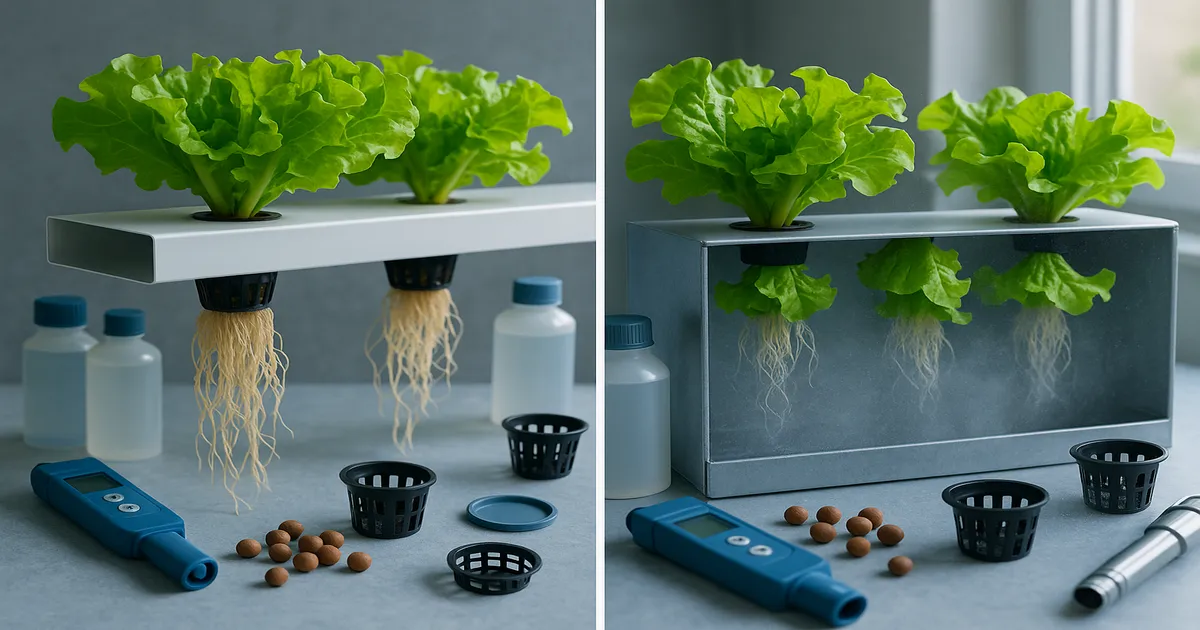
Quick Answer: Aeroponics delivers faster growth and lower water use than hydroponics — but it’s harder to run, more expensive to set up, and far less forgiving when things go wrong. For most growers, hydroponics is the better starting point. Aeroponics earns its place when maximum performance justifies the added complexity.
When people search aeroponics vs hydroponics which is better, they’re hoping for a clean, definitive answer. The honest answer: it depends on your goals, budget, and experience level. Both systems grow plants without soil and deliver nutrients through water — but they diverge sharply in how roots are exposed to oxygen, and that difference cascades into everything from growth speed to failure risk to daily maintenance.
Aeroponics vs Hydroponics: Quick Comparison
The Short Answer
Aeroponics wins on raw performance — faster growth, lower water consumption, maximum root oxygenation. Hydroponics wins on reliability, accessibility, lower startup cost, and forgiveness when something goes wrong. Neither is universally superior.
At-a-Glance Comparison Table
| Factor | Hydroponics | Aeroponics (HPA) |
|---|---|---|
| Growth speed | Baseline | 20–25% faster |
| Startup cost | Low–Moderate | High |
| Complexity | Low–Moderate | High |
| Water use | Up to 95% less than soil | ~20–30% less than hydroponics |
| Failure risk | Low–Moderate | High |
| Best for | Beginners to commercial | Advanced growers, R&D |
What Is Hydroponics?
How Hydroponics Works
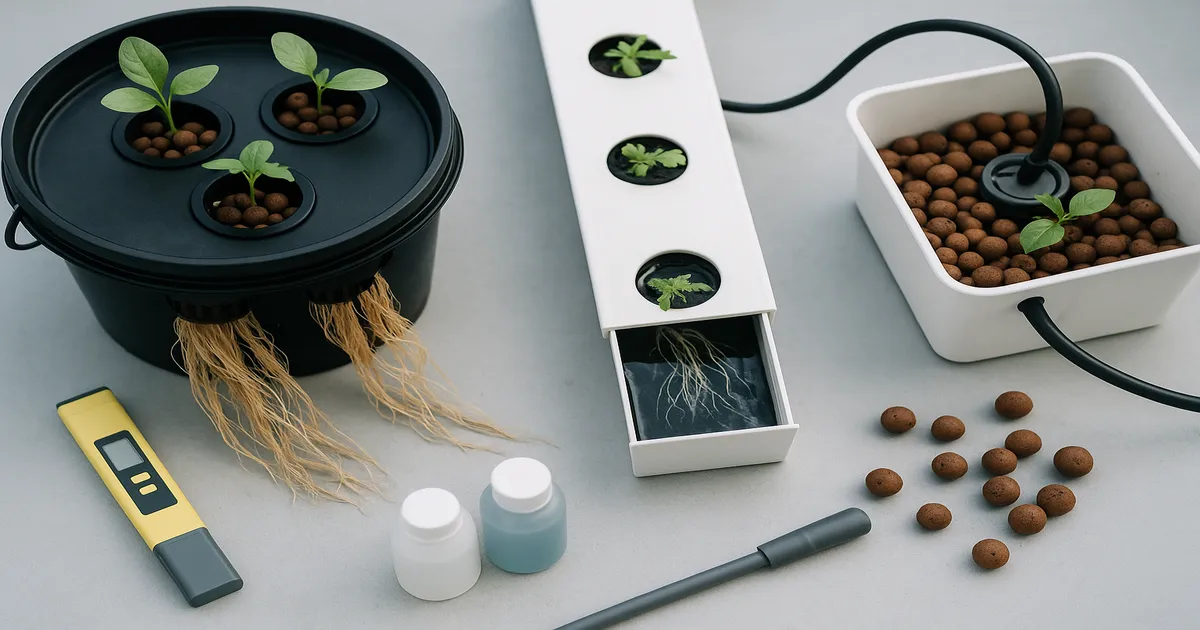
Hydroponics is soil-free growing where roots are supported by an inert medium — or suspended directly in solution — and fed a precisely formulated nutrient mix. Without soil acting as a buffer, nutrients go straight to the roots, which is why hydroponic plants typically outgrow their soil-grown counterparts.
Commercial hydroponics has a long track record. W.F. Gericke at UC Davis pioneered large-scale soilless growing in the 1930s, and the industry has never looked back. The global hydroponics market was valued at $9.5 billion in 2022 and is projected to exceed $21 billion by 2028.
The Six Main Hydroponic System Types
| System | Root Environment | Oxygen Level | Complexity | Best For |
|---|---|---|---|---|
| Deep Water Culture (DWC) | Submerged in solution | Moderate | Low | Leafy greens, beginners |
| Nutrient Film Technique (NFT) | Thin flowing film | High | Moderate | Lettuce, herbs |
| Ebb & Flow | Periodically flooded | Moderate–High | Moderate | Versatile crops |
| Drip Systems | Medium kept moist | Moderate | Moderate–High | Tomatoes, peppers |
| Kratky (passive DWC) | Partially submerged | Moderate | Very Low | Beginners, small-scale |
| Wick System | Wicked moisture | Low | Very Low | Herbs, microgreens |
New to soilless growing? DWC or Kratky are the most forgiving entry points — minimal equipment, straightforward maintenance, and a real margin for error. NFT and Ebb & Flow suit growers ready to step up. Once you’ve mastered any of these, aeroponics starts to make sense.
What Is Aeroponics?
How Aeroponics Works
Aeroponics is technically a subset of hydroponics — but instead of submerging roots in solution, it suspends them in air and delivers nutrients via fine mist. Between misting cycles, roots are exposed to open air, giving them maximum oxygen access. That oxygen availability is the key driver behind aeroponics’ speed advantage: roots absorb nutrients more efficiently when they’re not waterlogged.
No growing medium is required. Plants are held in net pots or foam collars, with roots hanging freely into a dark, enclosed chamber where misting occurs.
LPA vs HPA: Not Just Marketing Labels
- LPA (Low-Pressure Aeroponics): Uses standard pumps and spray heads. Droplet size runs 50–100+ microns — closer to a sprinkler than a true mist. More affordable and forgiving, but doesn’t fully replicate the oxygen-maximizing benefits of true aeroponics.
- HPA (High-Pressure Aeroponics): Uses pumps running at 80–120 PSI to generate droplets of 30–80 microns. This ultra-fine mist coats root surfaces without saturating them, maximizing both oxygen exposure and nutrient absorption. This is what researchers mean when they say “aeroponics” — and it costs significantly more to build and run.
NASA researched HPA extensively in the 1990s for space-based food production — the agency even coined the term in formal research documentation. The appeal was obvious: maximum food output with minimum water and no soil weight. Those findings on accelerated growth rates and water efficiency have held up in subsequent university research.
Aeroponics vs Hydroponics: Head-to-Head Performance
Growth Rate and Yield
Hydroponics already outpaces soil — typically by 20–30% in growth rate for most crops. Aeroponics pushes further. Per NASA studies and subsequent university research, HPA systems can produce growth rates 20–25% faster than standard hydroponics, and up to 30–40% faster than soil. For high-value crops where time-to-harvest directly affects profitability, that margin matters.
The catch: yield potential is only realised when the system runs flawlessly. A single pump failure or nozzle clog can wipe out that advantage within hours.
Water and Resource Efficiency
Both systems are dramatically more water-efficient than soil farming — hydroponics uses up to 95% less water than conventional growing. Aeroponics goes further, using roughly 20–30% less water than recirculating hydroponic systems, because the mist delivers only what roots can absorb with minimal runoff or evaporation. If water cost or scarcity is a real constraint, HPA has a genuine edge.
Setup Cost
Hydroponics can be started for a few hundred dollars with a DWC bucket, an air pump, and some basic nutrients. A serious HPA system is a different category of investment entirely. High-pressure pumps, precision stainless steel nozzles, accumulator tanks, short-cycle timers, and continuous monitoring equipment add up fast — easily $1,000–$3,000 for a small setup, and far more at commercial scale.
Reliability and Failure Risk
This is where hydroponics pulls decisively ahead. In a DWC or NFT system, a pump failure gives you hours — sometimes days — before plants are critically stressed. In HPA, roots dry out within hours if misting stops. Power outages, clogged nozzles, pump failures, and timer malfunctions are all potentially catastrophic. Serious HPA operations run backup pumps, battery-powered timers, and alarm systems. That’s not paranoia — it’s a requirement.
Nutrients: How Feeding Differs Between Systems
EC and PPM Targets by Growth Stage
Because root oxygen saturation in HPA is so high, plants absorb nutrients more efficiently. Running the same EC as a hydroponic system leads to overfeeding. In practice, aeroponics runs 15–25% lower PPM/EC than equivalent hydroponic setups, and nutrient burn appears faster than in any other system if you push concentrations too high.
| Growth Stage | Hydroponics PPM (EC) | Aeroponics PPM (EC) |
|---|---|---|
| Seedling/Clone | 400–600 PPM (0.8–1.2 EC) | 300–500 PPM (0.6–1.0 EC) |
| Vegetative | 800–1,200 PPM (1.6–2.4 EC) | 600–1,000 PPM (1.2–2.0 EC) |
| Early Flowering | 1,000–1,400 PPM (2.0–2.8 EC) | 800–1,200 PPM (1.6–2.4 EC) |
| Peak Flowering/Fruiting | 1,200–1,800 PPM (2.4–3.6 EC) | 1,000–1,600 PPM (2.0–3.2 EC) |
| Late Flower/Flush | 400–600 PPM (0.8–1.2 EC) | 300–500 PPM (0.6–1.0 EC) |
Macronutrient Ratios (N:P:K)
- Vegetative stage: 3:1:2 — nitrogen-forward to drive leaf and stem growth
- Flowering/fruiting: 1:3:2 — phosphorus-dominant to support bud and fruit development
- Leafy greens (all stages): Stay nitrogen-forward at 3:1:2 to 4:1:3
Secondary Nutrients and Micronutrients
- Calcium (Ca): 150–200 PPM — critical for cell wall integrity, especially in aeroponics where uptake is rapid
- Magnesium (Mg): 30–50 PPM — central to chlorophyll production
- Sulfur (S): 50–80 PPM — enzyme function and protein synthesis
- Iron (Fe): 2–5 PPM — use chelated Fe-EDTA or Fe-DTPA for pH stability
- Manganese (Mn): 0.5–1.0 PPM | Zinc (Zn): 0.05–0.3 PPM | Boron (B): 0.1–0.5 PPM
- Copper (Cu): 0.01–0.05 PPM | Molybdenum (Mo): 0.01–0.05 PPM
Nutrient Product Recommendations
For most growers, a quality 3-part system covers everything. The General Hydroponics Flora Series is reliable and widely available. Advanced Nutrients pH Perfect Trio removes the guesswork from pH management. For professional recirculating systems, Canna Aqua is a consistent performer.
Vegetative starter recipe — per 10 gallons (38L) using GH Flora Series:
- Start with RO or clean water
- Add FloraMicro first: 40 mL
- Add FloraGro: 40 mL
- Add FloraBloom: 20 mL
- Add CaliMagic: 20 mL (if using RO water)
- Target: 900–1,100 PPM (1.8–2.2 EC), pH adjusted to 5.8–6.0
Two important warnings for aeroponics: Don’t use organic nutrients in HPA systems — organic particles clog fine mist nozzles quickly. And if you’re supplementing with silica, add it directly to the reservoir and flush nozzles regularly. Heavy silica deposits will destroy your misters.
pH and EC Management
Optimal pH Ranges
- Hydroponics: pH 5.5–6.5, optimal target 5.8–6.2
- Aeroponics: pH 5.5–6.2, optimal target 5.8–6.0 — a noticeably tighter window
Fine mist droplets have far greater surface area than pooled solution, so CO₂ from root respiration interacts with the nutrient film faster — pH shifts happen in hours, not days. Above pH 6.5, calcium and phosphate begin to precipitate directly onto your nozzles. A clogged nozzle in HPA isn’t just an inconvenience; it’s a root-drying emergency.
Monitoring Tools and Frequency
For hydroponics, checking pH and EC every one to two days is typically sufficient. In aeroponics, daily monitoring is the minimum — and for HPA systems running tight misting cycles, continuous monitoring is strongly recommended.
Reliable tools include the Bluelab pH Pen and the Apera PC60 for spot checks. For HPA specifically, the Bluelab Guardian Monitor is worth every penny — it tracks pH, EC, and temperature around the clock. For EC alone, the Bluelab Truncheon is a durable, no-calibration option. Calibrate pH meters weekly using pH 4.0 and 7.0 buffer solutions; calibrate EC meters monthly.
Diagnosing Common pH and EC Problems
| Fluctuation | Likely Cause | Fix |
|---|---|---|
| pH rising steadily | Nitrate uptake raising solution pH | Add pH Down; consider partial ammonium nitrogen source |
| pH dropping rapidly | High root CO₂; possible root rot | Increase aeration; inspect roots; add pH Up |
| pH swinging wildly | Low solution volume; nutrient imbalance | Top off reservoir; full change if needed |
| pH stable but high (>6.8) | Hard tap water with high bicarbonates | Switch to RO water; add pH Down |
EC management logic: If EC is rising, plants are drinking water faster than nutrients — top off with plain pH-adjusted water. If EC is dropping, plants are eating faster than they’re drinking — top off with half-strength solution. Do a full reservoir change every 7–10 days for aeroponics and 10–14 days for hydroponics.
If your tap water tests above 200 PPM (0.4 EC), you’re starting with a compromised baseline that will constantly push pH upward and muddy your nutrient ratios. RO water at 0–50 PPM gives you a clean slate — just supplement with Cal-Mag at approximately 150 PPM Ca and 50 PPM Mg to compensate for what the membrane strips out.
Lighting: What Both Systems Need
Lighting requirements are identical whether you’re running aeroponics or hydroponics — the root delivery method doesn’t change what happens above the canopy. What matters is delivering the right spectrum, intensity, and duration for your crop.
Full spectrum (400–700 nm) covers the basics. Blue light (400–500 nm) drives compact vegetative growth. Red (600–700 nm) is the primary photosynthesis driver for flowering and fruiting. Far-red (700–750 nm) triggers the Emerson Enhancement Effect, extending effective photosynthesis. UV-A (315–400 nm) stimulates secondary metabolite production — relevant for herbs where terpene and flavonoid content matters.
DLI formula: DLI = PPFD × (photoperiod hours × 3,600) ÷ 1,000,000
PPFD and DLI Targets by Crop
| Crop | PPFD (µmol/m²/s) | DLI (mol/m²/day) | Photoperiod |
|---|---|---|---|
| Leafy greens | 150–250 | 12–17 | 16–18 hrs |
| Herbs | 200–400 | 15–20 | 16–18 hrs |
| Tomatoes (vegetative) | 400–600 | 20–30 | 18 hrs |
| Tomatoes (fruiting) | 600–900 | 30–40 | 16–18 hrs |
| Cannabis (vegetative) | 400–600 | 20–30 | 18 hrs |
| Cannabis (flowering) | 600–900 | 35–45 | 12 hrs |
For most indoor setups, a quality LED grow light covers all these crops efficiently. The Spider Farmer SF-4000 is a strong mid-range option for 4×4 tents. For larger commercial canopies, the Gavita Pro 1700e LED is an industry standard.
Which System Is Right for You?
Choose hydroponics if:
- You’re new to soilless growing
- Budget is a primary concern
- You want a reliable system that tolerates occasional mistakes
- You’re growing leafy greens, herbs, or fruiting crops at any scale
Choose aeroponics if:
- You have hands-on hydroponic experience already
- Maximum growth speed or water efficiency is a hard requirement
- You can invest in backup systems and daily monitoring
- You’re running an R&D operation or advanced vertical farm
The comparison between aeroponics vs hydroponics isn’t really about which system is objectively better — it’s about which system is better for you. Most growers who thrive with aeroponics spent years in hydroponics first. That foundation matters.
Frequently Asked Questions
Is aeroponics faster than hydroponics? Yes — HPA systems typically produce growth rates 20–25% faster than standard hydroponics, driven by superior root oxygenation and nutrient absorption. That advantage disappears quickly if the system experiences any downtime.
Can beginners use aeroponics? Technically yes, but it’s not recommended. HPA systems require daily monitoring, backup equipment, and a solid understanding of pH, EC, and root health. Most growers benefit from at least one full grow cycle in DWC or NFT before attempting aeroponics.
Do aeroponics and hydroponics use the same nutrients? The same nutrient elements are required, but aeroponics runs at 15–25% lower EC/PPM due to more efficient uptake. Organic nutrients should never be used in HPA systems — they clog fine mist nozzles rapidly.
Which system uses less water? Both are far more efficient than soil. Hydroponics uses up to 95% less water than conventional farming. Aeroponics uses roughly 20–30% less than recirculating hydroponics, making it the most water-efficient option available.
What’s the biggest risk with aeroponics? System failure. If misting stops — due to a pump failure, clogged nozzle, or power outage — roots can dry out and plants can die within hours. Redundant pumps, battery backup timers, and continuous monitoring are essential, not optional.