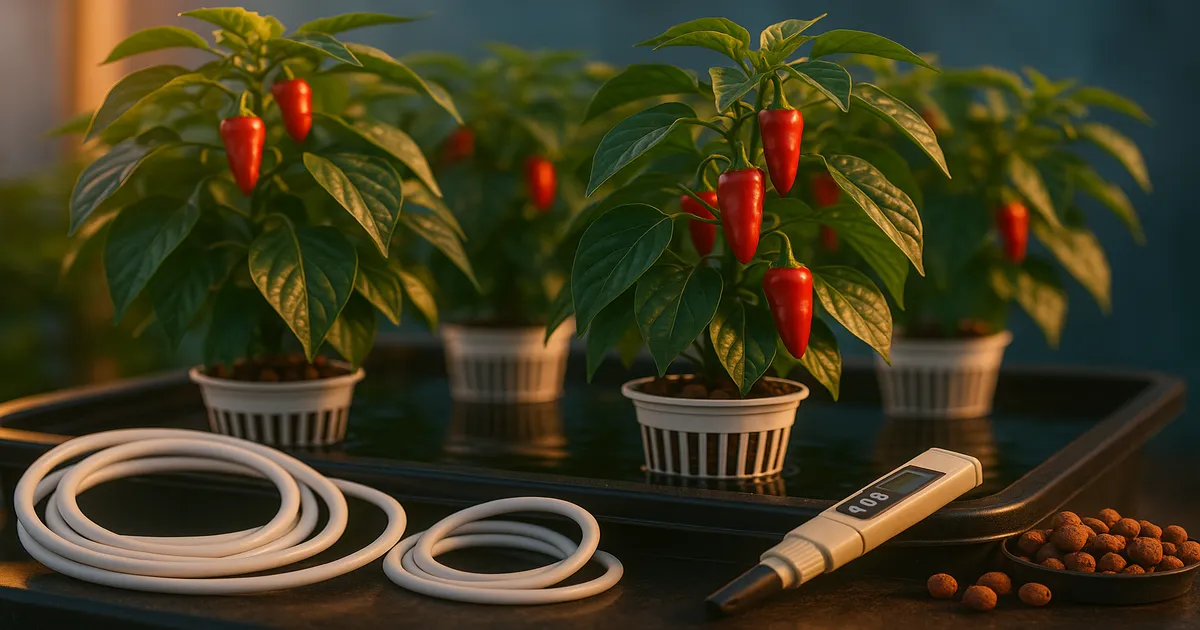
Quick Answer: To grow hot pepper plants successfully, give them warmth, strong light, and consistent nutrients scaled to their growth stage. Hot peppers are long-season crops — 70–150+ days from transplant to harvest depending on variety. They thrive in soil, containers, or hydroponic systems when kept at pH 6.0–6.8 (soil/coco) or pH 5.8–6.3 (hydro), with EC rising gradually from 0.7 EC at seedling stage to 3.4–4.5 EC at peak fruiting.
Whether you’re growing jalapeños on a windowsill or Carolina Reapers in a Dutch Bucket system, the fundamentals of how to grow hot pepper plants are the same: warmth, strong light, the right nutrients at the right time, and patience. Get those dialled in and peppers are surprisingly rewarding — prolific, long-producing, and endlessly varied in heat and flavour.
How to Grow Hot Pepper Plants: What You Need at a Glance
- Growing medium: Soil, coco coir, or a hydroponic system
- pH: 6.0–6.8 for soil/coco; 5.8–6.3 for hydroponics
- Nutrients: Start at 350–560 PPM (0.7–1.1 EC) and scale up to 1,680–2,240 PPM (3.4–4.5 EC) at peak fruiting
- Light: 600–1,000 PPFD during fruiting; 14–16 hours per day
- Temperature: 70–85°F (21–29°C) for growth; 80–85°F (27–29°C) for germination
- Days to harvest: 70–150+ days from transplant depending on variety
Key Growing Parameters
| Parameter | Soil / Coco | Hydroponics |
|---|---|---|
| pH range | 6.0–6.8 | 5.8–6.3 |
| Seedling EC | 0.7–1.1 | 0.7–1.1 |
| Fruiting EC | 3.4–4.5 | 3.4–4.5 |
| PPFD (fruiting) | 600–1,000+ | 600–1,000+ |
| Photoperiod | 14–16 hrs | 14–16 hrs |
One thing worth knowing upfront: mild stress — slightly elevated EC, a touch of drought between waterings, or higher temperatures during late fruiting — actually increases capsaicin production. The hottest peppers are often the ones that had to work for it a little.
Choosing the Right Growing System
Soil and Containers
Containers with well-draining potting mix and 20–30% added perlite are the most accessible starting point. Use at least a 5-gallon pot per plant; larger varieties appreciate 10 gallons or more. Containers also let you move plants indoors when temperatures drop — a real advantage with long-season superhots.
Hydroponic Systems: Dutch Bucket, DWC, and NFT
Dutch Bucket (Bato Bucket) is the commercial standard for peppers worldwide. It handles large root masses, allows precise fertigation control, and scales easily. If you’re serious about production, this is the system to invest in.
Deep Water Culture (DWC) delivers nutrients directly to roots around the clock, which drives fast vegetative growth. The trade-off is that EC and dissolved oxygen management become critical — warm reservoir water is your enemy. Keep reservoir temps at 65–68°F (18–20°C) to maintain adequate dissolved oxygen and suppress root pathogens.
NFT can work for compact varieties, but pepper root masses get large and can restrict flow in narrow channels. It’s not the first choice for anything beyond a dwarf variety.
Coco Coir
Coco coir is arguably the best starting point for growers moving beyond soil. It behaves like a hydroponic medium — fast drainage, excellent aeration, precise nutrient control — but forgives mistakes more readily than DWC. Pair it with perlite at a 70:30 ratio and water 2–4 times daily once plants are established.
Passive Hydro (Kratky) for Smaller Varieties
The Kratky method — a sealed reservoir with no pump — is genuinely low-effort and works well for compact varieties like Thai chilis or pequins. It won’t match the yields of an active system, but for a beginner who wants to try hydroponics without a big setup, it’s a solid entry point.
Which System Is Right for You?
- New to growing: Containers or coco coir
- Want fast growth and have experience: DWC or Dutch Bucket
- Commercial or large-scale: Dutch Bucket
- Minimal equipment: Kratky for smaller varieties
The best system is the one you’ll actually maintain consistently.
Hot Pepper Varieties and What to Expect
Scoville Heat Units (SHU)
The Scoville scale measures capsaicin concentration, from 0 SHU (bell peppers) to over 2,000,000 SHU in superhots like the Carolina Reaper. Most everyday hot peppers — jalapeños, serranos, cayennes — fall in the 2,500–50,000 SHU range.
| Heat Level | Variety | SHU Range |
|---|---|---|
| Mild | Poblano, Banana | 500–2,000 |
| Medium | Jalapeño, Serrano | 2,500–25,000 |
| Hot | Cayenne, Thai Bird | 30,000–100,000 |
| Very Hot | Habanero, Scotch Bonnet | 100,000–350,000 |
| Superhot | Ghost, Carolina Reaper | 800,000–2,200,000+ |
Days to Harvest and Species Notes
Capsicum annuum varieties (jalapeños, cayennes, serranos) are typically ready in 70–90 days from transplant. Capsicum chinense varieties — habaneros, ghost peppers, Carolina Reapers — are slow growers requiring 100–150+ days. Plan accordingly, especially indoors where you control the season.
The five main species each have distinct traits:
- C. annuum — the most common; jalapeños, serranos, bells, cayennes
- C. chinense — superhots and habaneros; long season, intensely aromatic
- C. frutescens — tabasco and Thai varieties; compact and prolific
- C. baccatum — South American aji varieties; fruity, moderate heat
- C. pubescens — rocotos; purple flowers, black seeds, cold-tolerant
Nutrient Requirements for Hot Pepper Plants
EC and PPM Targets by Growth Stage
| Stage | PPM | EC |
|---|---|---|
| Seedling (0–3 weeks) | 350–560 | 0.7–1.1 |
| Vegetative (3–6 weeks) | 800–1,120 | 1.6–2.2 |
| Pre-flowering (6–10 weeks) | 1,120–1,400 | 2.2–2.8 |
| Flowering & Fruit Set | 1,400–1,960 | 2.8–3.9 |
| Fruiting & Ripening | 1,680–2,240 | 3.4–4.5 |
Increase EC gradually — no more than 0.2–0.3 EC per week. Jumping too fast causes tip burn and blossom drop.
N:P:K Ratios Through the Season
During vegetative growth, peppers want a roughly 3:1:2 N:P:K ratio — nitrogen drives leaf and stem development. Once flowering begins, shift toward 1:1:3, pulling back on nitrogen and pushing potassium. High nitrogen during fruiting pushes leafy growth at the expense of fruit.
Phosphorus peaks in importance at pre-flowering. A deficiency at that stage shows up as purple undersides on leaves and poor fruit set. Target 50–80 PPM phosphorus during this window.
Calcium, Magnesium, and Blossom End Rot
Calcium is the most critical secondary nutrient for peppers. Deficiency causes blossom end rot (BER), where the base of the fruit turns dark and rots. Target 150–200 PPM calcium and keep irrigation consistent — calcium is immobile in plants and can only be absorbed through active water uptake.
Magnesium deficiency shows up as interveinal yellowing on older leaves. Maintain 50–75 PPM Mg and keep a Ca:Mg ratio of roughly 3:1 to 4:1.
Essential Micronutrients
| Micronutrient | Target PPM | Key Role |
|---|---|---|
| Iron (Fe) | 2–5 | Use chelated form; deficiency yellows new growth |
| Boron (B) | 0.3–0.5 | Critical for pollen viability and fruit set |
| Manganese (Mn) | 0.5–1.0 | Keep balanced with Fe |
| Zinc (Zn) | 0.3–0.5 | Enzyme function; deficiency distorts new leaves |
| Copper (Cu) | 0.05–0.1 | Excess is toxic — use sparingly |
Beginner Nutrient Recipe: General Hydroponics Flora Series
Vegetative stage (per gallon):
- FloraGro: 5 mL
- FloraMicro: 5 mL
- FloraBloom: 5 mL
- Target: 1,000–1,200 PPM (2.0–2.4 EC), pH 5.8–6.2
Fruiting stage (per gallon):
- FloraGro: 3 mL
- FloraMicro: 5 mL
- FloraBloom: 8 mL
- Target: 1,400–1,800 PPM (2.8–3.6 EC), pH 5.8–6.2
Intermediate Recipe: Masterblend 4-18-38
Per gallon of water, add in this order:
- Calcium Nitrate (15.5-0-0): 2.4 g — mix thoroughly before adding anything else
- Masterblend 4-18-38: 2.4 g — mix again
- Magnesium Sulfate (Epsom Salt): 1.2 g — add last
This yields approximately 800–1,000 PPM (1.6–2.0 EC). Scale proportionally for higher targets. Never mix calcium nitrate and Masterblend as concentrates — they’ll react and precipitate, locking out nutrients.
Boosting Capsaicin Through Nutrition
During late fruiting, increase potassium and sulfur while allowing EC to climb toward 3.5–4.5 (1,750–2,250 PPM). In soil or coco, let the medium dry slightly between waterings. Temperatures in the 85–90°F (29–32°C) range during this phase also push capsaicin production upward. It’s a deliberate stress strategy — push the plant a little, and it responds with more heat.
pH and EC Management
Ideal pH Ranges
- Soil and coco: 6.0–6.8, optimal around 6.5
- Hydroponics (DWC, NFT, Dutch Bucket): 5.8–6.3, optimal around 6.0
Even a small drift outside these windows can lock out nutrients that are technically present in solution.
Adjusting pH Up and Down
- pH Up: Potassium hydroxide (KOH) is the standard — it also contributes a small amount of beneficial potassium
- pH Down: Phosphoric acid is the most stable option for recirculating systems; citric acid breaks down too quickly to be reliable
Always adjust pH after mixing nutrients into water. Add adjusters in small increments — 0.5–1 mL per 5 gallons — wait 30 seconds, then re-test.
A quality digital pH pen calibrated weekly with pH 4.0 and 7.0 buffer solutions is non-negotiable. Store the probe in storage solution, not plain water, to extend its life.
EC Management and Reservoir Maintenance
Plants consume water faster than nutrients, so EC naturally rises as reservoir levels drop. When topping off, use plain pH-adjusted water — not full-strength nutrient solution. Do a complete reservoir change every 7–14 days in recirculating systems to prevent salt buildup.
In soil and coco, monitor runoff EC. If runoff EC exceeds your input EC by more than 0.5–1.0, flush with plain water.
For DWC and NFT systems, a continuous monitor catches problems before they become plant losses.
RO Water vs Tap Water
RO water gives you a 0 PPM baseline, making nutrient ratios precise and predictable. Tap water above 200 PPM (0.4 EC) can introduce calcium, magnesium, or sodium at levels that interfere with your mix. Test your tap baseline before building a nutrient solution — 150 PPM tap water means you’re already partway to your target before adding anything.
Lighting for Hot Pepper Plants Indoors
Spectrum and PPFD by Stage
| Stage | PPFD (µmol/m²/s) | DLI (mol/m²/day) |
|---|---|---|
| Seedling | 100–250 | 8–12 |
| Vegetative | 300–600 | 20–30 |
| Flowering | 500–800 | 30–40 |
| Fruiting | 600–1,000+ | 35–50 |
- Seedling: Blue-heavy spectrum (5,000–6,500K) for compact, strong growth
- Vegetative: Full spectrum with blue emphasis
- Flowering and fruiting: Red-heavy (600–700 nm); far-red (700–750 nm) can accelerate flowering via the Emerson effect
- Capsaicin boost: UV light (280–400 nm) has been shown to increase capsaicin — useful for superhot growers
Without CO₂ supplementation, diminishing returns kick in above about 800 µmol/m²/s.
Photoperiod
Peppers are day-neutral — they don’t need a specific light cycle to flower — but photoperiod still affects productivity. Run 16–18 hours during seedling and vegetative stages, then drop to 14–16 hours during flowering and fruiting. Don’t run 24-hour light; peppers need a dark period for respiration and metabolic recovery.
Calculating DLI
Formula: DLI = PPFD × hours × 3,600 ÷ 1,000,000
Example: 600 PPFD × 16 hours × 3,600 ÷ 1,000,000 = 34.6 mol/m²/day — solidly in the flowering target range.
Recommended LED Grow Lights
| Budget | Fixture | Coverage | Notes |
|---|---|---|---|
| Budget | Mars Hydro TS 1000 | 2×4 ft | ~150W actual draw |
| Mid-range | Spider Farmer SF-2000 | 2×4 ft | Samsung LM301B diodes; excellent efficiency |
| Mid-range | AC Infinity IONBOARD S33 | 3×3 ft | App-controlled dimming; quiet operation |
Plant Care: From Seedling to Harvest
Germination and Seed Starting
Hot pepper seeds germinate best at 80–85°F (27–29°C). Use a seedling heat mat to maintain consistent bottom heat — soil temperature matters more than air temperature at this stage. Sow seeds ¼ inch deep in a moist, sterile seed-starting mix. Most varieties sprout in 7–14 days; superhots can take 3–4 weeks.
Keep seedlings under low-intensity light (100–200 PPFD) for the first two weeks. Introduce nutrients only after the first true leaves appear, starting at 0.5–0.7 EC. Transplant to your final container or hydroponic system once roots are visible at the bottom of the cell tray and plants have 4–6 true leaves.
Transplanting and Early Vegetative Growth
Harden off seedlings grown indoors before moving them outside — expose them to outdoor conditions gradually over 7–10 days. In hydroponic systems, transplant into net pots with hydroton or rockwool and ensure roots make contact with the nutrient solution or medium immediately.
Pinch the first set of flower buds if they appear before the plant has 8–10 nodes. It feels counterintuitive, but redirecting energy to vegetative growth at this stage results in a larger, more productive plant overall.
Pruning, Training, and Support
Most hot pepper plants benefit from a simple two- or three-stem training approach. Remove suckers below the first main fork (the “Y” junction) to concentrate energy into the primary structure. Stake or cage plants early — a heavily fruiting pepper plant will topple without support, especially in containers.
Pollination Indoors
Outdoors, wind and insects handle pollination. Indoors, you need to help. Gently shake flowering branches daily, or use a small electric toothbrush against the stem near open flowers to simulate vibration. Low humidity (below 40%) and temperatures above 90°F (32°C) reduce pollen viability and cause blossom drop.
Harvest Timing
Most hot peppers can be harvested at any colour stage, but heat and flavour develop fully as the fruit ripens to its final colour — red, orange, yellow, or chocolate depending on variety. Harvesting regularly encourages the plant to set more fruit. Leave a few fruits to fully ripen on the plant to signal continued production.
Frequently Asked Questions About Growing Hot Pepper Plants
How long does it take to grow hot pepper plants from seed to harvest? Expect 100–180 days from seed to first harvest, depending on variety. That includes roughly 6–8 weeks of seedling and vegetative growth before transplant, then 70–150+ days to harvest from transplant. C. chinense varieties like ghost peppers and Carolina Reapers are on the longer end.
Can you grow hot pepper plants hydroponically? Yes — hot peppers are well-suited to hydroponics. Dutch Bucket and DWC systems are the most popular choices. Hydroponic peppers typically grow faster and yield more than soil-grown plants when managed correctly, because nutrients are delivered directly to the root zone.
Why are my hot pepper plant flowers dropping? Blossom drop is usually caused by temperature extremes (above 90°F or below 60°F), low humidity, poor pollination, or a sudden EC spike. Check your environment first, then review your nutrient solution. Consistent conditions are the best prevention.
What pH should I use for hot pepper plants in hydroponics? Keep pH between 5.8 and 6.3 for hydroponic systems, with 6.0 as the sweet spot. Drifting above 6.5 in hydro locks out iron and manganese; dropping below 5.5 locks out calcium and magnesium.
How do I make my hot peppers hotter? During late fruiting, let EC climb to 3.5–4.5, allow slight drought stress between waterings, and keep temperatures in the 85–90°F range. UV light exposure also increases capsaicin production. These mild stresses trigger the plant’s defence response — and more capsaicin is the result.