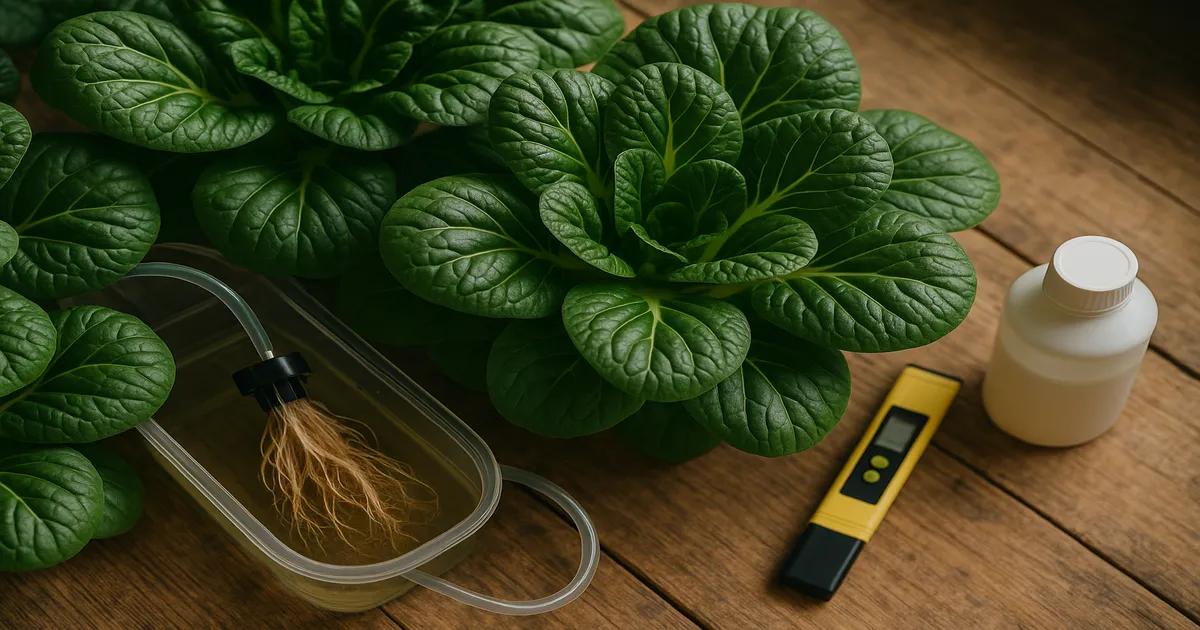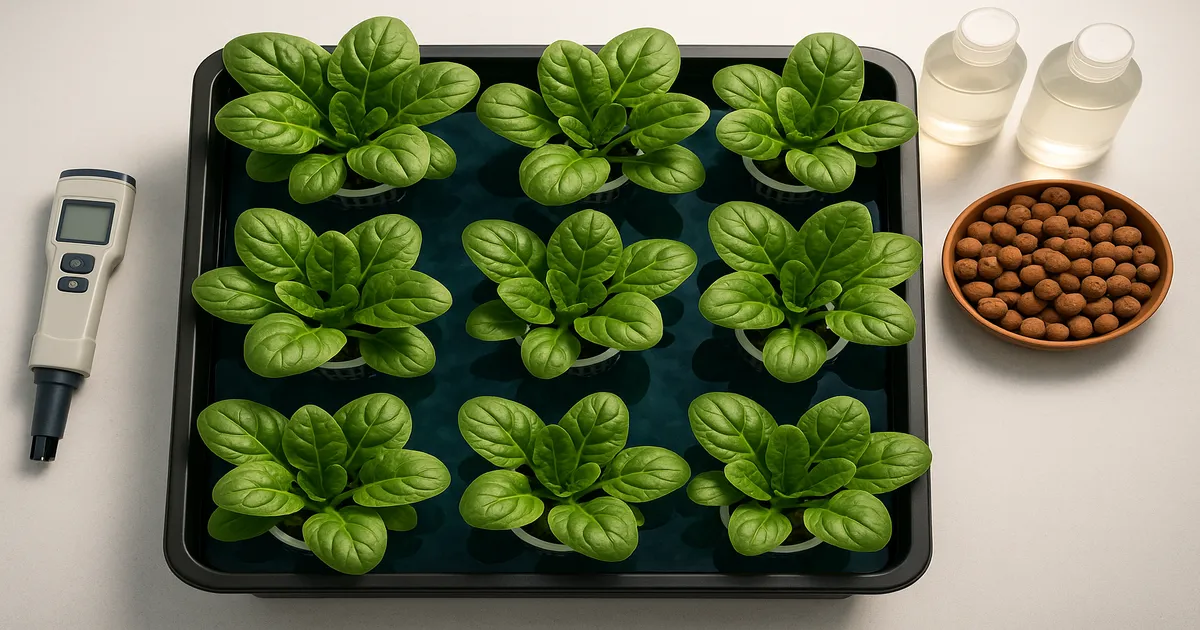
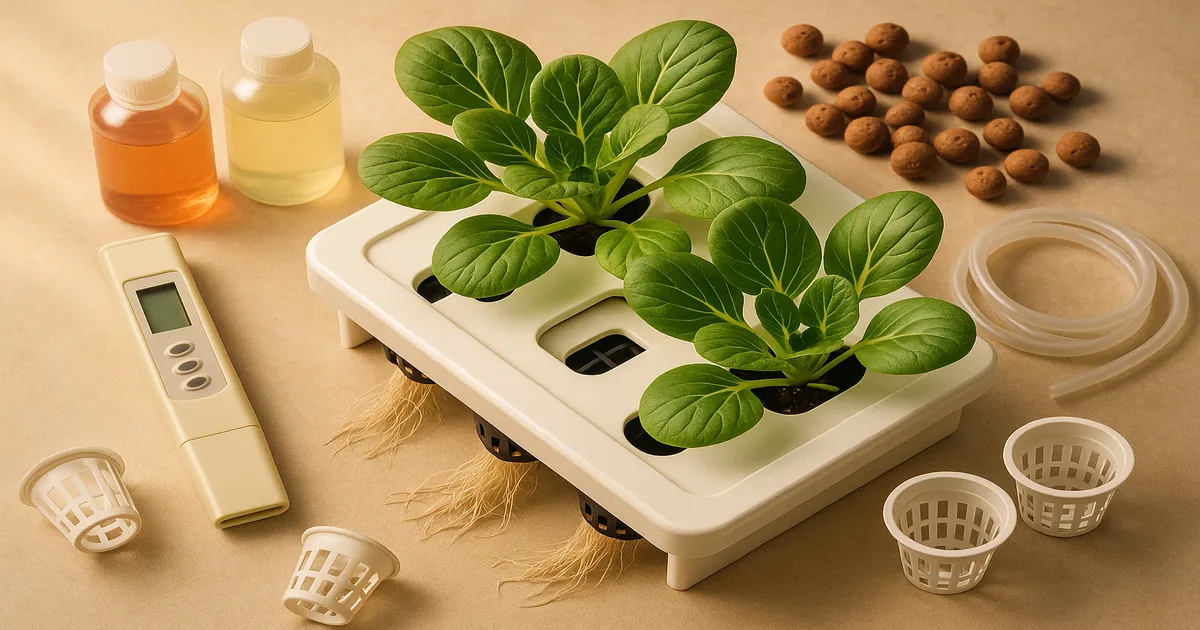
Quick Answer: The ideal EC for hydroponic bok choy runs from 1.6–2.8 EC (800–1,400 PPM on the 500 scale) through the main vegetative cycle. Seedlings start at 0.8–1.2 EC (400–600 PPM), and mature plants can push to 2.4–3.2 EC (1,200–1,600 PPM) in the final week before harvest. Keep pH at 6.0–6.5, targeting 6.2 as your daily working number. Bok choy is a low-to-moderate feeder — forgiving for beginners, but noticeably better when EC is dialed in by stage.
Bok choy is one of the fastest, most satisfying crops you can grow hydroponically. But getting the EC for hydroponic bok choy right at each stage is the difference between a limp, pale harvest and crisp, restaurant-quality heads. This guide covers every number you need — by growth stage, by system type, and by symptom — so you can troubleshoot confidently and grow consistently.
EC for Hydroponic Bok Choy: Targets by Growth Stage
Recommended EC and PPM Ranges
| Growth Stage | PPM (500 scale) | EC | Duration |
|---|---|---|---|
| Germination | 0–200 PPM | 0.0–0.4 EC | Days 1–7 |
| Seedling | 400–600 PPM | 0.8–1.2 EC | Days 7–14 |
| Early Vegetative | 600–900 PPM | 1.2–1.8 EC | Days 14–21 |
| Mid-Late Vegetative | 900–1,400 PPM | 1.8–2.8 EC | Days 21–35 |
| Pre-Harvest (optional) | 1,200–1,600 PPM | 2.4–3.2 EC | Final 5–7 days |
Ramp EC gradually as the plant grows. Jumping from seedling concentrations to full-strength solution too quickly is one of the most common beginner mistakes, and bok choy will show it fast — expect tip burn or leaf curl within a day or two.
Key pH Target
Maintain pH 6.0–6.5, targeting 6.2 as your daily working goal. This range keeps nitrogen, calcium, magnesium, and iron available at the same time — all four of which a fast-growing leafy green needs simultaneously.
EC Requirements Across Every Growth Stage
Germination: 0.0–0.4 EC (0–200 PPM)
Seeds don’t need nutrients during germination (days 1–7). They carry everything they need in the endosperm. Use plain pH-adjusted water or an extremely weak solution. Strong nutrient solution at this stage can inhibit germination or burn emerging radicles.
Seedling: 0.8–1.2 EC (400–600 PPM)
Once the first true leaves appear (days 7–14), introduce a quarter-to-half-strength nutrient solution. The root system is small and fragile, so keep EC conservative. This is not the stage to push growth — building healthy roots now pays off in weeks two and three.
Early Vegetative: 1.2–1.8 EC (600–900 PPM)
From days 14–21, plants establish quickly and can handle progressively stronger solution. Increase EC in increments of 100–200 PPM every few days rather than jumping straight to full strength. You’ll notice visibly faster growth and deeper green color as you approach the upper end of this range.
Mid-to-Late Vegetative: 1.8–2.8 EC (900–1,400 PPM)
This is the main feeding window (days 21–35) and where most of your harvest mass is built. Full-size varieties like Shanghai and Joi Choi do best toward the higher end. Baby bok choy varieties, which are harvested earlier, stay at 1.2–2.0 EC (600–1,000 PPM) — they simply don’t need maximum feeding before they come out of the system.
Pre-Harvest Mild Stress: 2.4–3.2 EC (1,200–1,600 PPM)
In the final 5–7 days before harvest, some commercial growers push EC slightly higher to trigger mild osmotic stress. The plant responds by concentrating sugars and tightening cell walls, producing crunchier stems and more intense flavor. This step is optional — skip it entirely if your plants are already showing any stress symptoms.
Bok Choy’s Salt Sensitivity vs. Other Crops
Bok choy has broad, high-water-content leaves that make it more sensitive to osmotic stress than fruiting crops. A tomato plant handles 3.0–4.0 EC without much trouble; bok choy starts showing stress above 2.8–3.0 EC in most conditions. Keep that in mind if you’re running a mixed system or adapting a tomato-focused nutrient schedule.
Nutrient Solution Recipes for Hydroponic Bok Choy
Ideal N-P-K Ratio for Leafy Brassicas
For vegetative bok choy, aim for a 3-1-2 nitrogen-phosphorus-potassium ratio. This nitrogen-forward profile drives leafy growth and chlorophyll production. Avoid high-phosphorus bloom formulas — they’re designed for flowering plants and will slow down the vegetative growth you’re after.
Macronutrient Targets
| Nutrient | Target PPM | Role |
|---|---|---|
| Nitrogen (N) | 150–200 PPM | Leaf growth, chlorophyll |
| Potassium (K) | 150–250 PPM | Cell turgor, crunch, disease resistance |
| Calcium (Ca) | 150–200 PPM | Cell walls, tip burn prevention |
| Magnesium (Mg) | 40–60 PPM | Chlorophyll production |
| Phosphorus (P) | 40–60 PPM | Root development, energy transfer |
| Sulfur (S) | 50–80 PPM | Flavor compounds (glucosinolates) |
Calcium deserves special attention. It’s immobile in the plant, meaning bok choy can’t redistribute it from older tissue to new growth. Adequate EC and good airflow over the leaves are both required for proper calcium uptake. Keep ammonium-nitrogen (NH₄⁺) below 30 PPM — too much ammonium destabilizes pH and can damage roots.
Micronutrient Targets
| Micronutrient | Target PPM |
|---|---|
| Iron (Fe) | 2–4 PPM |
| Manganese (Mn) | 0.5–1.0 PPM |
| Boron (B) | 0.3–0.5 PPM |
| Zinc (Zn) | 0.05–0.3 PPM |
| Copper (Cu) | 0.05–0.1 PPM |
| Molybdenum (Mo) | 0.01–0.05 PPM |
Always use chelated iron (Fe-EDTA or Fe-DTPA). Chelated forms stay available across a wider pH range and are far less likely to precipitate out of solution. Iron deficiency — yellowing of new growth while older leaves stay green — is the most common micronutrient problem in hydroponic bok choy.
Modified Hoagland’s Solution (Per 100 Gallons / 379 Liters)
- Calcium Nitrate [Ca(NO₃)₂]: 236 g
- Potassium Nitrate (KNO₃): 101 g
- Monopotassium Phosphate (KH₂PO₄): 136 g
- Magnesium Sulfate (MgSO₄·7H₂O): 246 g
- Chelated Iron (Fe-EDTA 13%): 15 g
- Commercial micronutrient mix: per manufacturer label
This produces approximately 2.8–3.2 EC (1,400–1,600 PPM). Dilute with pH-adjusted RO water to hit your target stage concentration.
3-Part Commercial Nutrient System
The General Hydroponics Flora Series is a reliable starting point for bok choy:
- Seedling: FloraMicro 2.5 mL/gal + FloraGro 5 mL/gal + FloraBloom 1 mL/gal → ~1.2–1.4 EC (600–700 PPM)
- Vegetative: FloraMicro 4 mL/gal + FloraGro 8 mL/gal + FloraBloom 2 mL/gal → ~1.8–2.2 EC (900–1,100 PPM)
Always add FloraMicro first, then FloraGro, then FloraBloom. Adding calcium and phosphorus sources together before diluting causes precipitation and a cloudy solution that’s difficult to recover.
Simple 2-Part System for Beginners
General Hydroponics MaxiGro at 7–10 g per gallon produces 2.0–2.8 EC (1,000–1,400 PPM) from a single dry powder. If you’re using RO or very soft tap water (under 100 PPM baseline), add a calcium-magnesium supplement at 3–5 mL/gal. (General Hydroponics CALiMAGic) This is the easiest starting point for a first-time grower.
pH Management for Hydroponic Bok Choy
The 6.2 Sweet Spot
The working range is pH 6.0–6.5. At 6.2, nitrogen, calcium, magnesium, and iron are all near peak availability simultaneously — exactly what a fast-growing leafy brassica needs.
Drop below pH 5.8 and iron and manganese become over-available to the point of toxicity, while calcium and magnesium absorption drops off. Push above pH 6.8 and iron, manganese, and boron all become locked out, causing interveinal chlorosis that looks like a nutrient deficiency even when your EC is perfect. pH lockout is one of the most misdiagnosed problems in hydroponic growing.
In aquaponic systems, the biological requirements of fish and bacteria push the acceptable range to pH 6.8–7.2. Bok choy can tolerate this, but it’s not ideal — expect slightly slower uptake of iron and manganese.
Raising and Lowering pH
- To raise pH: Use potassium hydroxide (KOH) or a KOH-based pH Up solution. KOH is preferred because it contributes beneficial potassium as it works.
- To lower pH: Use phosphoric acid (H₃PO₄) or a phosphoric acid-based pH Down solution. This is the standard choice for home systems.
Always dilute pH adjustment chemicals 1:10 before adding to the reservoir. Add slowly and wait 15–30 minutes before rechecking. pH doesn’t equilibrate instantly in a reservoir.
pH Drift: What’s Normal and What Isn’t
The most common drift pattern in DWC bok choy is gradual pH rise. As plants absorb nitrate (NO₃⁻) and phosphate (H₂PO₄⁻) anions, they release hydroxide (OH⁻) ions, making the solution more alkaline over time. This is normal — it just means your plants are eating.
Practical fixes:
- Slightly increase your ammonium-nitrogen ratio (NH₄⁺ uptake pulls pH down)
- Use phosphoric acid pH Down for routine corrections
- Change your reservoir every 7–14 days to reset the baseline
If pH is dropping rapidly instead, suspect microbial activity or root rot. Check roots for sliminess, increase aeration, and consider a hydrogen peroxide treatment (3 mL of 3% H₂O₂ per gallon) to knock back pathogens.
Monitoring EC in Your Hydroponic System
Choosing a Meter
For home growers, a quality digital pen meter from Bluelab, Apera, or HM Digital covers everything you need. The Apera Instruments EC20 is a solid mid-range option with automatic temperature compensation. The Bluelab Truncheon is a popular non-digital alternative that requires no calibration and is nearly indestructible — a great pick for beginners who don’t want to fuss with calibration solutions.
The 500 vs. 700 PPM Scale
Some meters convert EC to PPM using a factor of 500 (1.0 EC = 500 PPM); others use 700 (1.0 EC = 700 PPM). This guide uses the 500 scale, which is most common in North America. If your meter shows dramatically different numbers than expected, check which scale it’s set to. The EC reading itself is always accurate — only the PPM conversion differs.
Calibration
- Use a 1,413 µS/cm standard calibration solution — the universal reference point for EC meters.
- Rinse the probe with distilled water, then submerge in calibration solution.
- Adjust to the reference value per your meter’s instructions.
- Rinse again before use.
Calibrate monthly under normal use, or any time readings seem off. EC readings shift approximately 2% per 1°C, so always measure at a consistent temperature or use a meter with automatic temperature compensation (ATC).
Adjusting EC Up and Down
- EC too high: Dilute with pH-adjusted RO or distilled water. Avoid plain tap water — it adds an unknown mineral load that makes your numbers unpredictable.
- EC too low: Add concentrated nutrient solution in small increments and recheck after 30 minutes.
Reservoir Management
- Full reservoir change: Every 7–14 days for home systems; every 5–7 days in warm weather
- Top-off between changes: Use plain pH-adjusted water (pH 6.2), not fresh nutrient solution
- Reservoir temperature: 65–72°F (18–22°C); above 75°F (24°C) drops dissolved oxygen and invites pathogens
- Minimum volume: 1 gallon per plant to buffer EC and pH swings
- EC rising without adding nutrients? Plants are drinking more water than nutrients — top off with plain water
- EC dropping fast? Plants are in a heavy feeding phase — top off with dilute nutrient solution
Best Hydroponic Systems for Bok Choy EC Control
NFT and DWC
NFT (Nutrient Film Technique) and DWC (Deep Water Culture) are the top choices for bok choy. Both deliver nutrients directly to roots with minimal buffering, which means fast growth and easy, accurate EC monitoring. DWC in particular produces some of the fastest results — a full head in 30–35 days from transplant is achievable with dialed-in conditions.
Kratky Method
The Kratky method (passive DWC with no pump or electricity) works well for beginners growing small batches. The key management point is EC: as the reservoir depletes, the remaining solution becomes more concentrated. Check EC every 2–3 days and top off with plain water when EC climbs above your target. Don’t add more nutrient solution every time — that’s how EC creeps to damaging levels.
Ebb and Flow, Aeroponics, and Media Beds
Ebb and flow systems suit larger setups and work with a variety of growing media. Aeroponics delivers the fastest possible growth but requires more equipment and more careful EC management, since roots are exposed directly to misted solution. Media beds using coco coir or perlite integrate well with aquaponics, though EC control is slightly less precise than in recirculating liquid systems. For any of these setups, a reliable grow tent helps maintain the stable temperature and humidity that keep EC management predictable.
Troubleshooting EC Problems in Hydroponic Bok Choy
| Symptom | Likely Cause | Fix |
|---|---|---|
| Pale, floppy leaves | EC too low | Raise EC by 100–200 PPM increments |
| Tip burn on new leaves | EC too high or calcium deficiency | Lower EC; improve airflow over canopy |
| Yellowing new growth | Iron deficiency (often pH-related) | Check pH; switch to chelated iron |
| Stunted roots, slimy coating | Root rot (Pythium) | Lower reservoir temp; add beneficial bacteria or dilute H₂O₂ |
| Interveinal chlorosis | pH lockout (above 6.8) | Correct pH; do a partial reservoir change |
| Rapid EC drop | Heavy feeding phase | Top off with dilute nutrient solution |
| EC rising without additions | Excess evaporation | Top off with plain pH-adjusted water |
Frequently Asked Questions
What EC should I use for baby bok choy specifically? Baby bok choy is harvested at 3–4 weeks and rarely needs to exceed 2.0 EC (1,000 PPM). Keep it in the 1.2–2.0 EC range throughout its short cycle. Pushing higher doesn’t speed up growth — it just risks tip burn on a plant that’s almost ready to harvest anyway.
Can I use the same nutrient solution for bok choy and lettuce? Yes, with minor adjustments. Both are leafy greens with similar EC ranges (1.2–2.2 EC for lettuce vs. 1.6–2.8 EC for mature bok choy). A shared solution at 1.6–2.0 EC works well for mixed systems. Bok choy benefits from slightly higher calcium levels, so a cal-mag supplement helps if you’re running both together.
Why does my EC keep rising even though I’m not adding nutrients? This is a classic sign that plants are transpiring more water than they’re absorbing nutrients. The water evaporates or is taken up, leaving minerals behind and concentrating the solution. Top off with plain pH-adjusted water — not more nutrient solution — until EC returns to your target.
How often should I check EC during a grow? Check EC and pH daily during the seedling stage when the system is most sensitive. Once plants are established in the vegetative stage, every other day is sufficient for most home systems. Always check after topping off or making any reservoir adjustments.
Does water temperature affect EC readings? Yes. EC readings shift roughly 2% per 1°C change in temperature. Most quality meters include automatic temperature compensation (ATC), which corrects for this automatically. If your meter lacks ATC, always measure at the same time of day and at a consistent reservoir temperature for reliable comparisons.