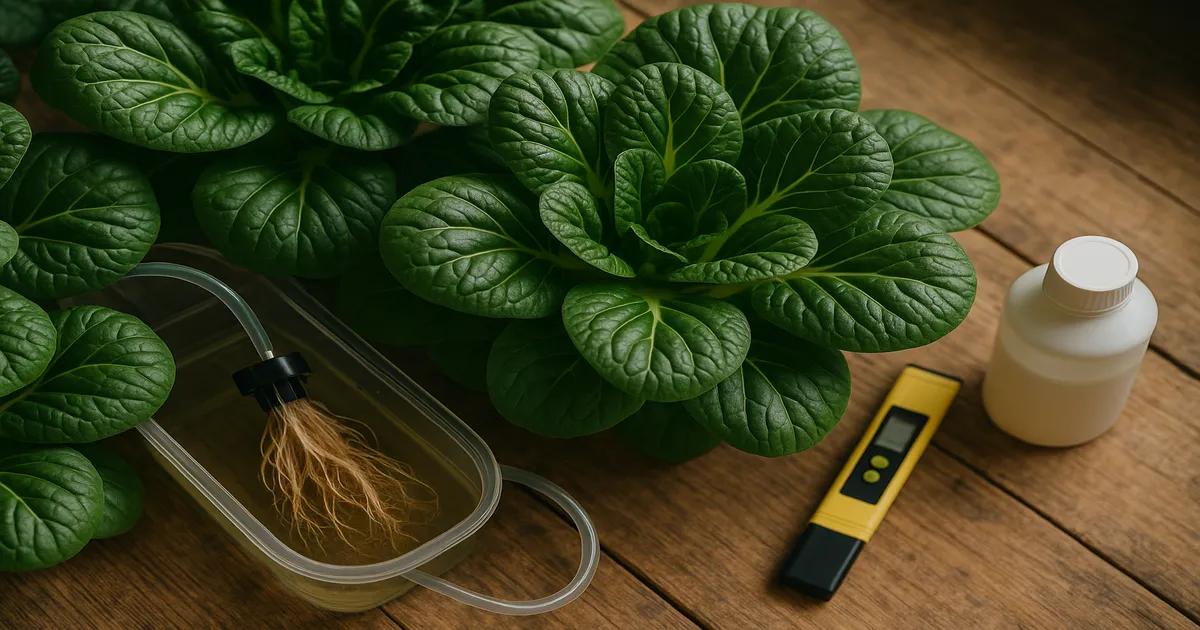
Quick Answer: Bok choy is ready to harvest when the head feels firm and compact, leaves are deep green and upright, and stalks are thick and crisp — with no flower stalk emerging from the centre. Baby varieties are ready in 21–30 days; full-size heads take 45–60 days. If you spot a tall central stem starting to push up, harvest immediately — bolting ruins flavour fast.
If you’re staring at your hydroponic setup and asking yourself “is my bok choy ready to harvest?”, you’re in good company. It’s one of the most common questions new growers ask, and for good reason. Unlike a tomato turning red or a cucumber reaching a certain length, bok choy doesn’t give you one dramatic signal. You’re reading a combination of visual and physical cues — and knowing what to look for makes all the difference.
Is Your Bok Choy Ready to Harvest? Key Signs to Look For
Check your variety, count your days, and look for a firm, compact head with upright dark-green leaves and thick, crisp stalks. No elongating centre stem. No flower buds. If all those boxes are checked, you’re good to cut.
Top visual cues for harvest readiness:
- Head feels dense when you gently squeeze it — not loose or open
- Leaves are dark green, glossy, and upright — not splayed flat or yellowing
- Stalks are thick, firm, and white to pale green — not thin or floppy
- No elongating central stem or visible flower buds
Baby Bok Choy vs. Full-Size: Key Differences
Baby bok choy is intentionally harvested young — it’s not an underripe full-size plant. Here’s how they compare:
| Baby Bok Choy | Full-Size Bok Choy | |
|---|---|---|
| Days to Maturity | 21–30 days | 45–60 days |
| Target Size | 4–6 inches tall | 10–14 inches tall |
| Head Feel | Tender, lightly compact | Dense, firmly packed |
| Harvest Method | Whole head or cut-and-come-again | Whole head at base |
| Best Systems | DWC, Kratky, vertical towers | NFT, DWC, ebb & flow |
Visual and Physical Signs Your Bok Choy Is Ready to Harvest
Leaf Colour, Texture, and Spread
Harvest-ready bok choy leaves should be deep green and slightly glossy. That shine comes from natural leaf wax and signals good cell turgor. Leaves should stand upright or angle slightly outward in a tight rosette. If they’re splaying flat or looking dull and matte, the plant is either stressed or past its prime.
Pale or yellowish-green leaves on a plant that hasn’t bolted usually point to a nitrogen or iron deficiency — not harvest readiness. See the troubleshooting section below for fixes.
Stalk Thickness and Firmness
Give the stalks a gentle press. They should feel crisp and firm, almost like celery. Thin, floppy stalks mean the plant needs more time or more nutrients. White to pale-green colouring is normal and ideal for most varieties.
Head Size and Compactness
A ready head should feel noticeably dense when you cup it in your hand. Baby varieties should form a tight bundle 4–6 inches across. Full-size heads should feel substantial — 10–14 inches tall with a solid, heavy base. Don’t wait for it to look “bigger.” Once bok choy hits its maturity window, the quality plateau is short.
The Bolting Warning: Spot It Before It Ruins Flavour
Bolting is the single biggest risk with bok choy, and it can happen fast — sometimes within 48 hours of the first signs. Watch for:
- An elongating central stem pushing up from the middle of the head
- Small yellow flower buds forming at the top of that stem
- Inner leaves starting to yellow or become loose and papery
Once the plant bolts, glucosinolates break down into bitter compounds and the stalks turn fibrous. The plant is still edible, but it won’t taste good. If you see a flower stalk, harvest immediately.
In hydroponic environments, bolting is accelerated by photoperiods over 18 hours and reservoir temperatures above 75°F (24°C). Keep your grow room cool and your light schedule at 16/8 to extend your harvest window.
Harvest Methods: Whole Head vs. Cut-and-Come-Again
How to Harvest the Entire Head
Use a sharp, clean knife or garden scissors and cut just above the root crown — the point where the stalks meet the root system. Leave the roots in the net pot if you’re running an NFT system and want to replant quickly; otherwise, remove the entire plant and clean the site.
Outer-Leaf Harvesting for Continuous Yield
Cut-and-come-again means removing outer leaves one at a time, starting with the oldest, largest ones at the base. Leave the central growing point — the tight cluster in the middle — completely intact. The plant will keep pushing out new leaves from the centre.
This works best with baby varieties like Toy Choy or Mei Qing Choi in DWC or Kratky setups. It’s less effective with full-size varieties, which put more energy into head formation than continuous leaf production.
Tools and Post-Harvest Storage
Always use a clean, sharp blade. Dull tools crush cell walls, accelerating wilting and inviting bacterial entry. Wipe your blade with isopropyl alcohol between plants — brassicas can share fungal issues. Cut in one smooth motion; avoid sawing.
For storage:
- Don’t wash before refrigerating — moisture speeds up decay
- Wrap loosely in a damp paper towel, place in a plastic bag, and refrigerate
- Use within 5–7 days for best texture and flavour
- Keep away from ethylene-producing fruits like apples and bananas — they’ll accelerate yellowing
Best Bok Choy Varieties for Hydroponics
Baby Varieties (21–35 Days)
- Toy Choy: The go-to baby variety. Compact at 4–6 inches, fast-growing, mild flavour, and ideal for DWC and Kratky. Best choice for beginners.
- Mei Qing Choi: Light green stalks, tender texture, slightly sweeter than Toy Choy. Takes 28–35 days but delivers excellent flavour.
- Win-Win Choi: A commercial hybrid bred for uniformity — great for NFT channels where consistent head size matters.
Full-Size Varieties (45–70 Days)
- Joi Choi: Top pick for beginners wanting full-size heads. Vigorous, bolt-resistant, and produces large, dense heads reliably.
- Shanghai Green: Classic spoon-shaped leaves, very productive, and widely available. A dependable workhorse.
- Black Summer: Darker leaves and better heat tolerance than most varieties — smart choice if your grow room runs warm.
Nutrient Management for Harvest-Ready Bok Choy
EC and PPM Targets by Growth Stage
| Growth Stage | PPM | EC |
|---|---|---|
| Seedling (0–10 days) | 350–500 | 0.7–1.0 |
| Vegetative (10–30 days) | 600–900 | 1.2–1.8 |
| Mature / Pre-Harvest (30–60 days) | 800–1,200 | 1.6–2.4 |
Don’t exceed 1,400 PPM (2.8 EC) — bok choy is moderately salt-sensitive and will show leaf margin burn at high concentrations.
Key Nutrients: Nitrogen, Calcium, and Potassium
Nitrogen drives leafy growth and should make up roughly 60–70% of total nutrient uptake. Use nitrate-nitrogen (NO₃⁻) as your primary source — it’s more stable and causes less pH swing than ammoniacal nitrogen.
Potassium supports cell turgor, which is directly responsible for that satisfying crunch in the stalks. Calcium prevents tip burn — the most common cosmetic defect in hydroponic bok choy. Maintain 150–200 PPM calcium and ensure good airflow so the plant can transpire and pull calcium up through the leaves.
Nutrient Recipes
Beginner — 3-Part Commercial Formula: Use any reputable 3-part line at 75–85% of the manufacturer’s recommended strength. The “lettuce/herbs” schedule on the label is your reference point. General Hydroponics Flora Series is a reliable starting point. If you’re on RO or soft water (below 150 PPM baseline), add CalMag at 3–5 mL per gallon. (Botanicare Cal-Mag Plus)
Intermediate — Masterblend 4-18-38 DIY Mix:
- Masterblend 4-18-38: 2.4 g/gallon
- Calcium Nitrate (15.5-0-0): 2.4 g/gallon
- Magnesium Sulfate (Epsom Salt): 1.2 g/gallon
This yields approximately 800–1,000 PPM (1.6–2.0 EC) — ideal for the vegetative stage. Scale up by 25% as plants approach harvest.
Tip Burn: The #1 Nutrient Problem at Harvest Time
Tip burn shows up as brown, crispy edges on inner leaves — frustrating because it appears right when your plant looks almost ready. It’s caused by calcium deficiency at the leaf tips, usually driven by poor airflow rather than low reservoir calcium. Add a small oscillating fan, confirm pH is sitting between 6.0–6.5, and supplement with CalMag if you’re on soft water.
pH, Lighting, and System Basics
pH Range
Target pH 6.0–6.5 for most hydroponic systems. Below 5.8, calcium and magnesium availability drops sharply — that’s when tip burn and stunted growth appear. Above 7.0, iron, manganese, and boron uptake decline noticeably. For aquaponic systems, aim for pH 6.8–7.2 to balance fish health with plant needs.
Calibrate your pH meter weekly using pH 4.0 and 7.0 buffer solutions. The Apera PC60 and Bluelab pH Pen are both solid choices for home growers. When adjusting down, use phosphoric acid in 0.5–1 mL increments per 5 gallons. When adjusting up, potassium hydroxide is preferred over sodium hydroxide — it adds beneficial potassium rather than accumulating sodium.
Lighting
Stick to a 16 hours light / 8 hours dark schedule. Bok choy is a facultative long-day plant, meaning extended light exposure combined with heat can trigger bolting. Don’t exceed 18 hours — especially if your grow room runs above 72°F (22°C).
Target 200–400 PPFD during the vegetative stage and 300–500 PPFD as plants approach harvest, with a DLI of around 17 mol/m²/day. For small setups, the Spider Farmer SF-1000 is an efficient, well-priced option. T8 LED shop lights at 5000K hung 4–6 inches above the canopy also work well for baby bok choy and cost a fraction of the price.
Troubleshooting Common Problems
Tip burn on inner leaves: Almost always poor airflow, not low reservoir calcium. Add a fan, check pH, and supplement CalMag if needed.
Premature bolting: Heat and long photoperiods are the usual culprits. Reduce light to 16 hours, lower reservoir temperature to 65–72°F (18–22°C), and harvest immediately if a flower stalk is already visible. There’s no reversing a bolt in progress.
Yellowing lower leaves: Nitrogen deficiency. Increase EC slightly and confirm pH is in range so nitrogen is actually available to the plant.
Pale green leaves on young plants: Could be iron deficiency (pH too high) or general underfeeding. Drop pH toward 6.0–6.2 and check your EC against the targets above.
Floppy, thin stalks: The plant needs more time, more nutrients, or both. Bump EC by 0.2–0.3 and reassess in 5–7 days.
FAQ: Bok Choy Ready to Harvest
Q: How do I know if my bok choy is ready to harvest without counting days? A: Squeeze the head gently — it should feel dense and firm, not loose. Leaves should be upright and dark green, stalks thick and crisp. If the centre is still tight with no elongating stem, you’re in the harvest window.
Q: Can I harvest bok choy early? A: Yes. Baby bok choy is intentionally harvested young, and even full-size varieties can be cut early if bolting threatens. Smaller heads are still perfectly edible — just milder in flavour.
Q: What happens if I leave bok choy too long before harvesting? A: It bolts. A central flower stalk emerges, the leaves loosen, and bitter compounds develop in the stalks. Once you see that stem pushing up, harvest the same day.
Q: How many times can I harvest bok choy using cut-and-come-again? A: With baby varieties like Toy Choy, you can typically get 2–3 rounds of outer leaves before the plant’s productivity drops. Full-size varieties aren’t well suited to this method — harvest them whole.
Q: Does hydroponic bok choy taste different from soil-grown? A: Hydroponic bok choy tends to be milder, crisper, and more uniform. Some growers find it slightly less complex in flavour, but the texture is often superior — especially when harvested at the right time.