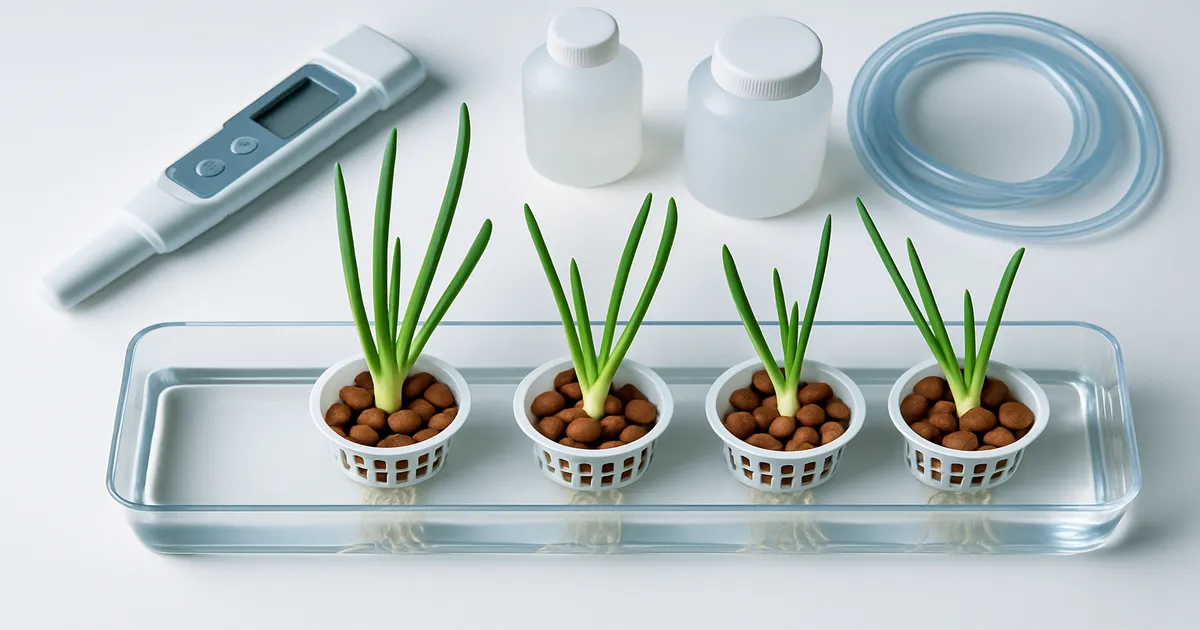
Quick Answer: Growing hydroponic green onions from seed takes 60–90 days from germination to harvest. Keep pH at 6.0–6.5, EC between 0.7–2.5 depending on growth stage, and run a 16-hour photoperiod. A Kratky or DWC system is the easiest starting point for beginners.
Growing hydroponic green onions from seed is one of the best entry points into hydroponics — results come fast, equipment costs are low, and you end up with something you’ll actually cook with. Unlike regrowing store-bought scraps, starting from seed gives you cleaner plants, better disease resistance, and the ability to run continuous succession harvests. This guide covers everything: system selection, seed varieties, nutrients, lighting, and troubleshooting.
Choosing the Best Hydroponic System for Green Onions
Green onions have shallow root systems — typically 6–10 inches deep — which makes them ideal for low-profile, space-efficient setups. You don’t need a deep reservoir or complex plumbing to grow them well.
Kratky and DWC: Best for Beginners Growing Hydroponic Green Onions From Seed
Kratky is the top pick for first-time growers. There are no pumps, no timers, and almost no maintenance — fill the reservoir, plant your seedlings, and let the roots do the work. DWC adds an air pump for extra oxygenation, which speeds up growth noticeably. A quality air pump like the Vivosun Air Pump keeps dissolved oxygen levels high and roots healthy throughout the cycle.
Both systems are cheap to set up and easy to monitor. For a home grow of 10–20 plants, a single 5-gallon bucket or a purpose-built DWC tote is all you need.
NFT and Ebb & Flow: Scaling Up
NFT (Nutrient Film Technique) channels work well for green onions at semi-commercial scale. The shallow channels suit the crop’s root depth, and the constant thin film of nutrient solution delivers excellent oxygen-to-root contact. Ebb & Flow systems offer flexibility — you can use a variety of growing media and run multiple trays from a single reservoir. Both require pumps, timers, and more plumbing knowledge than Kratky or DWC.
Vertical Tower Systems: Maximum Space Efficiency
Tower gardens and vertical NFT columns let you grow a large number of green onions in a very small footprint. They work particularly well with compact varieties like Parade. The trade-off is a higher upfront cost and more complex nutrient delivery to ensure even distribution across all levels.
System Comparison
| System | Cost | Complexity | Suitability |
|---|---|---|---|
| Kratky (passive DWC) | $ | Very Low | ⭐⭐⭐⭐⭐ |
| Deep Water Culture | $–$$ | Low | ⭐⭐⭐⭐⭐ |
| NFT | $$–$$$ | Medium | ⭐⭐⭐⭐ |
| Ebb & Flow | $$–$$$ | Medium | ⭐⭐⭐⭐ |
| Vertical Tower | $$–$$$ | Medium | ⭐⭐⭐⭐ |
| Wicking | $ | Very Low | ⭐⭐⭐ |
| Aeroponics | $$$–$$$$ | High | ⭐⭐⭐ |
Best Varieties for Growing Hydroponic Green Onions From Seed
Allium fistulosum vs. Allium cepa
A. fistulosum (Japanese bunching onion) is the better choice for hydroponics. It doesn’t form a true bulb, so it stays in a productive vegetative state and handles cut-and-come-again harvesting well. It’s also more disease-resistant in wet growing environments. A. cepa germinates quickly and is widely available, but it will eventually try to form a bulb — less of a problem when harvesting early, but A. fistulosum simply performs better over multiple cycles.
Top Varieties
| Variety | Type | Days to Harvest | Notes |
|---|---|---|---|
| Evergreen Hardy White | A. fistulosum | 65–75 days | Top pick; vigorous; mild flavor; excellent cut-and-come-again |
| Ishikura | A. fistulosum | 60–70 days | Long white shanks; high yield; great commercial presentation |
| Tokyo Long White | A. fistulosum | 65–75 days | Uniform stalks; ideal for market growers |
| Parade | A. fistulosum | 60–65 days | Compact; perfect for towers and small systems |
| White Lisbon | A. cepa | 60–70 days | Fast germination; widely available; good for single-cycle harvests |
| Red Beard | A. fistulosum | 65–75 days | Striking red/purple coloration; strong market appeal |
Evergreen Hardy White and Ishikura are the two most consistently recommended varieties for hydroponic production. Both germinate reliably and handle repeated harvesting without losing vigor.
Buy from reputable suppliers like Johnny’s Selected Seeds, True Leaf Market, or Kitazawa Seed Company. Always choose untreated seeds — fungicide coatings can introduce unwanted chemistry into a recirculating system.
Germinating and Transplanting Green Onion Seeds
Germination Setup
The ideal germination temperature is 65–75°F (18–24°C). Below 60°F, germination slows significantly; above 85°F, germination rates drop. Good starter media options include:
- Rockwool cubes — pre-soak to pH 5.5–6.0 before use
- Rapid Rooter plugs — ready to use; excellent moisture retention
- Coco coir in small cells or net pots
Keep the media consistently moist but not waterlogged. Cover with a humidity dome until sprouts emerge, then remove it to prevent damping off. Expect germination in 7–14 days.
Seedling Care
Once sprouts appear, move them under light immediately. Aim for 100–200 µmol/m²/s at this stage — inadequate light is the leading cause of leggy, weak seedlings. If you’re using T5 or T8 shop lights, keep them 4–6 inches above the seedling tops.
Thin to one or two seedlings per cell once they reach about an inch tall. Crowded seedlings compete for light and nutrients and rarely recover well after transplant.
Transplanting Into Your Hydroponic System
Seedlings are ready to transplant when they’re 2–3 inches tall with visible roots emerging from the bottom of the starter media. At this point, dial your nutrient solution to 560–840 PPM (1.1–1.7 EC) — the early vegetative target.
Place the starter cube or plug into a net pot (Bootstrap Farmer 2-inch Net Pots) and fill around it with hydroton (expanded clay pebbles) or lava rock. Lower the net pot so the roots are just touching or slightly submerged in the nutrient solution.
Succession Planting for Continuous Harvests
The most effective strategy for an uninterrupted supply is succession planting every 2–3 weeks. Start a new tray while the previous batch is in active vegetative growth and you’ll always have plants at different stages.
A simple rolling schedule: start Batch A on Week 1, Batch B on Week 3, Batch C on Week 5. By the time Batch A is ready to harvest around Week 9–10, Batch B is close behind and Batch C is just entering active growth.
Nutrient Solution Guide for Hydroponic Green Onions
EC and PPM Targets by Growth Stage
| Growth Stage | PPM | EC |
|---|---|---|
| Germination / Seedling | 350–560 PPM | 0.7–1.1 |
| Early Vegetative (transplant to 4 weeks) | 560–840 PPM | 1.1–1.7 |
| Active Vegetative / Bulking | 840–1260 PPM | 1.7–2.5 |
| Pre-Harvest | 700–1050 PPM | 1.4–2.1 |
A slight EC reduction in the final week encourages flavor development. Green onions are moderate feeders — overfeeding is one of the most common beginner mistakes.
Key Macronutrients
Nitrogen drives leaf and stem growth. Use nitrate-nitrogen (NO₃⁻) rather than ammoniacal forms — it produces cleaner growth and helps stabilize pH. Aim for an N:K ratio of roughly 1.5:1 to 2:1 throughout the vegetative stage.
Calcium is critical for cell wall integrity. Deficiency shows up quickly as tip dieback. Target 150–200 PPM calcium and supplement with Cal-Mag if you’re using RO water. Botanicare Cal-Mag Plus is a reliable option that also covers magnesium and iron.
Sulfur is uniquely important for Allium crops — it’s the building block of the compounds that give green onions their flavor and aroma. Target 30–50 PPM sulfur. If you’re using Masterblend with Epsom salt, you’re already covering this well.
Ready-to-Use Nutrient Recipes
Option 1 — Commercial 3-Part System (Beginner-Friendly)
General Hydroponics Flora Series or a comparable 3-part formula:
- Seedling: Grow 3 mL/gal + Micro 2 mL/gal + Bloom 1 mL/gal → ~500 PPM (1.0 EC)
- Vegetative: Grow 5 mL/gal + Micro 3 mL/gal + Bloom 2 mL/gal → ~900–1000 PPM (1.8–2.0 EC)
- Add Cal-Mag at 2–3 mL/gal when using RO or soft water
Option 2 — DIY Masterblend Recipe (Intermediate)
Per 1 gallon of RO/distilled water: (Masterblend 4-18-38)
- Masterblend 4-18-38: 2.4 g/gal
- Calcium Nitrate (15.5-0-0): 2.4 g/gal
- Magnesium Sulfate (Epsom Salt): 1.2 g/gal
- Full strength: ~800–900 PPM (1.6–1.8 EC). Use at 50% for seedlings.
Option 3 — Modified Hoagland’s Solution
Standard Hoagland’s targets ~1000–1200 PPM (2.0–2.4 EC) at full strength — use at 50–75% for green onions. Increase the sulfate concentration by 20–30% over the standard formula to meet Allium sulfur demands.
pH and EC Management
Optimal pH Range
Keep pH between 6.0–6.5. This is slightly higher than many hydroponic crops, reflecting the Allium family’s preferences. Drop below 5.8 and you risk iron and calcium lockout; climb above 6.8 and phosphorus and micronutrient availability suffers.
Monitoring and Adjusting pH
A reliable digital pH meter is non-negotiable. The Apera PH20 and Bluelab pH Pen are both excellent choices. Calibrate weekly using pH 4.0 and 7.0 buffer solutions, and replace probe storage solution monthly.
To adjust pH without overcorrecting:
- Add nutrients to your water first, then check pH
- If too high, add pH Down (phosphoric acid) in 0.5–1 mL increments
- If too low, add pH Up (potassium hydroxide) in the same small increments
- Let the solution circulate for 15–30 minutes before re-testing
- Repeat until stable within 6.0–6.5
Managing EC and Reservoir Changes
Plants consume water faster than nutrients, so reservoir EC tends to creep upward. When the water level drops, top off with plain pH-adjusted water rather than fresh nutrient solution. Change the reservoir fully every 7–14 days for active DWC or NFT systems, and every 2–3 weeks for Kratky. If EC climbs above your target range despite top-offs, do a partial or full flush.
pH Troubleshooting
| Issue | Likely Cause | Fix |
|---|---|---|
| pH dropping rapidly | Microbial activity or root rot | Increase reservoir change frequency; check roots |
| pH rising steadily | Plants absorbing anions (NO₃⁻, H₂PO₄⁻) | Normal in healthy systems; adjust down as needed |
| pH swings >0.5 in 24 hours | Reservoir too small; contamination | Increase reservoir volume; do a full change |
| pH won’t stabilize | RO/soft water with no buffering | Add silica supplement or Cal-Mag |
Lighting for Hydroponic Green Onions From Seed
Green onions are a vegetative crop, so blue-spectrum light (5000–7000K) drives the most productive growth. A full-spectrum LED with a strong blue component works well across all growth stages and runs cooler than T5 fluorescents, which matters in a small grow space.
Photoperiod: 16 hours light / 8 hours dark. Green onions don’t require a dark period to produce, but running lights 24/7 increases energy costs without a meaningful yield benefit and can stress plants over time.
Intensity targets:
- Seedling stage: 100–200 µmol/m²/s (PPFD)
- Vegetative / active growth: 200–400 µmol/m²/s
A quality LED panel like the Mars Hydro TS 600 covers a 2×2 ft area efficiently and delivers the right spectrum for leafy greens and alliums. Keep it 18–24 inches above the canopy during vegetative growth and adjust based on any leaf bleaching or stretching you observe.
Frequently Asked Questions
How long does it take to grow hydroponic green onions from seed? Expect 60–90 days from germination to first harvest, depending on variety and system. A. fistulosum varieties like Evergreen Hardy White typically hit the lower end of that range under good conditions.
Can I reuse the roots after cutting hydroponic green onions? Yes — this is one of the biggest advantages of growing A. fistulosum hydroponically. Cut the stalks to about 1–2 inches above the net pot and the plant will regrow. You can typically get 2–3 regrowth cycles before vigor declines noticeably.
What causes yellow tips on hydroponic green onions? Yellow or brown tips are usually a sign of calcium deficiency, overly high EC, or fluoride/chlorine sensitivity. Check your EC first, then verify calcium levels are at 150–200 PPM. If you’re using tap water, let it sit uncovered for 24 hours or switch to RO water with Cal-Mag supplementation.
Do I need a grow tent to grow hydroponic green onions indoors? Not strictly, but a grow tent helps contain light, maintain humidity, and keep pests out. For a small setup, even a 2×2 ft tent is enough for 20–30 plants and makes light management much easier.
What’s the difference between growing hydroponic green onions from seed vs. from scraps? Scraps produce one weak regrowth before petering out. Seeds give you full variety selection, healthier root systems, and true cut-and-come-again potential over multiple cycles. The extra 7–14 days of germination time is worth it.