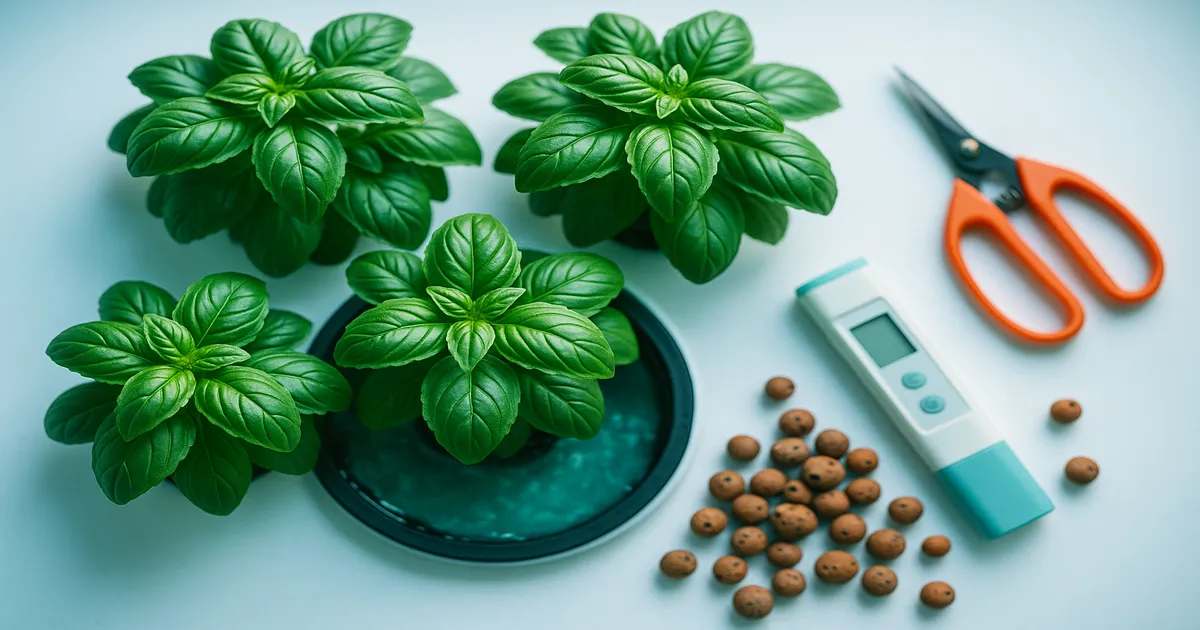
Quick Answer: To prune basil, cut the main stem just above a pair of leaf nodes, removing no more than the top one-third of the plant. Do this every 2–3 weeks in soil or every 7–14 days in hydroponics to prevent bolting, force bushy branching, and keep the most flavorful young leaves continuously regenerating.
Knowing how to prune basil correctly is the difference between a plant that bolts and dies in a month versus one that produces abundantly for four to six months. It’s a simple technique, but the details matter — where you cut, how much you remove, and how often you do it all affect the outcome significantly.
How to Prune Basil: The Core Technique
The 30-Second Pruning Rule
Find a pair of leaves with small lateral buds visible in the axils. Cut the stem 0.25–0.5 inches above that node pair. Remove no more than one-third of the total plant mass per session, and never cut below the lowest set of healthy leaves. That’s the whole technique.
Each cut triggers two new stems to emerge from the node below, so every pruning session roughly doubles the number of growing tips. Do it consistently and you get exponential branching instead of one leggy stem racing to flower.
How Often Should You Prune Basil?
Pruning frequency depends on how fast your system grows basil. Hydroponics delivers nutrients directly to roots around the clock, so regrowth is dramatically faster than in soil.
| Growing System | Pruning Interval |
|---|---|
| Soil / Container | Every 2–3 weeks |
| Kratky / Wicking | Every 10–14 days |
| Ebb and Flow | Every 7–14 days |
| Deep Water Culture (DWC) | Every 7–14 days |
| Nutrient Film Technique (NFT) | Every 7–10 days |
| Aeroponics | Every 5–10 days |
The Science Behind Pruning Basil
Apical Dominance and Sympodial Branching
Basil is a sympodial branching plant. It grows from a central stem with lateral branches waiting in the axils of every leaf pair. The catch is that the terminal growing tip constantly produces auxin — a hormone that travels downward and actively suppresses those lateral buds. Remove the tip, and those buds are suddenly free to grow.
This is why a single clean cut above a node triggers two new shoots, not one. Make three or four cuts across a mature plant and you can go from a handful of growing tips to a dozen in under two weeks.
How Pruning Prevents Bolting
Basil evolved as a tropical perennial that flowers quickly under stress or long days. Once it flowers, the plant redirects energy from leaf production to seed set. Flavor compounds drop, leaves get smaller and tougher, and the plant essentially starts shutting down.
Regular pruning interrupts this cycle. Removing the apical tip and any emerging flower buds keeps the plant locked in a vegetative state, producing the lush leaf growth you actually want.
Why Young Leaves Taste Better
The flavor compounds that make basil worth growing — linalool, eugenol, and methyl chavicol — are most concentrated in young leaves at the shoot tips. Older leaves lower on the plant have lower essential oil density. Pruning continuously regenerates those high-flavor shoot tips, so you’re always harvesting from the most potent part of the plant.
Step-by-Step Basil Pruning Technique
Tools You Need
You don’t need much, but what you use matters for plant health.
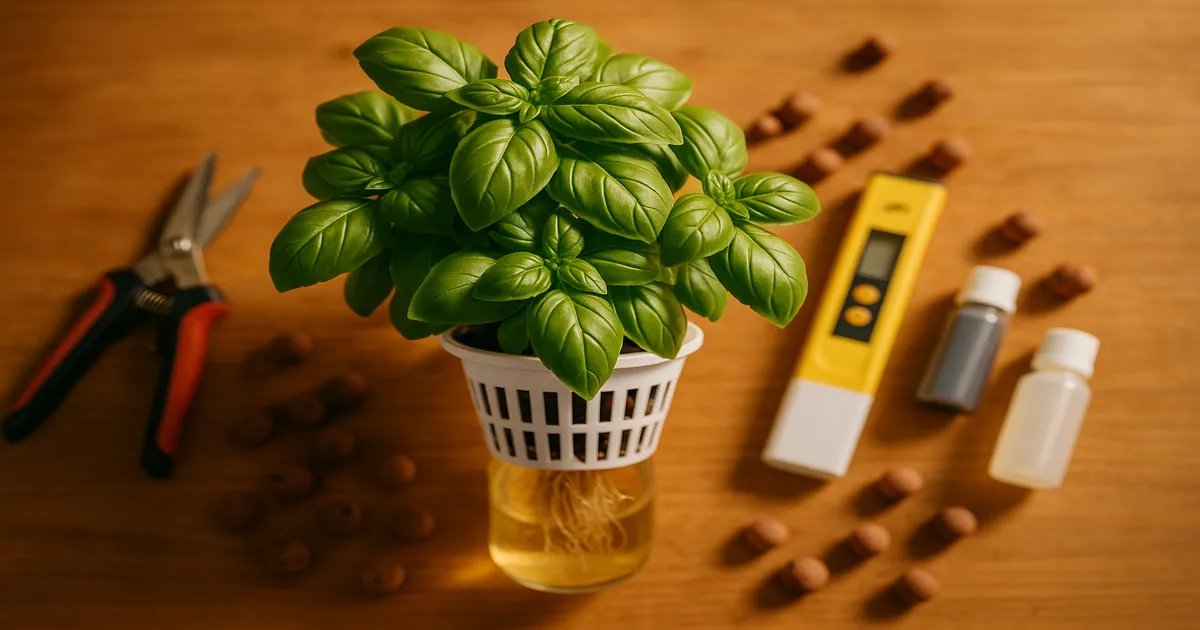
- Sharp scissors or pruning snips — dull blades crush stem tissue instead of cutting cleanly, creating entry points for disease
- Isopropyl alcohol (70%) — wipe blades between plants to prevent spreading fungal or bacterial pathogens
- A small bowl or tray — to collect cuttings, which root easily into new plants
Identifying the Right Node
Look down the main stem and find a leaf node pair where you can see small lateral buds — tiny green nubs or nascent leaves in the leaf axils. Cut above a node that has visible buds, because that’s where your new growth will come from. If no visible buds are present, the cut will produce nothing.
The Correct Cut
Cut at a slight angle, 0.25–0.5 inches above the node pair. The angle helps water shed off the cut surface rather than pooling, which reduces rot risk. Don’t cut flush against the node — you risk damaging the buds you’re trying to activate. Remove no more than one-third of total plant mass in a single session. Taking too much at once stresses the root zone and slows recovery significantly.
Dealing With Flower Buds
Pinch flower buds the moment you see them — don’t wait. They appear as a tight cluster of small leaves at the very top of a stem, distinct from the flat leaf pairs below. Once the actual flower structure is visible, the bolting process is already underway.
If a stem has already flowered and set seed, cut it back to the nearest healthy node with visible lateral buds. The plant can recover, but you’ll lose a few days of productive growth.
Seedlings vs. Established Plants
For seedlings, wait until the plant has 3–4 sets of true leaves and is 6–8 inches tall before the first pruning. At that stage, just remove the top growing tip — fingers or scissors both work. Pruning too early stunts a plant that hasn’t yet built enough root mass to support rapid regrowth.
Established plants can handle heavier structural pruning. Cut multiple stems simultaneously, shaping the plant into a wide, bushy form. The goal is always the same: more nodes exposed to light, more lateral growth triggered.
Pruning Schedules by Growing System
Soil and Container Basil
Soil-grown basil typically needs pruning every 2–3 weeks. Nutrient and water availability is less consistent than in hydroponics, so regrowth is slower. Watch the plant rather than the calendar — when new lateral shoots reach 3–4 inches, it’s time.
DWC and NFT
DWC keeps roots submerged in oxygenated nutrient solution around the clock, which translates directly into faster vegetative growth. Plan on pruning every 7–14 days. NFT is the commercial standard for basil production for exactly this reason — continuous flow, fast regrowth, short cycles. Commercial operations using NFT routinely achieve 6–10 harvests per plant before replacement through systematic pruning.
Kratky, Ebb and Flow, and Wicking Systems
Kratky is passive and slightly slower than active hydroponic systems, but still significantly faster than soil — prune every 10–14 days. Ebb and Flow systems deliver nutrients in timed flood cycles and suit bushy basil production well; prune every 7–14 days depending on flood frequency and ambient temperature. Wicking systems are the slowest hydroponic option, so treat them similarly to soil at every 2–3 weeks.
Aeroponics
Aeroponics delivers nutrient mist directly to suspended roots with maximum oxygenation, producing the fastest basil growth rates of any system. At peak production, you may need to prune every 5–10 days. Skip a session and you’ll be chasing flower buds instead of harvesting leaves.
Nutrients and Feeding After Pruning
Reduce EC for the First Few Days
After significant pruning, the plant has less leaf area, which means less transpiration and lower nutrient demand. If you maintain the same EC, nutrients accumulate in the root zone and can cause salt stress at exactly the moment the plant is most vulnerable.
For the first 3–5 days post-pruning, reduce nutrient concentration by 20–25%. After that window, ramp back up to your target EC as new growth becomes visible.
Key Macronutrients During Regrowth
Three macronutrients matter most during the post-pruning recovery phase:
- Nitrogen (150–200 PPM): The primary driver of vegetative regrowth. Don’t cut nitrogen when you reduce EC — maintain it at full strength or close to it.
- Potassium (150–250 PPM): Strengthens new stems and supports essential oil synthesis.
- Calcium (80–150 PPM): Keep this at full strength even when reducing overall EC. Rapidly dividing cells in new shoot tips are highly vulnerable to calcium deficiency, which shows up as tip burn.
Post-Pruning Nutrient Recipes
Mix all three recipes below at 75–80% of standard concentration for the 3–5 day recovery window. Calcium nitrate stays at full rate.
GH Flora Series (per gallon): FloraMicro: 2.0 mL, FloraGro: 2.0 mL, FloraBloom: 1.2 mL — Target: ~750–850 PPM (1.5–1.7 EC), pH 5.8–6.2
MaxiGro 1-part (per gallon): 5.5–7 g/gal — Target: ~750–800 PPM (1.5–1.6 EC)
Masterblend 4-18-38 (per gallon): Masterblend: 1.8 g, Calcium Nitrate: 2.4 g (full rate), Epsom Salt: 0.9 g — Target: ~650–800 PPM (1.3–1.6 EC)
Watch Your Boron
Most complete nutrient formulas cover micronutrients adequately, but pay attention to boron (0.1–0.5 PPM). When pruning stimulates multiple new growing tips simultaneously, boron demand spikes — it’s essential for cell wall formation in new meristematic tissue. Deficiency shows as distorted, cupped new growth. If you see that consistently after pruning, a trace boron supplement is worth adding.
pH and EC Management Around Pruning
Optimal pH Ranges
- Soil: pH 6.0–7.0, sweet spot at 6.4–6.8
- Hydroponics: pH 5.5–6.5, optimal at 5.8–6.2
Outside these ranges, nutrients lock out even when they’re present in solution — which is why pH problems often masquerade as nutrient deficiencies.
EC Targets by Growth Stage
| Growth Stage | PPM | EC |
|---|---|---|
| Seedling (0–2 weeks) | 350–500 | 0.7–1.0 |
| Vegetative / Early (2–4 weeks) | 600–900 | 1.2–1.8 |
| Active production | 800–1,200 | 1.6–2.4 |
| Peak harvest stage | 1,000–1,400 | 2.0–2.8 |
| Post-pruning recovery (3–5 days) | 600–900 | 1.2–1.8 |
Managing EC Drift After Pruning
Less canopy means less transpiration, so the plant drinks less water relative to nutrients. Expect EC to rise over 2–5 days after a heavy pruning session. If EC climbs more than 200 PPM above your target, top off the reservoir with plain pH-adjusted water only. Don’t add more nutrients until EC returns to the target range.
Monitoring and Meters
Check pH daily and EC every 1–2 days in DWC or NFT. In soil, check pH every 2–3 days and EC weekly.
A reliable digital pH meter is non-negotiable for hydroponic basil. The Apera PH20 and Bluelab pH Pen are both accurate and well-priced for home growers. If you want pH and EC in one unit, the Milwaukee MW102 is a solid choice. Calibrate weekly using pH 4.0 and 7.0 buffer solutions.
When adjusting pH, move no more than 0.5 units per session. Add pH Up or pH Down in small increments — 0.5–1 mL at a time — stir, wait 15 minutes, then retest. In DWC, expect natural upward pH drift of 0.2–0.5 units per day as plants consume nitrates; routine correction with pH Down keeps this in check.
Lighting for Regrowth After Pruning
Spectrum and Intensity
Blue light (400–500 nm) drives compact vegetative growth and stimulates essential oil production — exactly what you want when regenerating new shoot tips. Full-spectrum white LED at 4,000–6,500K delivers the right balance. Be cautious with far-red (700–750 nm); it accelerates flowering, which is the last thing you want when keeping basil in a vegetative production cycle.
| Growth Phase | PPFD (µmol/m²/s) | DLI (mol/m²/day) |
|---|---|---|
| Seedling | 100–200 | 8–12 |
| Vegetative / Active Production | 200–400 | 14–20 |
| High-yield commercial | 400–600 | 20–30 |
For most home growers, a DLI of 17–22 mol/m²/day hits the sweet spot between yield, flavor, and energy cost. Don’t push beyond 600 PPFD without CO₂ supplementation — you’ll get photoinhibition and bleaching on the tender new growth that emerges after pruning.
Photoperiod
Run 16–18 hours of light with 6–8 hours of darkness. Basil is a facultative long-day plant, so longer light periods delay flowering. Don’t run 24/0 — basil needs a dark period for proper metabolic function. Continuous light causes leaf curl, bleaching, and reduced essential oil content. Fourteen hours is the minimum to reliably suppress bolting in most varieties.
Recommended LED Fixtures
Budget / Home Grower:
- Barrina T5 LED strips — low heat, ideal for countertop herb gardens
- Mars Hydro TS-1000 — solid for a 2×2 to 3×3 ft canopy
Mid-Range:
- Spider Farmer SF-2000 — Samsung LM301B diodes, excellent spectrum for herbs
- HLG 225 Rspec — premium quantum board, superb for herbs
Commercial:
- Fluence SPYDR 2x — industry standard for herb production
- Gavita Pro 1700e LED — high output for large-scale operations
Keep most home LEDs 18–24 inches above the canopy and use a PAR meter to verify actual PPFD at canopy level rather than relying on manufacturer claims.
Best Basil Varieties for Pruning
High-Yield Varieties
Genovese basil is the gold standard. Large leaves, vigorous branching response, classic Italian flavor, and beginner-friendly. In hydroponics, it regrows in 7–14 days after pruning and yields 2–4 oz fresh per harvest cycle. If you’re just starting out, grow Genovese.
Nufar F1 is the top recommendation specifically for hydroponic systems. It has all the vigor of Genovese plus Fusarium wilt resistance — a real advantage in the warm, humid conditions of a DWC or NFT setup.
Compact Varieties for Small Systems
Spicy Globe, Boxwood, and Pistou are all naturally compact, globe-shaped varieties that respond well to light pruning. Their dense branching architecture and minimal bolting tendency make them ideal for Kratky jars, wicking systems, or any setup where vertical space is limited. Per-plant yield is lower, but you can pack plants closer together to compensate.
Specialty Varieties: What to Know
- Thai basil is more bolt-resistant than sweet basil and handles heat well, but its smaller internodes require careful pruning — cut too low and you’ll struggle to find a viable node. Intermediate difficulty.
- Purple / Dark Opal basil is striking but grows slower. Prune less aggressively and allow more recovery time between sessions.
- Holy basil (Tulsi) is the most bolt-resistant of the common varieties and tolerates aggressive pruning well. Flavor is distinct — clove-forward rather than sweet — so it suits specific culinary uses rather than general Italian cooking.
Frequently Asked Questions
Can you prune basil too much? Yes. Removing more than one-third of the plant in a single session stresses the root zone and slows recovery. In hydroponics, over-pruning combined with high EC can cause nutrient burn on tender new growth. Stick to the one-third rule and let the plant recover fully before the next session.
What happens if you never prune basil? The plant grows tall and leggy, flowers quickly, and shifts energy from leaf production to seed set. Flavor drops noticeably, leaves get smaller and tougher, and the productive lifespan of the plant shortens from months to weeks. Regular pruning is the single most impactful thing you can do to extend yield.
Should you prune basil before or after a nutrient change? Prune first, then reduce EC by 20–25% for the 3–5 day recovery window. Changing nutrients before pruning doesn’t give you the benefit of the reduced-EC recovery period when the plant actually needs it.
How do you know when basil is ready to prune again? Watch for new lateral shoots reaching 3–4 inches in length. In hydroponics, that typically happens within 7–14 days depending on your system. In soil, expect 2–3 weeks. Don’t rely solely on the calendar — the plant tells you when it’s ready.
Can you root basil cuttings from pruning? Absolutely, and it’s one of the best reasons not to throw trimmings away. Place 4–6 inch cuttings in plain water or a dilute nutrient solution (around 200–300 PPM), remove the lower leaves, and keep them under moderate light. Roots typically appear within 7–14 days. Once roots reach 1–2 inches, transplant into your hydroponic system or soil.