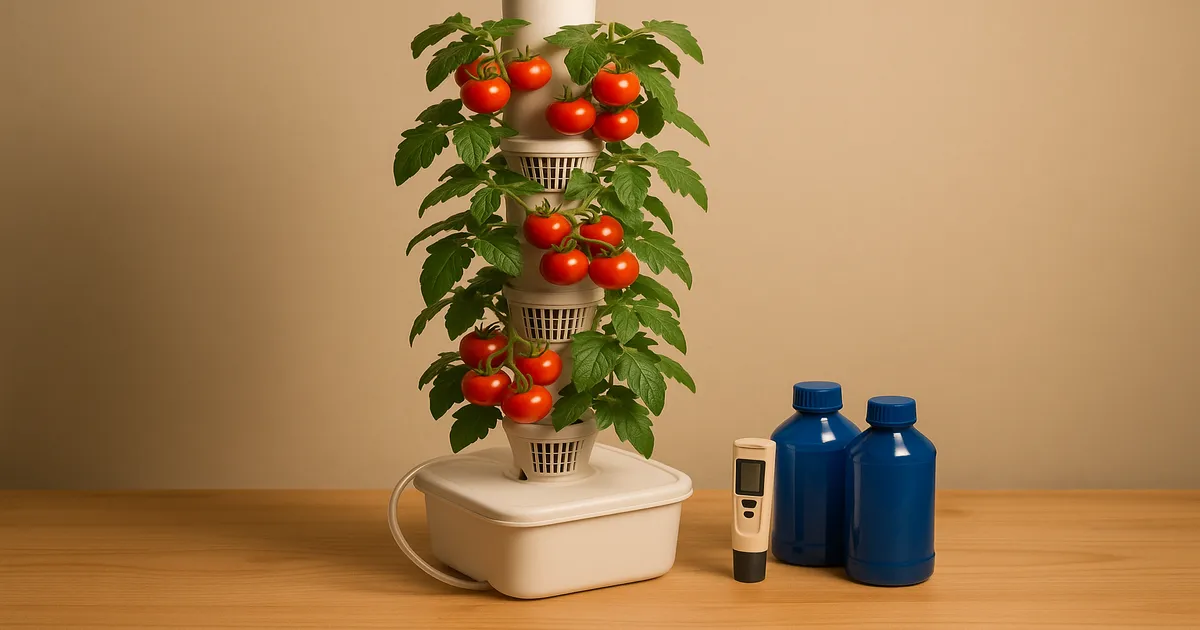
Quick Answer: To grow tomatoes in a hydroponic tower, choose compact varieties like cherry or grape types, maintain pH 5.8–6.3 and EC between 2.0–5.6 (1,000–2,800 PPM) during fruiting, and provide strong full-spectrum lighting at 600–900 µmol/m²/s. Expect your first harvest 55–85 days from transplant, with yields running 20–50% higher than soil when conditions are dialed in.
What Is a Hydroponic Tower?
A hydroponic tower is a vertical growing structure — typically 4–7 feet tall — where a pump pushes nutrient solution from a base reservoir up to the top, then lets it cascade down through growing pockets and back into the reservoir. Depending on the design, roots are bathed in a thin nutrient film, misted at timed intervals, or periodically flooded and drained.
The biggest selling point is space efficiency. A single 5-foot tower can replace 10–30 square feet of traditional garden bed, making towers genuinely useful for patios, balconies, garages, and indoor grow rooms where horizontal space is tight.
Can Tomatoes Really Grow in a Tower System?
Yes — but with caveats. Tomatoes are rated moderate-to-advanced difficulty in tower systems because of their size, heavy fruiting, and demanding nutritional needs. Get the fundamentals right — compact variety selection, stable pH, strong lighting, and consistent EC management — and a tower can outperform a garden bed by a meaningful margin.
Choosing the Right Tower System to Grow Tomatoes Hydroponically
Aeroponic Towers
Roots are suspended in air and misted with nutrient solution at timed intervals. Constant oxygenation drives fast growth and excellent nutrient uptake. The Tower Garden by Juice Plus+ is the most recognizable consumer product in this category. The tradeoff: if your pump or timer fails, roots dry out within minutes, so reliability matters more here than in any other system.
NFT Towers
Nutrient Film Technique towers run a thin, continuous stream of solution over root zones in channels or pockets. They use very little water, produce consistently well, and suit continuous production. Expect intermediate skill requirements — you’ll need to monitor flow rate and prevent channels from clogging.
Ebb & Flow Towers
These periodically flood and drain the tower column. The wet-dry cycling gives roots good oxygen exposure between floods and makes this the most forgiving system for beginners. It handles heavier-feeding crops like tomatoes reasonably well.
DWC Hybrid Towers
Less common in vertical setups, but some hybrid designs suspend roots into oxygenated nutrient solution. Good for heavy feeders, and root inspection is easier than in closed-channel systems.
Which System Is Best for Home Growers?
For most home growers, aeroponic or NFT towers are the top picks. They use the least water, deliver excellent oxygenation, and pair well with the compact tomato varieties that thrive in tower pockets. Ebb & flow towers are a solid beginner option if you want a more forgiving system while you learn the basics.
| System | Water Use | Oxygenation | Difficulty | Tomato Suitability |
|---|---|---|---|---|
| Aeroponic | Very Low | Excellent | Intermediate | High |
| NFT | Low | Good | Intermediate | High |
| Ebb & Flow | Moderate | Good | Beginner–Int. | Moderate |
| DWC Hybrid | Moderate | Good | Intermediate | Moderate |
Best Tomato Varieties for Hydroponic Towers
Cherry and Grape Varieties (Highly Recommended)
These are your safest bets. Compact growth habits, manageable root mass, and prolific fruiting make cherry and grape types a natural fit for tower pockets.
- Tiny Tim — True dwarf (under 18 inches), determinate, first fruit at ~55–60 days. Ideal for smaller towers.
- Tumbling Tom Red/Yellow — Compact, cascading habit, determinate. Fruits around 70 days. Made for container growing.
- Micro Tom — Ultra-compact at 6–8 inches. More of a novelty, but technically feasible in tower pockets.
- Juliet F1 — Grape tomato, semi-determinate, crack-resistant, excellent disease resistance, prolific producer.
- Sun Gold F1 — Legendary sweetness, orange cherry, indeterminate. Requires aggressive pruning to stay manageable.
- Sweet Million F1 — Prolific and disease-resistant. Indeterminate but responds well to regular pruning.
Cocktail and Medium Varieties (Moderate Fit)
These can work in larger tower systems but demand more attention to pruning and support.
- Patio F1 — Bred for containers, compact determinate, reliable yield.
- Bush Early Girl — Compact indeterminate, early fruiting (~54 days), manageable size.
- Celebrity — Semi-determinate, strong disease resistance (VFN), works in larger towers with good structural support.
Large and Beefsteak Varieties (Avoid)
Standard beefsteak varieties grow 5–8+ feet tall, develop massive root systems, and produce fruit heavy enough to pull plants out of tower pockets. Supporting them in a home tower setup is a genuine engineering challenge. Stick to compact varieties unless you’re running a large commercial system with purpose-built caging.
How to Grow Tomatoes in a Hydroponic Tower: Setup and Transplanting
Equipment Checklist
- Tower unit with reservoir and pump
- Digital timer for pump cycles
- Calibrated pH meter and EC/TDS meter
- pH Up and pH Down solutions
- Grow media (hydroton/clay pebbles, rockwool, or net pot inserts)
- Full-spectrum LED grow light (for indoor growing)
- Hydroponic nutrient solution
- CaliMag supplement
- Reservoir thermometer (target 65–72°F / 18–22°C)
Germinating and Transplanting Seedlings
Start seeds in rockwool cubes or rapid rooter plugs. Keep them at 70–80°F (21–27°C) with high humidity until the taproot emerges. Once seedlings have 2–3 true leaves and a visible root system, they’re ready for the tower. Seat the plug gently into the pocket and secure the stem — young tomato stems are more fragile than they look.
Start your nutrient solution at a low concentration during the first week: 400–600 PPM (0.8–1.2 EC). This prevents transplant shock and gives roots time to establish before you ramp up feeding.
Water Quality and Reservoir Setup
Starting water quality matters more than most beginners realize. Aim for source water below 0.3 EC (150 PPM) before adding nutrients. RO water is ideal — it gives you a clean slate for precise nutrient control. If you’re using tap water, let it sit uncovered for 24 hours to off-gas chlorine. Chloramine won’t off-gas on its own; treat it with ascorbic acid instead. Hard tap water with high baseline calcium or magnesium can throw off your nutrient ratios, so always test source water EC before mixing.
Keep reservoir water temperature between 65–72°F (18–22°C). Above 75°F, dissolved oxygen drops sharply and pythium root rot risk climbs fast.
Supporting Plants as They Grow
Tower pockets alone won’t hold a fruiting tomato stem steady. For indeterminate varieties, run a vertical string or wire from the tower frame above each pocket and loosely tie the main stem as it grows. For outdoor towers, consider a surrounding cage or trellis structure that wraps the entire column.
Nutrient Management for Hydroponic Tower Tomatoes
EC and PPM Targets by Growth Stage
| Growth Stage | PPM | EC |
|---|---|---|
| Seedling / Transplant | 400–600 | 0.8–1.2 |
| Early Vegetative | 800–1,000 | 1.6–2.0 |
| Late Vegetative | 1,200–1,600 | 2.4–3.2 |
| Flowering | 1,600–2,000 | 3.2–4.0 |
| Fruiting / Ripening | 2,000–2,800 | 4.0–5.6 |
Macronutrient Ratios: Vegetative vs. Fruiting
During vegetative growth, aim for an N-P-K ratio of roughly 3:1:2 — nitrogen drives leaf and stem development. Once flowers appear, shift toward 1:1:3. Potassium becomes the dominant macronutrient during fruiting, supporting cell wall integrity, water regulation, and sugar content (Brix). Keeping nitrogen too high during fruiting pushes the plant toward foliage at the expense of fruit development.
Key Micronutrients for Tomatoes
Calcium (target 150–200 PPM) is essential for cell wall strength — deficiency leads directly to blossom end rot. Magnesium (target 50–75 PPM) sits at the center of every chlorophyll molecule; without it, leaves yellow between the veins (interveinal chlorosis).
Also watch boron (0.3–0.5 PPM) — it’s critical for pollen viability and fruit set, and deficiency causes hollow fruit and poor pollination. Use chelated iron (Fe-EDTA or Fe-DTPA) at 2–5 PPM to ensure availability across your pH range.
Nutrient System Options
Beginner — 3-Part Liquid: The General Hydroponics Flora Series is the most beginner-friendly approach. Per gallon of water:
- Seedling: FloraGro 2.5 mL + FloraMicro 2.5 mL + FloraBloom 1.25 mL
- Vegetative: FloraGro 5 mL + FloraMicro 5 mL + FloraBloom 2.5 mL
- Flowering/Fruiting: FloraGro 2.5 mL + FloraMicro 5 mL + FloraBloom 7.5 mL
Add CaliMagic at 3–5 mL/gallon throughout all stages.
Intermediate — Dry Concentrate: MaxiGro and MaxiBloom dissolve directly in water. Use MaxiGro at 7 g/gallon during vegetative growth, then switch to MaxiBloom at 7 g/gallon for flowering and fruiting. Add a CalMag supplement throughout.
Advanced — DIY Masterblend Formula: The Masterblend 4-18-38 tomato formula is one of the most cost-effective and well-balanced options available. Per 5 gallons of water:
- Masterblend 4-18-38: 12 g
- Calcium Nitrate (15.5-0-0): 12 g
- Magnesium Sulfate (Epsom Salt): 6 g
This yields approximately 1,000–1,200 PPM (2.0–2.4 EC) — scale proportionally by growth stage.
Pro tip: Always dissolve calcium nitrate separately in water first, then add Masterblend. Mixing them directly causes calcium-sulfate precipitation that locks out nutrients.
pH and EC Management
Optimal pH Range
Keep pH between 5.8–6.3, with the sweet spot at 6.0–6.2. Below 5.5, iron, manganese, and zinc become toxic while calcium and magnesium lock out. Above 6.5, iron, boron, and zinc become unavailable even when present in solution — you’ll see deficiency symptoms despite a full nutrient tank.
Daily Monitoring
Invest in reliable meters. The Apera PC60 covers both pH and EC in one unit and is a strong value for home growers. If you prefer dedicated tools, the Bluelab pH Pen and Bluelab Truncheon are both excellent — the Truncheon in particular is nearly indestructible and needs no calibration. Calibrate your pH meter weekly using pH 4.0 and 7.0 buffer solutions; a drifting meter is one of the most common causes of unexplained deficiencies.
Check pH and EC daily during fruiting, and at minimum every 2–3 days during vegetative growth.
Adjusting pH
Use phosphoric acid for pH Down and potassium hydroxide for pH Up. Add in small increments — 1–2 mL per 5 gallons — wait 15 minutes, then retest. Never move pH more than 0.5 units in a single session. Rapid swings stress roots more than a slightly off pH does.
Managing EC Drift
- EC rising — Plants are consuming more water than nutrients (common in heat or high light). Top off with plain pH-adjusted water to dilute.
- EC dropping — Plants are consuming nutrients faster than water (common during heavy fruiting). Add fresh nutrient solution to bring EC back to target.
Do a full reservoir change every 7–14 days. Salt buildup and nutrient imbalances accumulate in ways that meters don’t fully capture. Flush the tower with plain water before refilling.
Lighting Your Hydroponic Tomato Tower
Spectrum and PPFD Targets
Tomatoes need full-spectrum light with emphasis on blue (400–500 nm) for compact vegetative growth, red (620–700 nm) for photosynthesis efficiency and fruiting, and far-red (700–750 nm) to trigger faster flowering via the Emerson effect. Green wavelengths (500–600 nm) penetrate deeper into multi-tier canopies — more relevant than most growers expect on a tall tower.
| Growth Stage | PPFD | DLI |
|---|---|---|
| Seedling | 100–200 µmol/m²/s | 8–12 mol/m²/day |
| Vegetative | 300–500 µmol/m²/s | 15–20 mol/m²/day |
| Flowering | 500–700 µmol/m²/s | 20–25 mol/m²/day |
| Fruiting | 600–900 µmol/m²/s | 25–35 mol/m²/day |
Insufficient DLI is the single most common reason indoor tower tomatoes fail to fruit well. If plants are flowering but not setting fruit, check light levels before anything else.
Recommended LED Fixtures
For a single home tower:
- Spider Farmer SF-2000 (~200W) — solid full-spectrum coverage for a 4×4 ft area
- Mars Hydro TS-1000 (~150W) — budget-friendly, good for smaller towers or supplemental side lighting
- Viparspectra P2000 (~200W) — reliable spectrum and coverage for fruiting crops
For multiple towers or commercial setups, look at the Gavita Pro 1700e LED or HLG 650R .
Photoperiod and Side Lighting
Tomatoes are day-neutral — they don’t need a specific light cycle to flower. Indoors, run 16–18 hours of light and 6–8 hours of dark. Avoid 24-hour continuous light; tomatoes use the dark period for respiration and starch translocation, and skipping it long-term reduces overall productivity.
On towers taller than 4 feet, overhead lighting alone leaves lower pockets severely light-starved. Adding vertical LED bar lights or T5 strips mounted alongside the tower column can increase lower-canopy PPFD by 30–50%. If your lower pockets consistently underperform, this is almost always why.
Outdoor Placement
Place outdoor towers in full sun — 6–8+ hours of direct sunlight daily. In the Northern Hemisphere, south-facing placement maximizes exposure. Rotate the tower 90° every 3–5 days so every growing site gets even light distribution.
Troubleshooting Common Problems
Blossom End Rot (BER)
BER appears as a dark, sunken, leathery patch on the bottom of developing fruit. It’s a calcium deficiency at the fruit tissue level — but it’s rarely caused by a lack of calcium in your solution. More often, inconsistent watering cycles or EC swings prevent calcium from moving through the plant fast enough. Fix it by stabilizing your pump schedule, keeping EC consistent, and supplementing with CaliMag at 3–5 mL/gallon.
Yellowing Leaves
Location is everything when diagnosing yellowing:
- Lower leaves yellowing uniformly — Mobile nutrient deficiency, most likely nitrogen. Increase EC slightly and check that your N-P-K ratio matches the current growth stage.
- Upper/new leaves yellowing — Immobile nutrient deficiency (calcium or iron). Check pH first — if it’s drifted above 6.5, iron locks out even when present. Correct pH before adding more nutrients.
- Interveinal yellowing (green veins, yellow between) — Magnesium deficiency. Add Epsom salt at 1–2 g/gallon or increase CaliMag dose.
Poor Fruit Set
If flowers are dropping or not setting fruit, check these in order: light levels (DLI below 20 is the most common culprit), temperature (above 85°F / 29°C causes pollen sterility), and pollination. Indoor towers have no wind or insects, so shake plants gently or use a small electric pollinator wand daily when flowers are open.
Root Rot
Slimy brown roots and a foul smell indicate pythium. The two main causes are high reservoir temperature (above 75°F / 24°C) and low dissolved oxygen. Lower reservoir temp, increase aeration, and treat with a beneficial bacteria product like Hydroguard. Prevent recurrence by keeping the reservoir dark — algae growth accelerates pythium.
Slow Growth or Stunted Plants
If growth stalls despite correct pH and EC, check reservoir temperature and pump function first. A partially blocked emitter in an aeroponic tower can starve a pocket of nutrients without triggering any obvious alarm. Inspect nozzles and lines every 2 weeks.
Frequently Asked Questions
How long does it take to grow tomatoes in a hydroponic tower? Most cherry and grape varieties reach first harvest 55–70 days from transplant. Medium varieties like Bush Early Girl can fruit in as little as 54 days. Larger cocktail types may take 75–85 days. Germination and seedling time (typically 10–14 days) comes before the transplant clock starts.
How many tomato plants can I grow in one tower? It depends on tower size and pocket spacing. A standard 5-foot tower with 20 pockets can support 4–6 tomato plants comfortably — cherry varieties at the upper end, medium types at the lower end. Overcrowding reduces airflow and light penetration, which hurts yield.
Do I need to pollinate tomatoes growing in a hydroponic tower indoors? Yes. Without wind or insects, you need to pollinate manually. Shake the flowering stems gently once a day, or use a small electric toothbrush or pollinator wand held against the flower stem for a few seconds. Do this when flowers are fully open, typically mid-morning.
What is the best nutrient solution for hydroponic tower tomatoes? For beginners, the General Hydroponics Flora Series is the most reliable starting point. For cost-conscious growers with some experience, the Masterblend 4-18-38 formula delivers excellent results at a fraction of the price per gallon. Whichever system you use, always supplement with CaliMag to hit calcium and magnesium targets.
Can I grow tomatoes in a hydroponic tower outdoors year-round? In USDA zones 9–11, outdoor tower growing is feasible most of the year. In cooler climates, tomatoes are a warm-season crop — move towers indoors or into a greenhouse once nighttime temperatures drop below 55°F (13°C). Frost will kill tomato plants quickly, and temperatures below 50°F slow growth significantly even without frost.