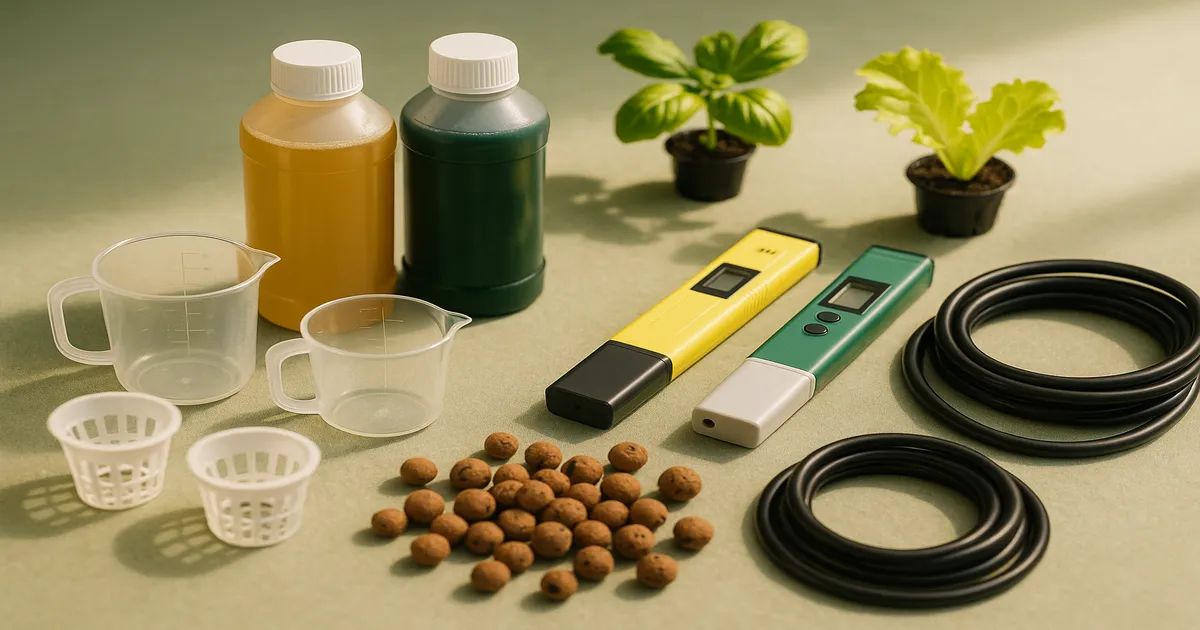
Quick Answer: This free hydroponic nutrients guide covers all 17 essential plant nutrients, pH and EC management, ready-to-use feeding recipes, and growth-stage schedules for DWC, NFT, Ebb & Flow, Kratky, and other popular systems. It’s written for beginner-to-intermediate home growers who want clear, actionable nutrition strategies — not a chemistry lecture. Download the PDF below and start growing with confidence.
What This Best Hydroponic Nutrients Guide PDF Covers
Growing hydroponically means you are the soil. Every nutrient your plant needs must come from your reservoir — in the right form, at the right concentration, at the right time. Get it right and plants grow faster than they ever would in dirt. Get it wrong and you’ll spend weeks chasing deficiencies in circles.
This free hydroponic nutrients guide cuts through the noise. Here’s what’s inside:
- All 17 essential plant nutrients, what each one does, and how much to use
- pH and EC management explained from first principles
- Ready-to-use nutrient recipes for Flora Series, Hoagland, and Masterblend
- Feeding schedules from seedling through final flush
- System-specific advice for DWC, NFT, Ebb & Flow, Kratky, drip, and aeroponics
Who it’s for: If you’re a beginner trying to figure out why your lettuce looks yellow, or an intermediate grower dialing in your tomato bloom feed, this guide is for you. No chemistry background required — but real numbers are included throughout.
→ [Download the Free PDF Guide Now] (Enter your email for instant access)
Hydroponic Nutrients vs. Soil Fertilizers: Why They’re Different
The 17 Essential Elements Every Plant Needs
Plants need 17 elements to complete their life cycle. Three — carbon, hydrogen, and oxygen — come from air and water. The remaining 14 must be dissolved in your nutrient solution:
- Primary macronutrients: Nitrogen (N), Phosphorus (P), Potassium (K)
- Secondary macronutrients: Calcium (Ca), Magnesium (Mg), Sulfur (S)
- Micronutrients: Iron, Manganese, Zinc, Boron, Copper, Molybdenum, Chlorine, Nickel
Miss any one of these and you’ll eventually see it in your leaves.
Why Bioavailability Matters More in Hydroponics
In soil, microbes slowly break down organic matter into ionic forms plants can absorb. That process takes time, but it also buffers mistakes. In hydroponics, there are no microbes doing that work. Every nutrient must already be in ionic, water-soluble form the moment it reaches the root zone. That’s why you can’t dissolve standard garden fertilizer in water and call it a nutrient solution — most granular fertilizers contain slow-release coatings or insoluble compounds that simply won’t work.
Liquid Concentrates vs. Water-Soluble Powders
2-part and 3-part liquid concentrates like the General Hydroponics Flora Series are the easiest starting point. They’re pre-balanced, mix quickly, and are widely available. The trade-off is cost — liquids are heavy to ship and have a shorter shelf life once opened.
Water-soluble powders (WSP) like Masterblend 4-18-38 cost significantly less per gallon mixed, store for years when kept dry, and give you more control over your formula. They require a little more math upfront but are well worth learning.
Nutrient Requirements by Growth Stage
Primary Macronutrients: N, P, and K
The ratios of nitrogen, phosphorus, and potassium shift dramatically between vegetative and flowering stages:
- Nitrogen: 150–250 PPM in veg; drop to 50–100 PPM at flower. High nitrogen late in flowering delays ripening and reduces fruit quality.
- Phosphorus: 50–80 PPM in veg; increase to 80–120 PPM at flower for root development and bud set. Note that extremely high phosphorus (above 150 PPM) can lock out zinc and iron.
- Potassium: 100–200 PPM in veg; 150–250 PPM in flower. Potassium supports disease resistance, stomatal regulation, and fruit quality.
Secondary Macronutrients: Calcium, Magnesium, and Sulfur
Calcium and magnesium are the most commonly deficient nutrients in systems using reverse osmosis (RO) water, because RO strips everything out.
- Calcium: Target 150–200 PPM throughout all stages. Deficiency causes tip burn in lettuce and blossom end rot in tomatoes.
- Magnesium: Target 50–75 PPM. Maintain a Ca:Mg ratio of roughly 3:1 to 4:1 — too much magnesium blocks calcium uptake.
- Sulfur: 50–100 PPM. Often overlooked, but critical for amino acid synthesis and the flavor compounds in herbs and alliums.
Micronutrients: Small Doses, Big Impact
Micronutrients are needed in tiny amounts, but they’re non-negotiable. Most quality commercial formulas include them. If you’re mixing DIY from scratch, you’ll need a dedicated micro blend.
Key targets:
- Iron (Fe): 2–5 PPM. Always use chelated iron (EDTA or DTPA) — non-chelated iron precipitates out of solution rapidly, especially above pH 6.5.
- Manganese (Mn): 0.5–1.0 PPM
- Boron (B): 0.3–0.5 PPM (values above 1.0 PPM can be toxic to sensitive crops like strawberries)
- Copper (Cu): 0.05–0.1 PPM — toxic above 0.5 PPM. More is not better.
- Zinc, Molybdenum, Chlorine, Nickel: Trace amounts; covered by most commercial micro blends.
PPM and EC Targets by Growth Stage
500-scale vs. 700-scale: Two PPM standards exist. The 500 scale (used by Bluelab and most North American meters) reads 1.0 EC as 500 PPM. The 700 scale (used by Hanna Instruments) reads 1.0 EC as 700 PPM. This guide uses the 500 scale. Check your meter’s manual before comparing numbers with other growers.
| Growth Stage | pH Range | PPM (500 scale) | EC |
|---|---|---|---|
| Seedling / Clone | 5.5–6.0 | 100–400 | 0.2–0.8 |
| Early Vegetative | 5.8–6.2 | 400–800 | 0.8–1.6 |
| Late Vegetative | 5.8–6.2 | 800–1,200 | 1.6–2.4 |
| Early Flowering | 5.8–6.3 | 1,000–1,400 | 2.0–2.8 |
| Mid/Late Flowering | 6.0–6.5 | 1,200–1,600 | 2.4–3.2 |
| Flush / Final Week | 6.0–6.5 | 0–400 | 0.0–0.8 |
N-P-K Ratio Guidelines by Crop
| Crop | Veg N:P:K | Bloom N:P:K |
|---|---|---|
| Leafy greens | 3:1:2 | N/A |
| Tomatoes / Peppers | 3:1:2 | 1:2:3 |
| Herbs (Basil, Mint) | 3:1:2 | 2:1:2 |
| Strawberries | 2:1:2 | 1:2:3 |
| Cannabis / Hemp | 3:1:2 | 1:3:4 |
| Cucumbers | 3:1:3 | 1:2:3 |
Best Hydroponic Nutrient Recipes: Beginner to DIY
All three recipes are included in the downloadable PDF with printable mixing charts.
General Hydroponics Flora Series 3-Part Recipe
Per gallon of RO or filtered water: (General Hydroponics Flora Series 3-Part)
| Stage | FloraGro | FloraMicro | FloraBloom |
|---|---|---|---|
| Seedling | 2.5 mL | 2.5 mL | 1 mL |
| Vegetative | 5 mL | 4 mL | 2 mL |
| Flowering | 2 mL | 4 mL | 6 mL |
Target EC: 600–1,000 PPM (1.2–2.0 EC) for most crops. Always add FloraMicro to water first — adding it directly to FloraBloom causes precipitation.
The Classic Modified Hoagland Solution
The Hoagland formula is the gold standard of hydroponic research, developed at UC Berkeley in the 1930s and still used in university labs today. Per liter of distilled water:
- Calcium Nitrate [Ca(NO₃)₂]: 945 mg
- Potassium Nitrate [KNO₃]: 607 mg
- Monopotassium Phosphate [KH₂PO₄]: 136 mg
- Magnesium Sulfate [MgSO₄·7H₂O]: 493 mg
- Micronutrient stock solution: 1 mL
Resulting EC: approximately 2.0–2.2 EC (1,000–1,100 PPM). This is full strength — dilute to 50% for seedlings and young transplants.
Budget DIY Masterblend 4-18-38 Recipe
Per gallon of water, add in this exact order: (Masterblend 4-18-38 Tomato Formula)
- Masterblend 4-18-38: 6 g
- Calcium Nitrate: 6 g
- Magnesium Sulfate (Epsom salt): 3 g
Resulting EC: 750–900 PPM (1.5–1.8 EC). Adjust pH to 5.8–6.2 after mixing. Adding calcium nitrate before Epsom salt prevents calcium-sulfate precipitation.
How to Mix Nutrients Correctly
Always add each component separately to your reservoir water — never mix concentrates together before diluting. Combining two concentrates directly causes calcium and sulfate to react, forming white sediment that plants can’t absorb.
Correct order:
- Start with most of your water (leave room for adjustments)
- Add Part A (or any calcium-containing component) first — stir well
- Add Part B (or phosphate-containing component) — stir well
- Add silica supplements first if using, then any remaining additives
- Top up to final volume, then adjust pH last
pH and EC Management: The Most Critical Skill in Hydroponics
Why pH Controls Nutrient Availability
pH determines whether the nutrients in your reservoir can actually enter the plant. The key takeaways from Mulder’s Chart:
- Below pH 5.5: Calcium, magnesium, and phosphorus become unavailable. Iron and manganese can reach toxic levels.
- Above pH 6.8: Iron, manganese, boron, copper, and zinc precipitate out of solution entirely.
- pH 5.8–6.2: The sweet spot where all 14 mineral nutrients are simultaneously available.
Most apparent deficiencies aren’t deficiencies at all — they’re pH lockout. Always check pH before adding more nutrients.
How to Adjust pH Safely
pH Down: Phosphoric acid is the standard choice. Add in 1 mL increments, stir, wait 30 seconds, then retest. Never pour it directly onto roots or concentrated nutrient solution.
pH Up: Potassium hydroxide (KOH) is most common. It’s more concentrated than pH Down, so start with 0.5 mL increments and work up slowly.
Choosing a pH and EC Meter
Accurate meters are non-negotiable. A drifting pH meter is worse than no meter at all.
pH meters:
- Budget: Apera PH20 (~$40) — accurate to ±0.1 pH, solid for beginners
- Mid-range: Bluelab pH Pen (~$80) — waterproof, highly reliable
- Professional: Bluelab Guardian Monitor (~$300) — continuous inline monitoring
EC/TDS meters:
- Budget: Vivosun TDS Meter (~$15) — adequate for getting started
- Mid-range: Apera EC60 (~$60) — temperature-compensated, more accurate
- Professional: Bluelab Truncheon (~$100) — no calibration required
Calibrate your pH meter weekly using pH 4.0 and pH 7.0 buffer solutions.
EC Management and the Top-Off Protocol
EC creep happens when water evaporates faster than plants consume nutrients, leaving salts behind in an increasingly concentrated solution. The fix is counterintuitive: top off with plain water, not nutrient solution.
- Reservoir drops 10–20%? Top off with plain, pH-adjusted water only.
- Reservoir drops 50%+ or it’s been 7–14 days? Do a full reservoir change with fresh nutrient solution.
- EC is rising despite normal water levels? Dilute with plain water and consider a partial flush.
Never increase EC by more than 0.2–0.3 per week. Rapid jumps stress roots and cause tip burn before you’ve noticed a problem.
System-Specific Nutrient Considerations
DWC and Kratky: DWC keeps roots submerged in aerated solution 24/7. EC can swing quickly in small reservoirs, so check daily and top off with plain water as levels drop. Kratky is passive DWC — as the plant drinks, an air gap forms below the net pot for passive oxygenation. Start at the lower end of your EC range since concentration rises naturally as water is consumed. A quality air pump and air stone are essential for active DWC to prevent root rot.
NFT: Runs a thin film of solution over bare roots continuously. Keep your reservoir below 72°F (22°C) — warmer water crashes dissolved oxygen and invites pythium root rot fast.
Ebb & Flow: Floods the grow tray periodically, then drains. Salt residue builds up in media between flood cycles, so flush with plain water weekly to prevent EC creep at the root zone.
Drip systems: Check runoff EC weekly. If it reads more than 0.5 EC higher than your input solution, flush immediately.
Aeroponics: Mists roots with fine droplets for maximum oxygen and nutrient contact. Even minor mineral precipitation clogs nozzles, so ultra-pure water and a strict cleaning schedule are non-negotiable.
Wick systems: Slow and inconsistent delivery means you should stick to low-demand crops like herbs and small lettuce. Keep EC at 400–600 PPM (0.8–1.2 EC) — wicks can’t flush excess salts efficiently.
Frequently Asked Questions
Can I use regular garden fertilizer in hydroponics? No. Most garden fertilizers contain slow-release coatings or insoluble compounds that won’t dissolve properly. Plants in hydroponic systems need nutrients in fully ionic, water-soluble form from the moment they hit the root zone. Use fertilizers specifically formulated for hydroponics or water-soluble powders like Masterblend.
How often should I change my reservoir? Every 7–14 days for most systems. Nutrient ratios drift over time as plants selectively absorb certain elements, and microbial populations can build up even in clean systems. A full reservoir change resets both problems at once.
Why are my plants showing deficiency symptoms even though my EC is correct? pH lockout is the most likely cause. Check your pH first — if it’s drifted above 6.8 or below 5.5, nutrients are chemically unavailable regardless of how much is in the water. Correct pH before adding more nutrients.
What’s the difference between PPM and EC? EC (electrical conductivity) measures how well a solution conducts electricity, which correlates with dissolved salt concentration. PPM (parts per million) is EC converted to a weight-based measurement. The conversion factor depends on your meter’s scale — 500 or 700. EC is the more universal measurement; use it when comparing notes with other growers.
Do I need to pH-adjust my water if I’m using tap water? Yes, almost always. Most tap water sits between pH 7.0 and 8.0, which is too alkaline for hydroponics. Even if your tap water happens to be in range today, it can vary seasonally. Always test and adjust to 5.8–6.2 before adding nutrients, and recheck after mixing.
The complete version of this best hydroponic nutrients guide PDF — including printable feeding charts, a deficiency visual reference, and system-specific reservoir logs — is available as a free download above.