Quick Answer: You can grow cilantro from seed hydroponically in as little as 3–4 weeks from germination to first harvest — roughly 2–3x faster than soil. Use a Kratky or DWC system, keep pH between 5.8–6.4, and maintain temperatures below 75°F (24°C) to prevent bolting. Succession plant every 2–3 weeks for a continuous supply.
If you’ve ever watched a bunch of store-bought cilantro wilt in three days, you already know why learning how to grow cilantro from seed hydroponically is worth the effort. You get faster growth, fresher flavor, and — most importantly — control over the two things that make cilantro miserable to grow outdoors: heat and long days. Both trigger bolting, and both are completely manageable indoors.
This guide covers everything from system selection and germination to nutrients, lighting, harvesting, and troubleshooting.
How to Grow Cilantro from Seed Hydroponically: At a Glance
| Parameter | Target |
|---|---|
| Germination time | 7–10 days |
| First harvest | 3–4 weeks from germination |
| pH range | 5.8–6.4 (sweet spot: 6.0–6.2) |
| EC at active growth | 1.6–2.4 (800–1,200 PPM) |
| Ideal temperature | 60–75°F (15–24°C) |
| Main challenge | Bolting (premature flowering) |
Choosing the Best Hydroponic System for Cilantro
Kratky and DWC: Best for Beginners
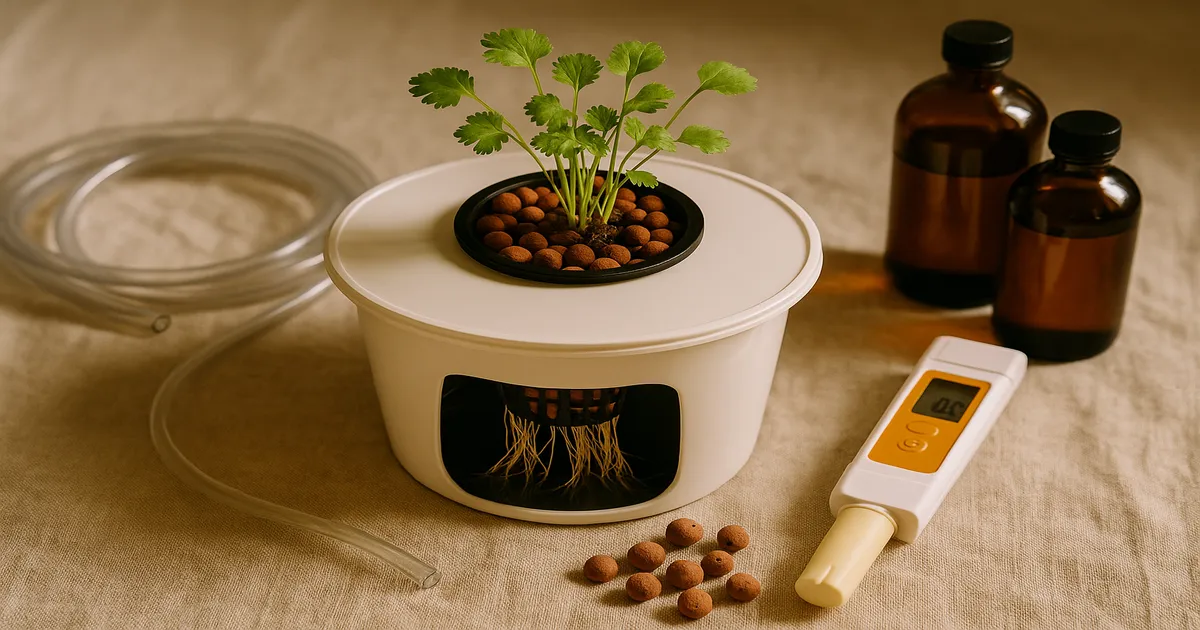
Kratky and Deep Water Culture (DWC) are the top choices for cilantro. Cilantro has a taproot tendency — it likes to send one root straight down into a deep water column — and both systems deliver exactly that. Kratky requires zero pumps or electricity beyond lighting, making it the simplest setup possible. DWC adds an air pump for oxygenation, which speeds growth slightly and lowers root rot risk. Either works well for a first grow.
For DWC, you’ll need a reliable air pump to keep dissolved oxygen high.
NFT, Ebb & Flow, and Vertical Towers
NFT (Nutrient Film Technique) suits continuous or commercial cilantro production well. A thin film of nutrient solution keeps roots oxygenated without waterlogging them. Ebb & Flow systems are equally capable — just more complex to set up.
Vertical tower gardens are excellent for home growers who want space efficiency. You can pack a lot of plants into a small footprint. Watch for uneven water distribution between the top and bottom of the tower, and check lower sites regularly.
Wicking and Aeroponics
Wicking systems are cheap and require no electricity, but growth is noticeably slower. They work — just don’t expect the same 3–4 week harvest window. Aeroponics is technically capable but overkill for an herb that completes its productive life in a matter of weeks.
| System | Suitability | Best For |
|---|---|---|
| Kratky | ⭐⭐⭐⭐⭐ | Beginners, small home setups |
| DWC | ⭐⭐⭐⭐⭐ | Beginners to intermediate |
| NFT | ⭐⭐⭐⭐ | Continuous/commercial production |
| Ebb & Flow | ⭐⭐⭐⭐ | Intermediate growers |
| Vertical Tower | ⭐⭐⭐⭐ | Space-constrained home growers |
| Wicking | ⭐⭐⭐ | Absolute beginners, low budget |
| Aeroponics | ⭐⭐ | Advanced setups; not necessary here |
Germinating Cilantro Seeds Hydroponically
Prepare Your Seeds First
Here’s something most beginner guides skip: what looks like a single cilantro seed is actually a two-seeded husk. Lightly crush the husk between your fingers — just enough to crack it, not pulverize it — so moisture can reach both seeds inside. After cracking, soak seeds in room-temperature water for 12–24 hours before planting. This simple step can meaningfully improve germination rates.
Best Growing Media for Seed Starting
Three media work well for cilantro starts:
- Rockwool cubes (1.5-inch) — widely available, excellent moisture retention; pre-soak in pH 5.5 water for 30–60 minutes before use
- Rapid Rooter plugs — made from composted organic material; great germination rates; very beginner-friendly
- Hydroton (expanded clay pebbles) — best as a top-layer cover over rockwool in net cups; not ideal for seed starting on its own
Step-by-Step Germination
- Pre-soak rockwool cubes or Rapid Rooters in pH 5.5–6.0 water for 30–60 minutes.
- Lightly crush and soak seeds as described above.
- Place 2–3 seeds per cube, about ¼ inch deep.
- Squeeze excess water from rockwool before use — moist, not waterlogged.
- Maintain temperature at 65–75°F (18–24°C). A seedling heat mat helps if your space runs cool.
- Use low light (50–100 PPFD) or indirect light only during germination.
- Expect sprouts in 7–10 days. Thin to the strongest seedling per cube once they reach ½ inch tall.
Transplanting into Your System
Transplant once roots are visibly emerging from the bottom of the cube — usually around day 10–14. For the first 3–5 days after transplanting, use a dilute nutrient solution of 100–200 PPM (0.2–0.4 EC). Seedling roots are sensitive; hitting them with full-strength nutrients right away can slow early growth.
Nutrient Solution for Hydroponic Cilantro
EC and PPM Targets by Growth Stage
| Growth Stage | PPM | EC |
|---|---|---|
| Germination/Seedling | 350–500 | 0.7–1.0 |
| Early Vegetative (weeks 1–2) | 500–800 | 1.0–1.6 |
| Active Vegetative/Harvest | 800–1,200 | 1.6–2.4 |
| Maximum (do not exceed) | 1,400 | 2.8 |
Cilantro is a light feeder. Pushing past 1,400 PPM (2.8 EC) risks nutrient burn, tip browning, and accelerated bolting. More nutrients does not mean more growth with this herb.
Recommended Nutrient Formulas
3-Part Commercial Formula: General Hydroponics Flora Series at half to three-quarters of the recommended herb dosage targets 800–1,000 PPM during active growth. Advanced Nutrients pH Perfect is another solid option for growers who want automated pH stabilization.
Masterblend Recipe (per gallon of water):
- Masterblend 4-18-38: 2.4 g/gallon
- Calcium Nitrate (15.5-0-0): 2.4 g/gallon
- Magnesium Sulfate (Epsom Salt): 1.2 g/gallon
This targets approximately 800–900 PPM (1.6–1.8 EC) — a great fit for cilantro’s light-feeder profile and one of the most cost-effective options available.
Organic Nutrients: Fish-based organics like FoxFarm Grow Big Hydro produce excellent flavor but require more pH vigilance. Expect daily pH checks and more frequent reservoir changes.
What to Prioritize in Your Nutrient Mix
Nitrogen form matters more than most guides acknowledge. Favor nitrate-nitrogen (NO₃⁻) over ammoniacal nitrogen — it promotes stable pH and reduces bolting risk. Target a 3:1:2 N:P:K ratio and avoid high-phosphorus or bloom formulas entirely; they can trigger premature flowering.
For secondary nutrients and micros, keep these in range:
- Calcium: 150–200 PPM — deficiency causes tip burn
- Magnesium: 30–50 PPM — deficiency shows as interveinal yellowing on older leaves
- Iron: 2–3 PPM in chelated form (Fe-EDTA or Fe-DTPA) — the most commonly deficient micronutrient in hydroponic cilantro
Managing pH and EC
Optimal pH Range
The sweet spot is 6.0–6.2, within the broader acceptable range of 5.8–6.4. Drop below 5.5 and calcium, iron, and magnesium become less available. Creep above 6.8 and phosphorus, iron, manganese, and zinc all lock out. Most nutrient deficiency problems in hydroponic cilantro trace back to pH drift, not an actual shortage of nutrients.
Tools You Need
Skip the test strips — they’re too imprecise for consistent results. A digital pH meter like the Apera PH20 gives readings accurate to ±0.01 pH. Calibrate with pH 4.0 and 7.0 buffer solutions every 1–2 weeks. For EC/PPM, any digital TDS meter in the $15–$50 range works fine — just confirm whether yours uses the 500 or 700 scale, since the same solution reads differently on each.
Adjusting pH Safely
- To raise pH: Add pH Up (potassium hydroxide) in 1–2 mL increments per gallon; stir, wait 15 minutes, retest.
- To lower pH: Add pH Down (phosphoric acid) the same way — small increments, always add to water, never water to acid.
- Always adjust pH after mixing nutrients, since nutrients themselves shift pH.
Reservoir Maintenance
- Full reservoir change: Every 7–14 days to prevent salt buildup and microbial contamination
- Reservoir temperature: 65–72°F (18–22°C) — above 75°F, dissolved oxygen drops and pythium (root rot) risk climbs sharply
- Cover your reservoir: A lightproof lid prevents algae and slows evaporation
- Minimum volume: 1 gallon per plant in DWC; larger reservoirs buffer pH and EC swings more effectively
When EC rises (more evaporation than uptake), top off with plain pH-adjusted water. When EC drops (plants feeding actively), top off with fresh nutrient solution at your target concentration.
Lighting for Indoor Hydroponic Cilantro
Spectrum, PPFD, and DLI
Blue light (400–500 nm) is your bolt-prevention tool — it keeps internodes short and delays flowering. Red light (600–700 nm) drives photosynthesis and biomass. A full-spectrum LED covering both is ideal. Avoid far-red-heavy spectra during the vegetative phase; they can accelerate bolting.
| Growth Stage | PPFD (µmol/m²/s) | DLI (mol/m²/day) |
|---|---|---|
| Germination | 50–100 | 2–4 |
| Seedling (weeks 1–2) | 100–200 | 5–8 |
| Vegetative/Harvest | 200–400 | 10–16 |
| Maximum | 500 | 18 |
A DLI of 12–14 mol/m²/day is the practical sweet spot. Cilantro is a low-to-medium light herb — more intensity doesn’t mean more yield.
Photoperiod: The Key to Preventing Bolting
Run 12–14 hours of light per day for leaf production. Cilantro is a long-day plant, meaning extended photoperiods trigger bolting — especially when combined with heat. Never run 24-hour lighting; cilantro needs a dark period for proper metabolic function. As plants approach maturity, shortening the day to 10–12 hours can delay bolting a bit longer.
Recommended LED Grow Lights
Budget ($30–$100): Barrina T5 LED strips mount 4–8 inches above the canopy and are perfect for shelf setups. The Spider Farmer SF-1000 covers roughly a 2×2 ft area and works well for small DWC or Kratky setups.
Mid-Range ($100–$300): The AC Infinity IONBOARD S24 is dimmable, full-spectrum, and quiet — a strong choice for home herb gardens. The Spider Farmer SF-2000 covers 3×4 ft and should be positioned 18–24 inches above the canopy.
Harvesting and Succession Planting
Cut-and-Come-Again Harvesting
Start harvesting when plants reach 4–6 inches tall — usually 3–4 weeks after germination. Cut outer stems just above a leaf node, leaving the inner growth intact. This encourages the plant to push out new leaves rather than divert energy toward flowering. Never harvest more than one-third of the plant at once.
Succession Planting for Continuous Supply
Start a new batch of seeds every 2–3 weeks while the current crop is actively growing. By the time your first planting bolts, your second batch is ready to harvest. It sounds simple because it is — but most home growers skip it and end up with feast-or-famine cycles.
Preventing Bolting
Once bolting starts — you’ll notice the central stem elongating and leaves turning feathery — it cannot be reversed. Harvest everything usable immediately and start fresh. Prevention is everything:
- Keep temperatures below 75°F (24°C)
- Use a 12-hour photoperiod with a blue-dominant spectrum
- Avoid high-phosphorus nutrients
- Favor nitrate-nitrogen over ammoniacal nitrogen
- Shorten day length to 10–12 hours as plants mature
Troubleshooting Common Problems
| Problem | Likely Cause | Fix |
|---|---|---|
| Yellowing new growth | Iron deficiency | Add chelated iron; confirm pH is below 6.4 |
| Yellowing older leaves | Nitrogen deficiency | Increase N; confirm pH is above 5.8 |
| Tip burn / distorted leaves | Calcium deficiency | Raise Ca to 150–200 PPM; improve airflow |
| Brown, slimy roots | Root rot (pythium) | Cool reservoir below 72°F; add Hydroguard |
| Leggy, stretched stems | Insufficient light | Lower fixture; increase PPFD to 200–400 |
| Premature bolting | Heat or long photoperiod | Cool temps; switch to 12-hour light cycle |
Yellowing new growth vs. old growth: Iron deficiency shows up on new leaves first — young leaves turn yellow while veins stay green. Nitrogen deficiency starts on the oldest, lowest leaves and works upward. For iron, confirm pH is at or below 6.4 and add chelated iron (Fe-EDTA). For nitrogen, increase nutrient concentration slightly and confirm pH is above 5.8.
Tip burn and distorted growth are almost always calcium-related in hydroponic cilantro. Poor airflow around the canopy reduces transpiration and limits calcium uptake even when solution levels are correct. Add a small oscillating fan and raise calcium to 150–200 PPM before assuming a nutrient formula problem.
Frequently Asked Questions
How long does it take to grow cilantro hydroponically from seed? Expect germination in 7–10 days and your first harvest 3–4 weeks after that. The full cycle from seed to spent plant is typically 6–8 weeks before bolting occurs.
Can I regrow cilantro from cuttings instead of seed? Cilantro does not propagate reliably from cuttings — it’s best started from seed each time. This is why succession planting every 2–3 weeks is the standard approach for a continuous supply.
What’s the best hydroponic system for growing cilantro from seed? Kratky is the easiest starting point: no pump, no timer, minimal maintenance. DWC is a close second and grows slightly faster due to better oxygenation. Both are well-suited to cilantro’s taproot growth habit.
Why does my hydroponic cilantro keep bolting? The two most common causes are temperatures above 75°F (24°C) and photoperiods longer than 14 hours. Check both before adjusting nutrients. High-phosphorus formulas and ammoniacal nitrogen can also accelerate bolting.
How often should I change the nutrient solution for cilantro? Every 7–14 days for a full reservoir change. In between, top off with plain pH-adjusted water when EC rises, or dilute nutrient solution when EC drops. Cilantro’s short crop cycle means you’ll rarely need more than two full changes before harvest.