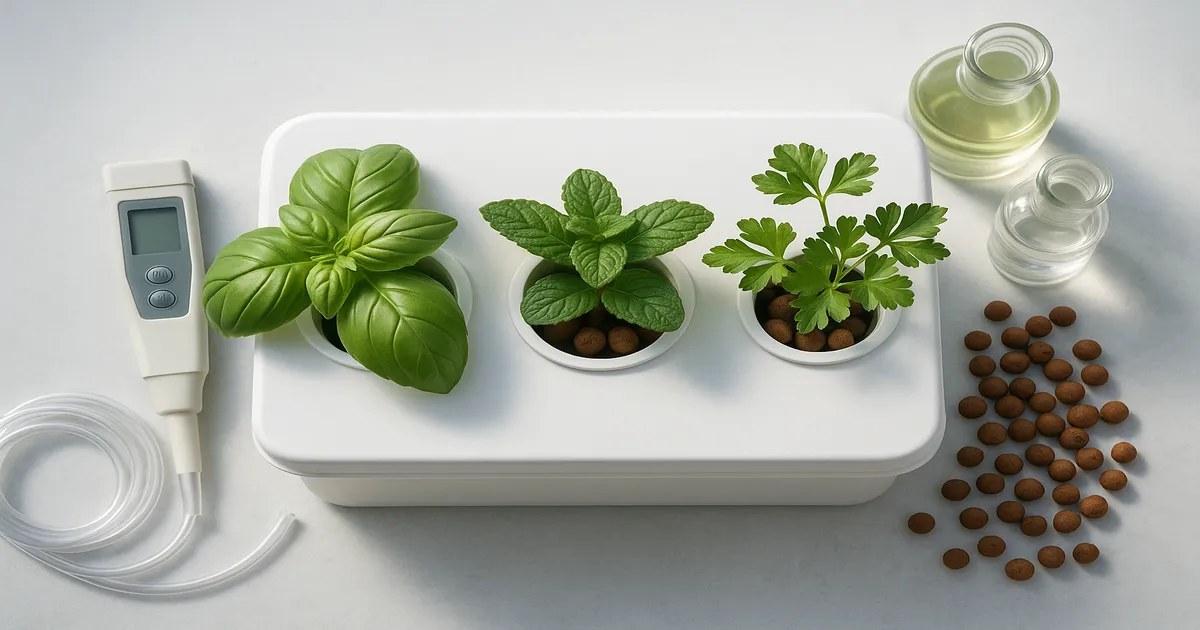
Quick Answer: Yes, you can absolutely grow herbs in hydroponics — and they’re one of the best crops to start with. Herbs have shallow roots, low nutrient demands, and fast turnover times of 3–6 weeks, making them ideal for soil-free growing. Most hydroponic herbs grow 30–50% faster than their soil-grown counterparts and can be harvested year-round.
If you’ve ever wondered whether you can grow herbs in hydroponics, the short answer is a firm yes. Basil, mint, parsley, chives, cilantro, and dozens of other culinary herbs thrive in hydroponic systems, often outperforming soil-grown plants in both speed and consistency. Whether you’re setting up a small countertop garden or scaling up for a farmers market, herbs are one of the smartest crops to start with — and this guide covers everything you need to know.
Can You Grow Herbs in Hydroponics? (And Why They Excel)
Herbs are practically built for hydroponics. Their shallow root systems fit easily into net pots and channels, they don’t need the heavy nutrient loads that fruiting crops like tomatoes require, and fast growers like basil and mint can go from seedling to harvest in as little as three weeks.
They’re also forgiving. A beginner who slightly miscalculates their nutrient solution is far less likely to lose a crop of chives than a crop of peppers. That combination of speed, simplicity, and resilience makes herbs the go-to recommendation for anyone new to soil-free growing.
Hydroponic herbs typically grow 30–50% faster than the same plants in soil. Roots have direct, constant access to dissolved nutrients and oxygen, so the plant spends less energy searching for food and more energy producing leaves. Add year-round production — no seasons, no frost, no waiting — and the case for growing herbs in hydroponics is hard to argue with.
Best Hydroponic Systems for Growing Herbs
Kratky Method
The Kratky method is as simple as hydroponics gets. Suspend a plant in a net pot over a reservoir of nutrient solution, leave an air gap as roots grow, and top off occasionally. No pump, no electricity, no timer. It works beautifully for low-to-medium-light herbs like mint, chives, and parsley, and it’s the easiest possible entry point for beginners.
The main limitation is scalability — Kratky suits a few jars on a windowsill, not large harvests.
Deep Water Culture (DWC)
DWC suspends plant roots directly in an oxygenated nutrient solution, with an air pump and airstone keeping dissolved oxygen levels high. It’s a step up from Kratky in equipment but delivers noticeably faster growth, especially for basil and mint. Most home DWC setups cost $30–$80 to build and support 4–8 plants comfortably. A quality air pump like the Vivosun 317 GPH keeps oxygen levels consistent without breaking the bank.
Nutrient Film Technique (NFT)
NFT runs a thin film of nutrient solution continuously through angled channels, bathing roots while leaving most of the root zone exposed to air. It’s water-efficient, highly scalable, and the backbone of commercial herb production worldwide. The tradeoff: pump failures can kill plants quickly because there’s no reservoir buffer. Better suited to growers who can monitor their system daily.
Other Systems at a Glance
| System | Difficulty | Best For |
|---|---|---|
| Kratky | Very Easy | Beginners, low-maintenance herbs |
| DWC | Easy–Moderate | Fast growth, basil, mint |
| NFT | Moderate | Commercial production |
| Ebb & Flow | Moderate | Mixed herb gardens, flexibility |
| Aeroponics | Advanced | Maximum growth speed |
| Wick System | Very Easy | Desktop herbs, no electricity |
Ebb & Flow floods and drains a growing tray on a timer — flexible and forgiving, good for mixed plantings. Aeroponics mists roots directly and produces the fastest growth rates, but requires precise management and higher upfront cost. Wick systems use capillary action to draw nutrients to roots — zero electricity, but too slow for vigorous growers like basil.
For total beginners, all-in-one countertop systems like the AeroGarden Harvest are a genuinely excellent entry point. They handle lighting, water, and nutrient delivery in one compact unit.
Best Herbs to Grow in a Hydroponic System
Beginner-Friendly Herbs
These herbs are reliable, fast-growing, and forgiving of minor nutrient or pH swings:
- Basil — the classic hydroponic herb; thrives in DWC and Kratky, loves warmth and long light cycles
- Mint — grows aggressively; keep it in its own container to avoid crowding other plants
- Chives — low-maintenance, tolerates lower light, great for Kratky or wick systems
- Parsley — slow to germinate but steady once established; works in any system
- Lemon balm — low-light tolerant, minimal fuss, pleasant aroma
- Oregano — compact, adapts well to hydroponics despite its drought-tolerant roots
Herbs That Need Special Attention
Cilantro is the trickiest on this list. It’s a long-day plant, meaning extended light exposure triggers bolting (flowering and going to seed). Keep your photoperiod at 12–14 hours and temperatures cool — below 75°F (24°C) if possible — to extend the vegetative phase.
Rosemary and thyme are Mediterranean herbs that prefer higher light intensity (400–600 µmol/m²/s), slightly lower moisture at the roots, and good airflow. They’ll grow in hydroponics, but they’re slower than basil and less tolerant of waterlogged roots. Make sure your system provides strong oxygen delivery to the root zone — DWC with a well-sized airstone is a better choice than Kratky for these two.
Nutrient Requirements for Hydroponic Herbs
pH Range
Most culinary herbs thrive at pH 5.8–6.2, within the broader acceptable range of pH 5.5–6.5. Basil prefers the lower end (5.5–6.2), while mint tolerates slightly higher readings up to pH 6.5. Staying within the 5.8–6.2 window keeps all major nutrients soluble and available.
EC and PPM Targets by Growth Stage
| Growth Stage | PPM (500 scale) | EC |
|---|---|---|
| Seedling / Clone | 400–600 PPM | 0.8–1.2 |
| Vegetative (young herb) | 600–900 PPM | 1.2–1.8 |
| Mature / Harvest-ready | 800–1,200 PPM | 1.6–2.4 |
Start low and increase gradually. Overfeeding is one of the most common beginner mistakes — herbs are light feeders and will show tip burn or nutrient lockout well before fruiting crops would. Note that the PPM values above use the 500 scale (1.0 EC = 500 PPM); confirm which scale your meter uses before comparing readings.
Macronutrients
For leafy herbs, aim for an N-P-K ratio of approximately 3:1:2 — nitrogen-heavy to drive vegetative growth and chlorophyll production. Slightly elevated potassium improves aromatic intensity in basil, rosemary, and thyme by supporting essential oil synthesis.
- Calcium: Target 150–200 PPM. Deficiency causes tip burn in basil and mint.
- Magnesium: Target 30–50 PPM. The central atom of chlorophyll; deficiency shows as interveinal yellowing.
- Sulfur: Supports essential oil production — particularly important for chives and other allium-family herbs.
Micronutrients
- Iron (Fe): 2–5 PPM; use chelated iron (Fe-EDTA or Fe-DTPA) — the most commonly deficient micro in hydroponics
- Manganese (Mn): 0.5–1.0 PPM
- Zinc (Zn): 0.05–0.1 PPM
- Boron (B): 0.1–0.5 PPM
- Copper (Cu): Keep below 0.1 PPM — toxicity is possible at higher levels
- Molybdenum (Mo): 0.01–0.05 PPM
Recommended Nutrient Solutions
General Hydroponics Flora Series (3-part, beginner-friendly): At full vegetative rate — 5 mL/gal FloraMicro + 5 mL/gal FloraGro + 2 mL/gal FloraBloom — you’ll hit approximately 800–1,000 PPM (1.6–2.0 EC).
General Hydroponics MaxiGro (single dry concentrate): 7g per gallon yields around 800–900 PPM (1.6–1.8 EC). Great for growers who want simplicity without sacrificing quality.
MasterBlend 4-18-38 (3-part dry): 2.4g MasterBlend + 2.4g Calcium Nitrate + 1.2g Epsom Salt per gallon targets 800–1,000 PPM (1.6–2.0 EC). Popular with serious hobbyists for its precision and low cost per gallon.
Key mixing rules:
- Always add calcium nitrate to water before other nutrients to prevent precipitation
- Never mix concentrated calcium and sulfate/phosphate solutions directly
- Use reverse osmosis or filtered water — tap water above 200 PPM baseline will skew your targets
Lighting for Hydroponic Herbs
PPFD and DLI Targets
| Herb Type | PPFD Target | DLI Target |
|---|---|---|
| Low-light (mint, chervil, lemon balm) | 150–250 µmol/m²/s | 8–12 mol/m²/day |
| Medium-light (basil, parsley, cilantro) | 250–400 µmol/m²/s | 12–18 mol/m²/day |
| High-light (rosemary, thyme, oregano) | 400–600 µmol/m²/s | 18–25 mol/m²/day |
DLI (Daily Light Integral) is the total light dose your plants receive per day. Calculate it with: DLI = PPFD × hours × 0.0036. For example, 300 µmol/m²/s over 16 hours = 17.3 mol/m²/day — right in the sweet spot for most culinary herbs.
Most herbs do best at 16–18 hours of light and 6–8 hours of darkness. The dark period matters; plants use it for respiration and metabolic processes, and skipping it entirely can cause leaf curl and stress. Cilantro is the exception — keep it at 12–14 hours to delay bolting.
Spectrum
Full-spectrum white LEDs at 3,500–5,000K cover everything most home herb growers need. Blue light (400–500 nm) keeps growth compact and bushy; red light (620–700 nm) drives photosynthesis and leaf expansion. UV-A (315–400 nm) is worth seeking out if flavour is a priority — it stimulates essential oil and flavonoid production in basil, mint, and thyme.
Recommended Grow Lights
- Spider Farmer SF-1000 (100W) — Samsung LM301B diodes, efficient and reliable, covers a 2×2 ft area
- HLG 100 V2 Rspec (95W) — premium light quality, worth the price step up for serious growers
Hang lights 24–36 inches above seedlings and 12–24 inches above mature herbs, adjusting based on any signs of light stress.
Getting Started: Equipment and Setup
What You Need
- Reservoir or system (DWC bucket, NFT channel, Kratky container)
- 2-inch net pots for herbs
- Growing medium: rockwool cubes for seedlings, clay pebbles or perlite for established plants
- Pre-mixed nutrient solution
- Digital pH and EC meters — the Apera PC60 reads both in one unit and is well worth the investment
- pH Up and pH Down solutions
- LED grow light appropriate for your space
- Air pump and airstone (for DWC)
Keep your growing environment between 65–80°F (18–27°C) with relative humidity around 50–70%. Good airflow strengthens stems and reduces fungal pressure.
Seed vs. Cuttings
Starting from seed gives you more variety options and costs less, but germination adds 1–2 weeks to your timeline. Rockwool starter cubes work well — pre-soak them in pH 5.5 water before use. Cuttings (clones) skip the germination stage entirely and are the faster route if you already have a mother plant. Mint, basil, and lemon balm all root readily in water or a small DWC clone bucket before being transferred to your main system.
pH Management
A reliable digital pH meter is non-negotiable. Calibrate with pH 4.0 and 7.0 buffer solutions every 1–2 weeks, and store the probe in storage solution — not plain water. Liquid test kits work in a pinch but aren’t accurate enough for dialing in a system.
- To raise pH: Use pH Up (potassium hydroxide-based). Add 0.5–1 mL at a time to a 5-gallon reservoir, stir, wait 15 minutes, then recheck.
- To lower pH: Use pH Down (phosphoric acid-based). Add in small increments — overshooting and chasing pH back and forth stresses plants.
Target pH 6.0 as your adjustment midpoint. This gives you drift room in both directions before leaving the optimal range. Upward drift is common when plants consume nitrate nitrogen; downward drift is caused by ammonium uptake and root exudates. Larger reservoirs (10+ gallons) are inherently more stable than small ones.
Frequently Asked Questions
Can you grow herbs in hydroponics without a pump? Yes. The Kratky method requires no pump, no electricity, and no timer. It’s ideal for low-to-medium-demand herbs like mint, chives, parsley, and lemon balm. Basil can work in Kratky too, though it grows faster in an aerated DWC setup.
How long does it take to grow herbs hydroponically? Fast growers like basil and mint can be harvest-ready in 3–4 weeks from transplant. Parsley takes 6–8 weeks. Rosemary and thyme are the slowest, often taking 10–12 weeks to reach a useful size, though they can be harvested lightly before that.
What is the easiest herb to grow hydroponically? Mint is arguably the easiest — it grows aggressively, tolerates a wide pH range (6.0–7.0), and thrives in low-tech systems like Kratky. Basil is a close second and is the most popular hydroponic herb overall.
Do hydroponic herbs taste as good as soil-grown herbs? Often better. Controlled nutrient delivery and the option to add UV-A light can increase essential oil concentration, making hydroponic basil, mint, and thyme noticeably more aromatic than supermarket equivalents. Slightly stressing plants by reducing nutrients in the final week before harvest also intensifies flavour.
Can you grow herbs in hydroponics and sell them profitably? Yes. Culinary herbs offer some of the highest value per square foot of any hydroponic crop. Basil, chives, and specialty herbs like chervil and lemon balm command strong prices at farmers markets and through direct restaurant sales. For small-scale commercial growers, herbs are usually the first crop worth prioritising.