Quick Answer: The best grow lights for indoor hydroponics in 2025 are full-spectrum LED quantum boards — specifically the Spider Farmer SF-1000 (budget), HLG 200 Rspec (mid-range), and HLG 650R (commercial). Match your fixture to your crop’s PPFD target, measure light intensity with a PAR meter, and prioritize efficacy ratings above 2.5 µmol/J to keep energy costs in check.
Choosing the best grow lights for indoor hydroponics is the single most consequential equipment decision you’ll make. Unlike soil growing, where a nutrient-rich substrate can partially compensate for weak light, hydroponic plants have no such buffer — photosynthesis depends entirely on what you provide. Get it right, and your plants grow faster than they ever would outdoors. Get it wrong, and no amount of perfectly balanced nutrient solution will save them.
Best Grow Lights for Indoor Hydroponics: Top Picks at a Glance
| Tier | Fixture | Wattage | Efficacy | Coverage | Best For |
|---|---|---|---|---|---|
| Budget ($50–$200) | Spider Farmer SF-1000 | 100W | 2.7 µmol/J | 2×2–3×3 ft | Seedlings, leafy greens, small DWC |
| Budget ($50–$200) | Mars Hydro TS-1000 | 150W | 2.35 µmol/J | 2×2–3×3 ft | Herbs, lettuce, Kratky setups |
| Mid-Range ($200–$600) | HLG 200 Rspec | 200W | 2.8 µmol/J | 3×3–4×4 ft | Fruiting crops, NFT, DWC |
| Mid-Range ($200–$600) | Mars Hydro FC-E3000 | 300W | 2.8 µmol/J | 4×4 ft | Tomatoes, peppers, cannabis veg |
| Premium ($600+) | HLG 650R | 650W | 3.0+ µmol/J | 5×5 ft | Commercial yields, high-PPFD crops |
The grow light market has shifted decisively toward LED. Modern quantum board fixtures deliver 2.5–3.5 µmol/J — more than double what HPS achieves — with far less heat and a lifespan measured in decades. For most hydroponic growers, the question is no longer whether to choose LED, but which LED.
Understanding Grow Light Science: PAR, PPFD, DLI, and Efficacy
Before you buy anything, you need to understand four core metrics. They govern every grow light decision worth making.
PAR, PPFD, and DLI Explained
PAR (Photosynthetically Active Radiation) is the 400–700 nm slice of the spectrum that plants use for photosynthesis. Lumens and lux measure brightness as the human eye perceives it — plants don’t care about that. PAR is what feeds them.
PPFD (Photosynthetic Photon Flux Density) measures how many PAR photons land on your canopy each second, expressed in µmol/m²/s. Think of it as the flow rate of useful light. Lettuce grows well at 200–250 µmol/m²/s; cannabis in full flower wants 800–1,200 µmol/m²/s or more.
DLI (Daily Light Integral) is the total PAR dose your plants receive over a full day, measured in mol/m²/day. It ties intensity and photoperiod together:
DLI = PPFD × hours × 0.0036
A lettuce setup running at 200 µmol/m²/s for 16 hours delivers: 200 × 16 × 0.0036 = 11.5 mol/m²/day — right in the sweet spot for leafy greens. DLI is the most actionable number for dialing in crop-specific light recipes because it lets you trade intensity for time, or vice versa.
Efficacy (µmol/J) tells you how efficiently a fixture converts electricity into plant-usable light. Premium LEDs hit 2.5–3.5 µmol/J. HPS sits at 1.0–1.7 µmol/J. That gap shows up directly on your electricity bill — and in your yield per watt.
Grow Light Technologies Compared: LED, HPS, CMH, and Fluorescent
LED Grow Lights
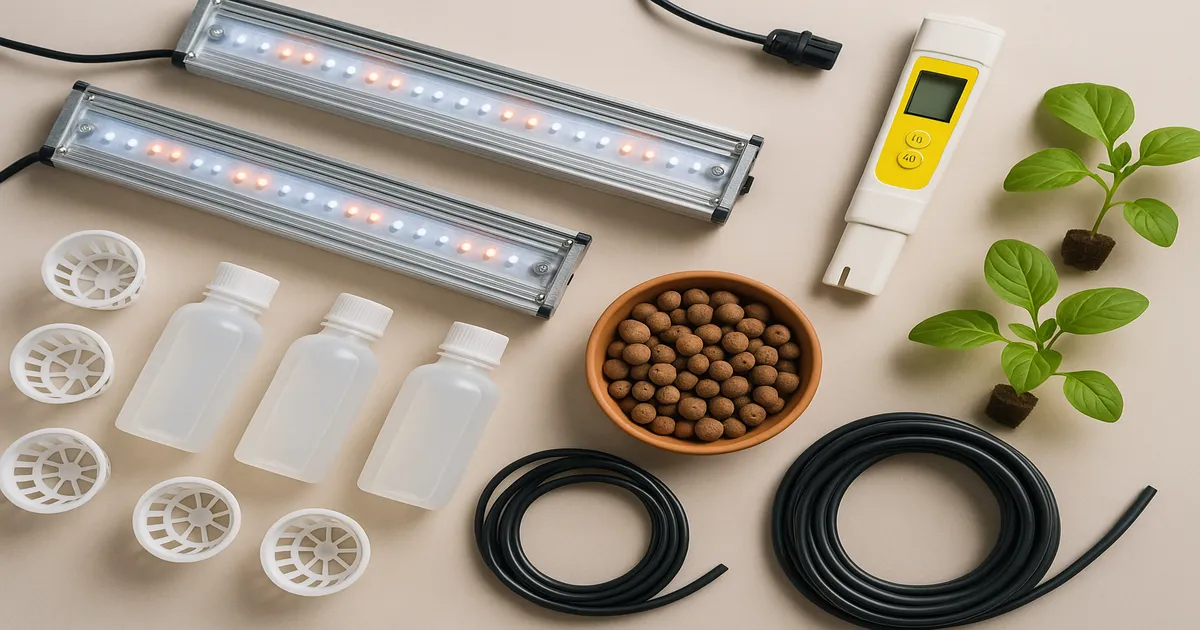
The quantum board LED revolution, pioneered by Horticulture Lighting Group around 2017, brought commercial-grade efficacy to hobbyist price points. Samsung LM301H and LM301B diodes are now the industry benchmark — you’ll find them in nearly every quality fixture under $600. LEDs run cooler, last 50,000–100,000 hours, and give you precise spectrum control that older technologies can’t match.
HPS and HID Lights
High-Pressure Sodium isn’t dead. Large commercial operations with existing ballast infrastructure still run it profitably. But for anyone starting fresh, the math doesn’t favor HPS. Higher heat output means more HVAC cost, shorter bulb life (10,000–24,000 hours) means recurring replacement expense, and the fixed spectrum locks you into a compromise. HPS makes sense if you already own the equipment; it rarely makes sense to buy new.
CMH / LEC Lights
Ceramic Metal Halide offers a broader, more natural spectrum than HPS and better efficacy than standard metal halide. A 315W CMH is a legitimate option for a 3×3 to 4×4 ft space, particularly for growers who want some UV output without a separate supplement. The downside: more heat than LED, a shorter lifespan, and efficacy that tops out around 1.9–2.1 µmol/J.
T5 Fluorescent and CFL
These are low-intensity, low-heat options that excel in propagation. They’re forgiving for cuttings and seedlings that can’t handle high PPFD. Beyond that narrow use case, their efficacy (1.0–1.5 µmol/J) and limited canopy penetration make them a poor choice for mature plants.
Technology Comparison Table
| Technology | Efficacy (µmol/J) | Lifespan (hrs) | Heat Output | Best Application |
|---|---|---|---|---|
| LED (quantum board) | 2.0–3.5 | 50,000–100,000 | Low | All hydroponic grows |
| HPS | 1.0–1.7 | 10,000–24,000 | Very High | Large commercial (existing setup) |
| CMH/LEC | 1.9–2.1 | 20,000 | Moderate | 3×3–4×4 ft mixed grows |
| T5 Fluorescent | 1.0–1.5 | 20,000–30,000 | Low | Seedlings and clones |
| CFL | 0.9–1.3 | 8,000–15,000 | Low | Propagation only |
Light Spectrum: Matching Wavelengths to Your Crops
Blue light (400–500 nm) drives chlorophyll synthesis, stomatal regulation, and tight internodal spacing. Plants under blue-dominant light stay compact — exactly what you want during vegetative growth. Seedlings and leafy greens benefit from higher blue ratios, typically from fixtures in the 5000–6500K range.
Red light (600–700 nm) is the most efficient wavelength for photosynthesis, with a peak at 660 nm. It accelerates flowering and fruiting. Most full-spectrum LEDs are red-heavy by design, and dedicated 660 nm diodes appear in nearly every quality bloom-oriented fixture.
Green light (500–600 nm) was once dismissed as useless — plants reflect it, so the thinking went. That’s wrong. Green penetrates deeper into the canopy than blue or red, driving photosynthesis in lower leaves that would otherwise be shaded. Full-spectrum white LEDs outperform narrow-band red/blue “blurple” fixtures in practice, partly for this reason.
Far-red (700–750 nm) triggers phytochrome signaling that accelerates flowering. When combined with red light, it also triggers the Emerson Enhancement Effect — a measurable boost in photosynthetic efficiency beyond what either wavelength achieves alone. Many premium fixtures (HLG Rspec line, Spider Farmer SE series) include dedicated far-red diodes for this reason.
UV (280–400 nm) stresses plants in a controlled, beneficial way — triggering terpenes, flavonoids, and anthocyanins as a protective response. Cannabis growers use UV finishing protocols in the final two weeks of flower to increase resin production. It’s not essential for most crops, but it’s a meaningful upgrade for the right applications.
PPFD and DLI Targets by Crop
Leafy Greens and Microgreens
Lettuce and spinach thrive at 200–250 µmol/m²/s, targeting a DLI of 12–17 mol/m²/day over a 16–18 hour photoperiod. Maintain nutrient solution pH between 5.5 and 6.5, with an EC of 0.8–1.6 mS/cm for most leafy varieties. Microgreens are even lower — 100–200 µmol/m²/s for 12–16 hours. Entry-level LEDs handle these crops easily.
Herbs and Strawberries
Basil, cilantro, and most culinary herbs want 200–400 µmol/m²/s and a DLI of 15–25 mol/m²/day. Keep pH at 5.5–6.5 and EC at 1.0–1.6 mS/cm. Strawberries in fruiting mode sit in a similar light range, though they’re photoperiod-sensitive — they need 12 hours of uninterrupted darkness to flower reliably. A mid-range LED covers this tier comfortably.
Tomatoes, Cucumbers, and Peppers
This is where you need real power. Tomatoes in vegetative growth need 400–600 µmol/m²/s; fruiting tomatoes push to 600–1,000 µmol/m²/s with a DLI of 30–45 mol/m²/day. Target pH 5.8–6.3 and EC 2.0–4.0 mS/cm for fruiting tomatoes. Cucumbers sit in a similar light range at 500–800 µmol/m²/s. These crops are day-neutral — they respond primarily to DLI rather than photoperiod, so longer days at moderate PPFD often outperform shorter days at maximum intensity.
Cannabis and High-Light Specialty Crops
Cannabis in flower is the most light-hungry crop most home growers will encounter: 800–1,200+ µmol/m²/s and a DLI of 40–65 mol/m²/day on a strict 12/12 photoperiod. Maintain pH at 5.5–6.1 in hydro and EC at 1.2–2.4 mS/cm depending on growth stage. At these intensities, CO₂ supplementation (raising ambient CO₂ to 1,000–1,500 ppm) unlocks additional photosynthetic capacity that would otherwise go to waste.
Photoperiod Quick Reference
- Long-day plants (lettuce, spinach, most herbs): 16–18 hours of light; some growers push to 20/4 for maximum growth rate
- Short-day plants (cannabis, strawberries): 12 hours or fewer of uninterrupted darkness to trigger flowering — even a brief light leak can disrupt the cycle
- Day-neutral plants (tomatoes, cucumbers, peppers): DLI-driven; 16–18 hour days at moderate PPFD typically produce the best results
A quality digital timer and a light-proof grow tent are essential for photoperiod-sensitive crops. Light leaks are a silent killer in these grows.
Best Grow Lights for Indoor Hydroponics: Reviews by Budget
Budget Tier ($50–$200)
Spider Farmer SF-1000 (~$110)
- 100W | Samsung LM301B diodes | 2.7 µmol/J
- Covers 2×2 ft at flowering intensity; 3×3 ft for vegetative growth and leafy greens
- Pros: Outstanding efficacy for the price, runs cool, dimmable
- Cons: No UV/IR diodes; limited coverage for larger setups
- Best for: Small DWC, Kratky lettuce, seedling propagation
Mars Hydro TS-1000 (~$100)
- 150W | Full-spectrum | 2.35 µmol/J
- Covers 2×2 to 3×3 ft
- Pros: Affordable, good uniformity, widely available
- Cons: Lower efficacy than SF-1000; no dimmer on base model
- Best for: Herbs, leafy greens, Kratky and small ebb-and-flow systems
AC Infinity IONBOARD S22 (~$130)
- 100W | Samsung LM301H diodes | 2.6 µmol/J
- Integrates with AC Infinity’s controller ecosystem for automated scheduling
- Best for: Growers already using AC Infinity fans and controllers who want a unified smart setup
Mid-Range Tier ($200–$600)
HLG 200 Rspec (~$350)
- 200W | Samsung LM301H + 660 nm + far-red diodes | 2.8 µmol/J
- Covers 4×4 ft vegetative; 3×3 ft at flowering intensity
- Pros: Best-in-class build quality, excellent spectrum for fruiting crops, dimmable
- Cons: Premium price for the wattage; no UV
- Best for: DWC tomatoes, peppers, cannabis vegetative
Mars Hydro FC-E3000 (~$280)
- 300W | Foldable quantum board | 2.8 µmol/J
- Strong canopy penetration; covers 4×4 ft
- Pros: Exceptional value at this efficacy level; foldable for easy transport
- Cons: Slightly less refined build than HLG
- Best for: NFT systems, 4×4 ft DWC setups, tomatoes and cucumbers
Spider Farmer SE-5000 (~$450)
- 500W | Full-spectrum with UV/IR | 2.9 µmol/J
- Covers 4×4 to 5×5 ft
- Best for: Serious home growers wanting UV capability without going full commercial
Premium and Commercial Tier ($600+)
HLG 650R (~$1,100)
- 650W | 3.0+ µmol/J | Covers 5×5 ft at full flowering intensity
- The benchmark for serious home and small commercial grows; built to run 24/7 for years
- Best for: High-PPFD crops (cannabis, tomatoes), aeroponic systems, commercial DWC
At this tier, Fluence (SPYDR series) and Gavita (1700e LED) are also worth considering for large-scale operations. These are purpose-built for professional environments — with matching price tags.
Best Grow Lights by Hydroponic System
| System | Recommended Fixture | Why |
|---|---|---|
| Deep Water Culture (DWC) | HLG 200 Rspec or HLG 650R | High PPFD uniformity; dimmable for seedling stage |
| Nutrient Film Technique (NFT) | Mars Hydro FC-E3000 | Wide, even coverage across long channels |
| Kratky / Passive DWC | Spider Farmer SF-1000 | Low heat, low wattage — ideal for sealed containers |
| Ebb and Flow | Spider Farmer SE-5000 | Covers larger trays; UV/IR for fruiting crops |
| Aeroponics | HLG 650R | Matches the high-PPFD potential of aeroponic root zones |
How to Measure and Map Your Grow Light Coverage
A dedicated quantum PAR meter gives you accurate PPFD readings at canopy level. Take measurements in a grid — center, corners, and midpoints — to identify hot spots and dead zones. Adjust hanging height until the canopy average hits your target PPFD for the crop.
Free smartphone apps like Photone can approximate PAR using the phone’s light sensor. They’re useful for ballpark checks, but accuracy varies enough that they shouldn’t replace a dedicated meter for precision dialing.
FAQ: Best Grow Lights for Indoor Hydroponics
How many watts do I need per square foot for hydroponics? A useful starting point is 30–50W of true LED power per square foot for fruiting crops, and 20–30W for leafy greens. That said, wattage alone is a poor proxy — efficacy (µmol/J) and PPFD at canopy level are far more meaningful numbers. A 100W fixture at 2.7 µmol/J outperforms a 150W fixture at 1.8 µmol/J.
Can I use regular LED bulbs for hydroponics? No. Standard household LEDs are optimized for human vision, not plant photosynthesis. They lack the red and blue wavelengths plants need most, and their output is far too low for anything beyond very early seedling stages. Purpose-built grow lights are not optional.
How far should my grow light be from the canopy? It depends on the fixture’s intensity and your crop’s PPFD target. As a general guide: budget LEDs (100–150W) typically hang 18–24 inches above the canopy; high-power fixtures (300W+) may need 24–36 inches to avoid light burn. Always verify with a PAR meter rather than relying on manufacturer charts alone.
Do I need a separate light for seedlings and mature plants? Not necessarily. Most dimmable quantum board LEDs can be dialed back to 20–30% power for seedlings and clones, then ramped up as plants mature. If your main fixture isn’t dimmable, a cheap T5 or CFL propagation light is a cost-effective alternative for the early stage.
What’s the difference between the HLG Rspec and the standard HLG lineup? The Rspec (“red spectrum”) versions add dedicated 660 nm deep-red and far-red diodes to the standard Samsung white diode array. This enhances the Emerson Enhancement Effect and makes them particularly well-suited for flowering and fruiting crops. The standard lineup is excellent for vegetative growth; the Rspec is the better choice if you’re running a crop through its full cycle.