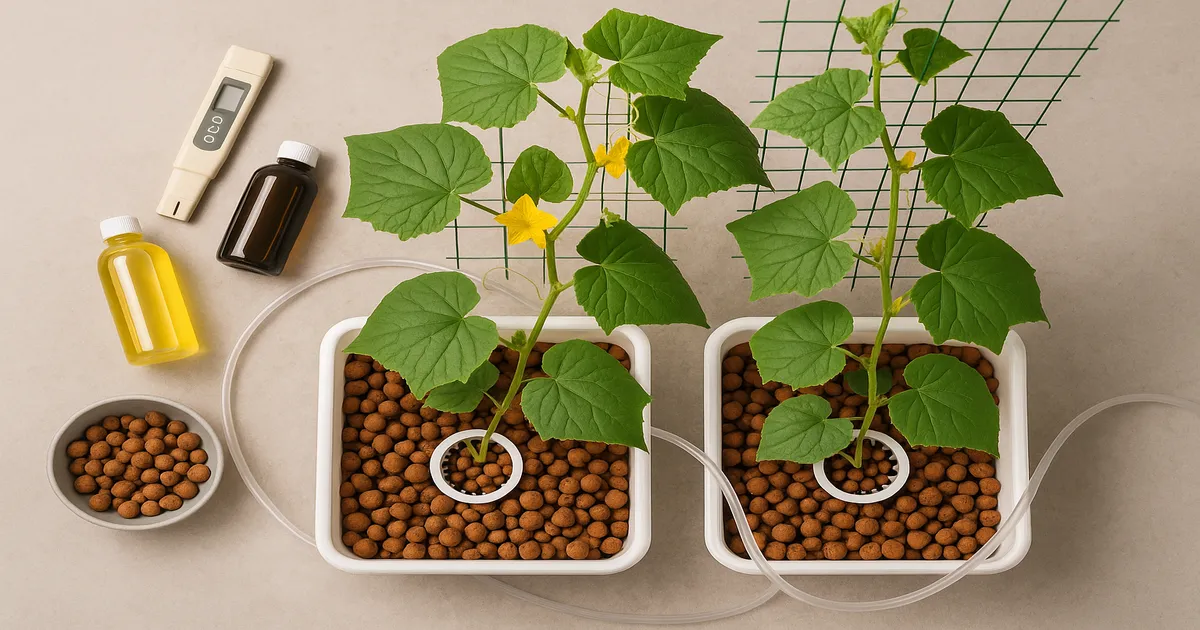
Quick Answer: Learning how to grow cucumbers indoors hydroponically is a moderate-difficulty project that rewards you with year-round harvests in just 50–70 days from seed. You’ll need a DWC or Dutch Bucket system, parthenocarpic (self-pollinating) varieties, pH held at 5.8–6.2, and 16–18 hours of full-spectrum light daily. Nail those four things and cucumbers become one of the most productive crops you can grow under artificial lights.
Learning how to grow cucumbers indoors hydroponically means fresh cucumbers every month of the year, regardless of what’s happening outside. Cucumbers are heavy feeders and vigorous vines — more demanding than lettuce, but far more forgiving than tomatoes, and the payoff is substantial. This guide covers everything from system selection and variety choice to nutrient recipes, lighting, and day-to-day plant care.
How to Grow Cucumbers Indoors Hydroponically: What to Expect
At a Glance
- Time to first harvest: 50–70 days from seed, depending on variety
- Difficulty: Moderate — more involved than leafy greens, manageable for beginners willing to monitor pH and EC regularly
- Yield potential: Multiple fruits per plant per week at peak production, year-round
- Space needed: Plants reach 6–10 feet tall indoors — vertical trellising is non-negotiable
Key Requirements Summary
| Factor | Target |
|---|---|
| System | DWC or Dutch Bucket (best); NFT, drip, or ebb & flow (solid alternatives) |
| Varieties | Parthenocarpic only (Picolino, Socrates, Diva, Beit Alpha) |
| pH | 5.8–6.2 (sweet spot: 6.0) |
| EC / PPM | 800–1,200 PPM (1.6–2.4 EC) veg; up to 2,000 PPM (4.0 EC) at peak fruiting |
| Light | 16–18 hours/day, full-spectrum LED, 600–1,000 PPFD vegetative / 800–1,200 PPFD fruiting |
| Temperature | 70–85°F (21–29°C) day; no lower than 60°F (16°C) night |
Choosing the Right Hydroponic System for Cucumbers
Deep Water Culture (DWC): Best for Beginners
DWC suspends plant roots directly in an oxygenated nutrient solution. It’s the simplest system to build or buy, and cucumbers thrive in it — constant access to dissolved oxygen and nutrients drives explosive growth. A 5-gallon DWC bucket per plant is the standard starting point. Pair it with a quality air pump to keep dissolved oxygen high; cucumbers are sensitive to oxygen-deprived roots. A dual-outlet pump like the Vivosun Air Pump handles two buckets comfortably and keeps roots healthy through the heavy-fruiting stage.
Dutch Bucket (Bato Bucket): The Commercial Standard
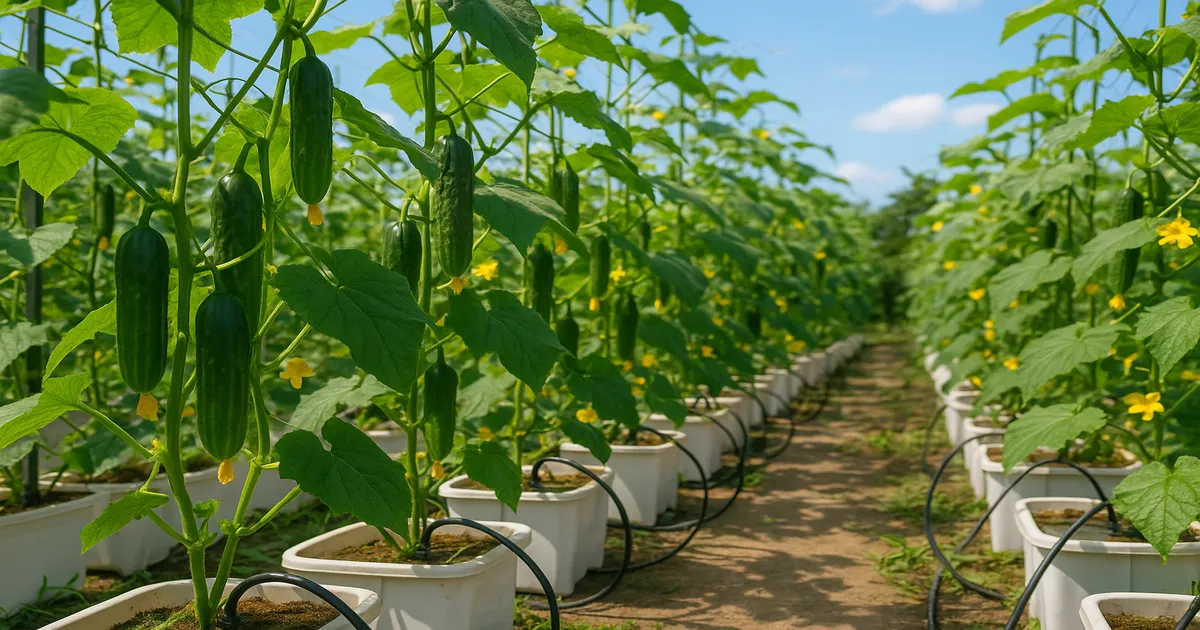
Dutch Bucket systems are what commercial greenhouse operations worldwide use for cucumbers. Each plant sits in its own bucket filled with perlite or coco coir, fed by a drip emitter, with excess solution draining back to a central reservoir. This setup handles the heavy water and nutrient demands of fruiting cucumbers exceptionally well and scales easily from 2 plants to 20. It’s the best choice if you want serious yields and room to expand.
NFT, Ebb & Flow, and Drip Systems: Viable Alternatives
All three work well for cucumbers, each with trade-offs:
- NFT: Efficient water use and great for multiple plants in a row, but the shallow nutrient film can struggle to keep pace with the dense root mass of a heavily fruiting cucumber plant
- Ebb & Flow: Versatile and forgiving; works with any grow media; a good fit for larger setups where you want flexibility
- Drip systems: Highly scalable and commonly paired with coco coir or perlite; delivers Dutch Bucket-style results without the bucket hardware
Systems to Approach with Caution
Kratky (passive, no pump) can technically work for cucumbers, but plants drink so heavily during fruiting that you’ll be topping off the reservoir almost daily — it’s more maintenance than it sounds. Aeroponics produces the fastest growth but is expensive, technically complex, and unforgiving when equipment fails. Neither is recommended for beginners growing cucumbers specifically.
Quick recommendation:
- New grower, small space → DWC
- Intermediate grower, want to scale → Dutch Bucket or drip
- Experienced grower, efficiency-focused → NFT or ebb & flow
Best Cucumber Varieties for Indoor Hydroponic Growing
Why Parthenocarpic Varieties Are Essential
Standard cucumber varieties need pollination to set fruit. Outdoors, bees handle this. Indoors, there are no bees — which means no fruit unless you hand-pollinate every day or choose varieties that don’t need it. Parthenocarpic cucumbers produce fruit without any pollination at all, making them the only practical choice for most indoor growers.
Top Varieties to Grow
| Variety | Type | Days to Harvest | Key Traits |
|---|---|---|---|
| Beit Alpha | Mini/Persian | 50–55 days | Extremely productive, compact, excellent flavor |
| Diva | Slicing | 58 days | Seedless, thin skin, no bitterness, AAS Award winner |
| Socrates | Mini/Snacking | 52 days | Prolific, disease resistant, ideal for DWC |
| Tyria | European Greenhouse | 60–65 days | Long English-style fruit, commercial standard |
| Corinto | European Greenhouse | 60 days | Excellent disease resistance, consistent yields |
| Picolino | Mini/Cocktail | 50–55 days | Very high yield, small fruits, great for beginners |
| Katrina | Snacking | 55 days | All-female flowers, very productive |
For beginners, Picolino and Socrates are the top picks — both are fast, forgiving, and outrageously productive in DWC.
A Note on Hand-Pollinating Open-Pollinated Varieties
Varieties like Marketmore 76 and Straight Eight can be grown indoors, but they require daily hand pollination. Use a small paintbrush to transfer pollen from a male flower (no swelling at the base) to the center of a female flower (small cucumber-shaped swelling behind the petals). It works, but it adds a daily task that parthenocarpic varieties eliminate entirely.
Setting Up Your Indoor Hydroponic Cucumber System
Space Planning and Trellising
Cucumbers are vines. Even compact varieties will reach 6 feet or more indoors, so plan your vertical space before you plant. In a grow tent, run paracord or trellis netting vertically from the top bars. In a spare room, install a horizontal support rod near the ceiling and drop lengths of soft garden twine for each plant to climb. Give each plant at least 2 square feet of floor space, but vertical real estate is what matters most.
Germinating and Transplanting Seedlings
- Soak rockwool starter cubes in pH 5.5 water for 30 minutes
- Push one seed per cube, about ½ inch deep, pointy end down
- Keep cubes at 75–85°F (24–29°C) in a humidity dome — germination takes 3–5 days
- Once seedlings have 2–3 true leaves and roots are visible at the cube’s base (7–14 days), transplant into your system
- Start nutrient solution at seedling strength: 400–600 PPM (0.8–1.2 EC)
Grow Media Options
- Rockwool: Excellent water retention and aeration; the industry standard for transplanting; works in any system
- Hydroton (clay pebbles): Great drainage and reusable; ideal for DWC net pots and ebb & flow
- Coco coir: Superb water retention and beneficial microbial environment; best for Dutch Bucket and drip systems
- Perlite: Lightweight, excellent drainage; often mixed with coco coir (70/30 perlite/coco is a popular Dutch Bucket blend)
Reservoir Sizing
The minimum is 1 gallon of solution per plant, but 2–3 gallons per plant is strongly preferred. A larger reservoir buffers against rapid pH swings and EC spikes — both common problems when a fruiting cucumber is drinking heavily. For a 4-plant DWC setup, aim for a 10–15 gallon reservoir.
Nutrient Management for Hydroponic Cucumbers
NPK Requirements by Growth Stage
During vegetative growth, cucumbers need high nitrogen to build their vines and leaves quickly. Once flowering begins, shift the balance: potassium demand spikes sharply during fruit development, driving fruit sizing, sugar content, and cell wall integrity. The ideal N-P-K ratio for fruiting cucumbers is approximately 3:1:4 — notably potassium-heavy compared to the vegetative stage.
Calcium and Magnesium
Calcium deficiency causes blossom end rot — the dark, sunken patch at the fruit’s tip. Don’t wait for symptoms. Maintain calcium at 150–200 PPM and magnesium at 50–75 PPM throughout the grow. Add a Cal-Mag supplement to your reservoir before your base nutrients, and if you’re using RO or very soft water, be especially diligent. Botanicare Cal-Mag Plus is a reliable option that mixes cleanly with most base nutrient lines.
Micronutrients to Watch
Iron is the most commonly deficient micronutrient in hydroponic cucumbers — it shows up as yellowing between the veins of new leaves (interveinal chlorosis). Use chelated iron (Fe-EDTA or Fe-DTPA) and maintain 2–4 PPM. Boron (0.3–0.5 PPM) is critical for cell wall formation and fruit development. Manganese, zinc, copper, and molybdenum are all needed in trace amounts and are typically covered by a complete nutrient formula.
Three Nutrient Solution Recipes
Option 1 — Three-Part Commercial Formula (Easiest) Use a complete 3-part line like the General Hydroponics Flora Series at 75–100% of the manufacturer’s schedule, shifting toward the bloom formula at flowering. Always add Cal-Mag at 5–10 mL/gallon first, before base nutrients.
Option 2 — Masterblend Two-Part Recipe (Best Value) Per gallon of water, in this order:
- Calcium Nitrate (15.5-0-0): 2.4 g/gallon — dissolve fully before adding anything else
- Masterblend 4-18-38: 2.4 g/gallon
- Magnesium Sulfate (Epsom salt): 1.2 g/gallon
This produces approximately 800–1,000 PPM (1.6–2.0 EC). Scale proportionally for the fruiting stage. Never mix concentrates directly together — always dissolve each in water separately. (Masterblend 4-18-38 Tomato Formula)
Option 3 — Single-Part Formula (Simplest) Products like Jack’s Hydro FeED offer one-scoop mixing. You lose some stage-specific control, but they’re perfectly adequate for beginners and produce consistent results.
EC and PPM Targets from Seedling to Harvest
| Growth Stage | PPM | EC |
|---|---|---|
| Seedling (0–2 weeks) | 400–600 | 0.8–1.2 |
| Early Vegetative (2–4 weeks) | 800–1,000 | 1.6–2.0 |
| Late Vegetative / Pre-flower | 1,000–1,400 | 2.0–2.8 |
| Flowering & Fruiting | 1,400–2,000 | 2.8–4.0 |
| Late Fruiting / Harvest | 1,200–1,600 | 2.4–3.2 |
Don’t exceed 2,200 PPM (4.4 EC) — beyond that point, osmotic stress and nutrient burn become real risks.
pH Management for Healthy Cucumber Growth
Optimal pH Range
The window of pH 5.8–6.2 keeps all essential nutrients in their most plant-available form. Drop below 5.5 and iron and manganese become toxic while calcium locks out. Rise above 6.8 and iron, manganese, and boron all become unavailable. Target 6.0 when mixing fresh solution — it gives you room to drift in either direction before hitting a problem zone.
How to Measure and Adjust pH
A quality digital pH meter is essential — test strips and cheap pens aren’t reliable enough for cucumbers. The Apera PC60 is an excellent all-in-one option that measures pH and EC simultaneously. Calibrate weekly using pH 4.0 and 7.0 buffer solutions.
When adjusting:
- pH Down (phosphoric acid): Add 1–2 mL per 5 gallons, stir, wait 15 minutes, retest. Repeat as needed.
- pH Up (potassium hydroxide): Same incremental approach. Potassium hydroxide is preferred over sodium hydroxide because it contributes beneficial K⁺ ions rather than sodium.
- Mix nutrients into water and wait 30–60 minutes before your final pH adjustment — some chemical reactions need time to stabilize.
Managing EC Fluctuations During Fruiting
During heavy fruiting, plants drink water faster than they consume nutrients — EC creeps upward. The fix is simple: top off the reservoir with plain pH-adjusted water, not fresh nutrient solution. If EC is falling, plants are eating nutrients faster than water — add a fresh nutrient mix. Check EC daily during fruiting; every 2–3 days during vegetative growth is sufficient.
Reservoir Change Schedule
- DWC: Full reservoir change every 7–10 days
- Recirculating systems (Dutch Bucket, drip): Every 14 days
- During peak fruiting, change more frequently — nutrient imbalances accumulate faster
- When changing, clean the reservoir, rinse roots gently if accessible, and start fresh at the appropriate stage EC
Troubleshooting Common pH and EC Problems
| Problem | Likely Cause | Fix |
|---|---|---|
| pH crashes rapidly (below 5.5) | Root rot, microbial activity | Clean reservoir; add beneficial bacteria such as Botanicare Hydroguard |
| pH rises steadily | Normal plant nutrient uptake | Routine pH Down adjustments; ensure adequate nitrogen |
| EC spikes without adding nutrients | High evaporation, hot environment | Top off with plain water; lower ambient temperature |
| EC drops too fast | Heavy fruiting, small reservoir | Increase reservoir volume; feed more frequently |
| pH swings wildly | Low buffering capacity (soft water) | Add Cal-Mag or calcium carbonate to baseline |
Lighting for Indoor Hydroponic Cucumbers
PPFD, DLI, and Why Both Matter
PPFD (µmol/m²/s) measures light intensity at a single point in time. DLI — Daily Light Integral — measures the total photons delivered over an entire day, and it’s the number that actually determines yield. Commercial cucumber operations target a DLI of 30–50 mol/m²/day. Home growers should aim for at least 25–30 during fruiting for meaningful harvests.
To calculate your DLI: DLI = PPFD × photoperiod hours × 3,600 ÷ 1,000,000
Light Spectrum
- Blue (400–500 nm): Drives compact vegetative growth and strong stems — prioritize during seedling and early veg stages
- Red (600–700 nm): The primary driver of photosynthesis, flowering, and fruit development
- Far-red (700–750 nm): Triggers the Emerson effect, enhancing fruit set when added in small amounts
- Full-spectrum white LEDs cover all of the above and are the practical choice for most home growers
Photoperiod
Cucumbers are day-neutral — they don’t need a specific photoperiod to flower. Run 16–18 hours of light and 6–8 hours of darkness daily. The dark period is not optional: cucumbers use it for respiration and recovery. Running lights 24/0 causes leaf curling, chlorosis, and reduced fruit set. Use a reliable timer and keep the schedule consistent.
Recommended LED Grow Lights
Budget (under $200):
- Mars Hydro TS-1000 (~$100): 150W draw, good coverage for 2–3 plants
- Spider Farmer SF-1000 (~$100): Samsung LM301B diodes, efficient and reliable for a 2×2 ft space
Mid-range ($200–$600):
- Spider Farmer SF-4000 (~$500): Covers a 4×4 ft area well, excellent for 4–6 plants
- Mars Hydro FC-E4800 (~$400): High-efficiency bar-style light, ideal for fruiting crops
High-end ($600+):
- Gavita Pro 1700e LED: The commercial standard; overkill for most home growers but delivers exceptional yields in a 4×4 or 5×5 ft space
Mount lights so the canopy receives 600–800 PPFD during vegetative growth and 800–1,200 PPFD during fruiting. Always check manufacturer PPFD maps at your specific hanging height — numbers vary significantly between models.
Ongoing Plant Care and Troubleshooting
Training and Pruning
As your cucumber vines grow, guide the main stem up your trellis or twine weekly. Pinch off lateral shoots (suckers) that emerge below the fourth or fifth node — this directs energy into the main stem and upper fruiting zone. Once the plant reaches the top of your trellis, you can either top it to encourage lateral branching or lower and lean the stem if your setup allows.
Remove yellowing lower leaves promptly. They don’t recover, and leaving them creates humid pockets that invite fungal disease.
Common Problems and Fixes
| Problem | Likely Cause | Fix |
|---|---|---|
| Yellow leaves (new growth) | Iron or manganese deficiency | Check pH; add chelated iron |
| Yellow leaves (old growth) | Nitrogen deficiency | Increase N; check EC |
| Blossom end rot | Calcium deficiency | Add Cal-Mag; check pH is not above 6.5 |
| Powdery mildew | Low airflow, high humidity | Improve circulation; reduce humidity below 60% |
| Bitter fruit | Heat stress or water stress | Maintain consistent temps; check EC isn’t too high |
| Flowers dropping, no fruit | Wrong variety (needs pollination) | Switch to parthenocarpic variety |
Frequently Asked Questions
How long does it take to grow cucumbers hydroponically indoors? Most parthenocarpic varieties reach first harvest in 50–60 days from transplant (roughly 65–75 days from seed). Once fruiting begins, you’ll be picking every 2–3 days at peak production.
Can I grow cucumbers in a small grow tent? Yes. A 4×4 ft tent comfortably fits 4 plants with proper vertical trellising. A 2×4 ft tent works for 2 plants. The limiting factor is height — choose a tent at least 6 feet tall, and 7–8 feet is better.
Do hydroponic cucumbers taste different from soil-grown ones? Hydroponic cucumbers are typically crisper, milder, and less bitter than field-grown varieties. The controlled environment and consistent nutrient delivery produce very uniform fruit. Many growers find the flavor superior, particularly with varieties like Diva or Picolino.
How often should I change the nutrient solution? Every 7–10 days for DWC systems; every 14 days for recirculating systems like Dutch Bucket or drip. During peak fruiting, lean toward the shorter interval — nutrient imbalances build up faster when plants are producing heavily.
What’s the biggest mistake beginners make growing hydroponic cucumbers? Neglecting pH. Cucumbers are sensitive to pH drift, and a reservoir that swings from 5.5 to 6.8 over a week will show nutrient deficiencies that look like a dozen different problems. Check pH daily during fruiting, invest in a reliable meter, and calibrate it weekly.