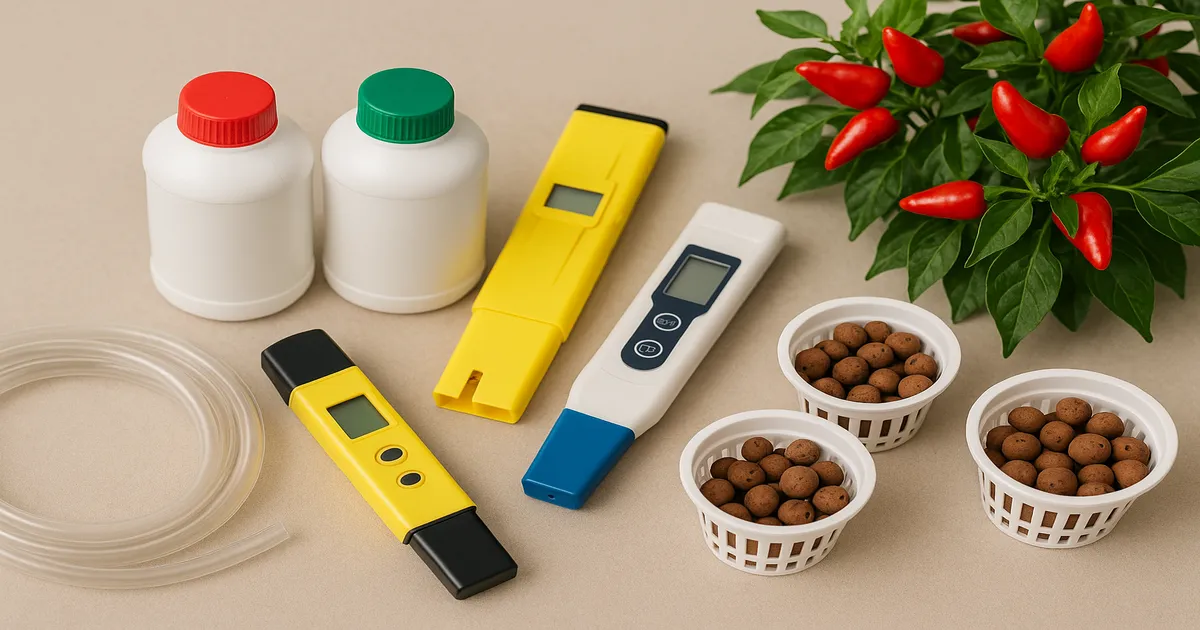
Quick Answer: Peppers need a stage-based nutrient strategy centered on high potassium during fruiting (200–300 PPM), consistent calcium throughout (150–200 PPM) to prevent blossom end rot, and a target pH of 5.8–6.3 in hydroponic systems. Run EC between 800–1,120 PPM (1.6–2.2 EC) during vegetative growth and push up to 1,400–1,960 PPM (2.8–3.9 EC) at peak fruiting.
If you’re serious about maximizing your harvest, choosing the right nutrients for growing peppers — and delivering them at the right time — is the single biggest lever you can pull. Peppers are heavy feeders that respond dramatically to optimized nutrition, rewarding you with bigger fruits, thicker walls, and in hot varieties, serious heat. Get the nutrition wrong and you’ll face blossom end rot, flower drop, and disappointing yields. Get it right and you’ll wonder why you ever grew anything else.
What Nutrients Do Peppers Need?
The Short Version for Experienced Growers
Peppers follow a clear two-phase nutritional strategy: nitrogen-dominant in vegetative growth, potassium-dominant at fruiting. The target N:P:K ratio shifts from roughly 3:1:3 vegetatively to 3:1:4 during fruiting. Calcium stays high throughout at 150–200 PPM — non-negotiable. Keep pH between 5.8–6.3 in hydroponics, and dial EC from 560 PPM (1.1 EC) at seedling stage up to 1,960 PPM (3.9 EC) at late fruiting.
Why Pepper Nutrition Is Different From Other Crops
Unlike lettuce or herbs that finish in weeks, peppers can produce for years under indoor conditions. That long lifespan means you need a long-term nutrient strategy, not a one-size-fits-all formula. Peppers also have an unusually high calcium demand and are extremely sensitive to pH drift — problems that don’t bite you as hard with most other crops.
Compared to tomatoes, peppers are slightly more forgiving of general nutrient imbalances but far more sensitive to blossom end rot when calcium uptake is disrupted. In soil, the buffering capacity buys you time to correct mistakes. In hydroponics, problems show up fast — which is actually a feature, not a bug, once you know what to look for.
Choosing the Right Growing System
Deep Water Culture (DWC)
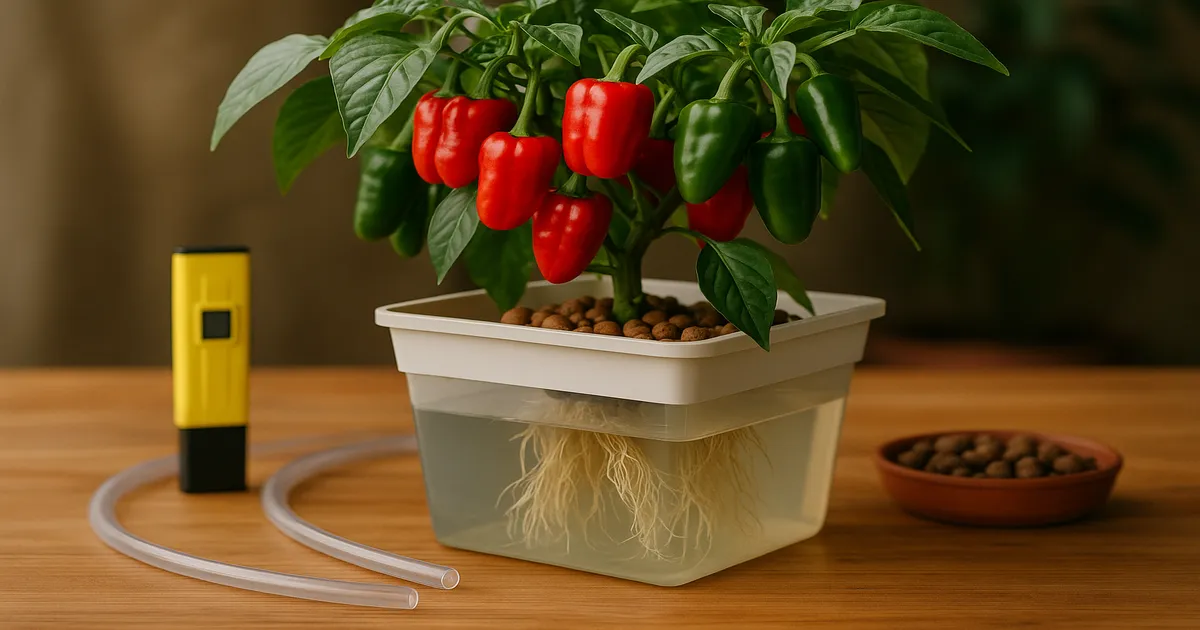
DWC gives pepper roots constant access to an oxygen-rich nutrient solution, which drives fast vegetative growth. The trade-off is that pH and EC can swing quickly in a single reservoir, so daily monitoring is essential. DWC works best with a well-dialed nutrient formula and a reliable air pump to keep dissolved oxygen high.
Dutch Bucket Systems: The Commercial Standard
Dutch Bucket (Bato Bucket) systems are the commercial standard for pepper production worldwide. Each bucket holds an individual plant in a substrate like perlite or coco coir, drains to a return line, and allows you to customize feeding per plant. The substrate provides buffering that pure DWC lacks, and the system scales easily from a backyard greenhouse to a full commercial operation.
NFT and Ebb & Flow
NFT works well for smaller and medium-sized pepper varieties, delivering nutrients efficiently through a thin flowing film. Ebb & Flow suits peppers particularly well because the flood-and-drain cycle lets the root zone dry slightly between waterings — mimicking the well-drained volcanic soils peppers evolved in. Both systems require checking pH and EC every 2–3 days.
Coco Coir
Coco coir is arguably the most beginner-friendly option for peppers. It behaves like hydroponics in terms of nutrient delivery — you’re feeding with every watering — but the coir provides natural buffering that slows pH swings and forgives minor dosing errors. One important note: always pre-buffer fresh coco with a calcium-magnesium solution before planting, since raw coco naturally binds calcium and magnesium ions.
Nutrients for Growing Peppers: NPK by Growth Stage
Nitrogen: Fuel for Veg, Reduced at Fruiting
Nitrogen drives leaf and stem development in the vegetative phase — target 150–200 PPM. Once flowering begins, pull it back to 100–150 PPM. Too much nitrogen during fruiting pushes the plant into producing foliage at the expense of fruit, a common mistake that leaves growers with beautiful bushy plants and a disappointing harvest.
In hydroponic systems, use nitrate nitrogen (NO₃⁻) as your primary nitrogen source. Ammoniacal nitrogen (NH₄⁺) should stay below 10–15% of total nitrogen — excess ammonium damages roots, causes pH instability, and can lock out calcium.
Phosphorus: Roots and Flower Initiation
Phosphorus is critical for root establishment and flower initiation. Run 40–60 PPM during vegetative growth, then increase to 60–100 PPM as the plant transitions to flowering. Phosphorus availability drops sharply if pH drifts above 7.0 or below 5.5, so maintaining that 5.8–6.3 window isn’t just a guideline — it’s what keeps phosphorus accessible.
Potassium: The Most Important Fruiting Nutrient
Potassium is where pepper nutrition really diverges from general-purpose feeding. During fruiting, push potassium to 200–300 PPM — some growers run up to 350 PPM for thick-walled bell peppers. Potassium directly influences fruit size, wall thickness, sugar content, and capsaicin production.
That last point is worth emphasizing: deliberately elevating potassium during late ripening is a legitimate tool for increasing heat in hot pepper varieties. It’s one of the few nutrients you can consciously manipulate to change flavor.
N:P:K Targets by Growth Stage
| Stage | N (PPM) | P (PPM) | K (PPM) | Approx. Ratio |
|---|---|---|---|---|
| Seedling | 70–100 | 30–40 | 80–120 | 2:1:3 |
| Vegetative | 150–200 | 40–60 | 150–200 | 3:1:3 |
| Pre-flower | 130–160 | 50–70 | 175–225 | 3:1:4 |
| Fruiting | 100–150 | 60–100 | 200–300 | 3:1:4 |
| Late Fruiting | 80–120 | 60–80 | 250–350 | 2:1:4+ |
Secondary Macronutrients: Calcium, Magnesium, and Sulfur
Calcium: Preventing Blossom End Rot
Calcium is arguably the most important nutrient you’ll manage when using nutrients for growing peppers. Target 150–200 PPM throughout the entire grow cycle — not just during fruiting. Calcium is immobile in the plant, meaning it can’t be relocated from older tissue to new growth. Once blossom end rot (BER) appears on a fruit, that fruit is lost.
Here’s the nuance most guides miss: BER is usually a calcium uptake problem, not a calcium deficiency in the solution. Overwatering, poor airflow, and pH imbalance all restrict the transpiration-driven uptake that moves calcium into the plant. Fix those conditions first, then verify your calcium levels are adequate.
Magnesium: Chlorophyll and Interveinal Chlorosis
Magnesium sits at the center of every chlorophyll molecule, making it essential for photosynthesis. Target 40–70 PPM and maintain a Ca:Mg ratio of 3:1 to 4:1. Deficiency shows up as interveinal chlorosis on older leaves — the tissue between the veins yellows while the veins stay green.
Epsom salt (magnesium sulfate) is a cheap and effective supplement. One teaspoon per gallon delivers roughly 30–40 PPM of magnesium, so dose carefully. For a more complete solution, a dedicated cal-mag supplement handles both nutrients in one product.
Sulfur: Enzyme Function and Flavor
Sulfur supports enzyme function, protein synthesis, and the development of flavor compounds in peppers. Target 50–80 PPM. In most complete nutrient formulas, sulfur is adequately supplied by calcium sulfate or magnesium sulfate, so it rarely needs separate supplementation.
Ca:Mg and K:Ca Ratios
These ratios matter more than individual PPM targets in isolation. During fruiting, maintain a K:Ca ratio of 1:1 to 1.5:1. Push potassium too high relative to calcium and you’ll antagonize calcium uptake — which leads directly to blossom end rot. The ratios are the guardrails that keep your nutrient program balanced.
Micronutrients Peppers Need
Iron, Manganese, and Zinc
Iron (2–4 PPM), manganese (0.5–1.0 PPM), and zinc (0.3–0.5 PPM) are the micronutrients most likely to cause visible problems in hydroponic peppers. All three are highly pH-sensitive — rising above pH 6.5 will begin locking them out even if they’re present in the solution.
Use chelated forms (EDTA or DTPA chelates) for maximum availability across the pH range. A quality chelated micronutrient blend covers all three in one product. (General Hydroponics FloraMicro)
Boron: Pollen Viability and Hollow Fruit Prevention
Boron deficiency shows up as hollow fruit, flower drop, and poor fruit set. Target 0.3–0.5 PPM. Most commercial blends include adequate boron, but if you’re mixing raw salts, it’s easy to overlook. Boron also plays a key role in calcium transport within the plant, so the two nutrients are more interconnected than most growers realize.
Silicon: Not Essential, But Worth Adding
Silicon isn’t technically classified as an essential plant nutrient, but the practical benefits for peppers are real. Supplementing with potassium silicate at 50–100 PPM strengthens cell walls, improves heat and drought tolerance, and increases resistance to fungal pathogens and spider mites. Add silicon before any other nutrients and adjust pH afterward — potassium silicate raises pH significantly and will react with other minerals if added to a mixed solution. (General Hydroponics Armor Si)
Identifying Micronutrient Deficiencies by Symptom
| Symptom | Likely Deficiency | Where It Appears |
|---|---|---|
| Interveinal yellowing | Iron or Manganese | Young/new leaves |
| Interveinal yellowing | Magnesium | Older/lower leaves |
| Small leaves, short internodes | Zinc | New growth |
| Hollow fruit, flower drop | Boron | Fruit and flowers |
| Marginal leaf scorch | Molybdenum | Leaf edges |
| Wilting despite adequate water | Copper | General |
The key diagnostic question: is it happening on new growth or old growth? Deficiencies of immobile nutrients (iron, calcium, boron) show on new growth first. Mobile nutrient deficiencies (nitrogen, magnesium, potassium) show on older leaves first.
Nutrient Solution Recipes
Before mixing anything, start with RO water or soft water at 0–50 PPM baseline. Hard tap water can push your baseline EC high enough to throw off your entire formula, and the bicarbonates in it will interfere with pH management. Also confirm whether your meter uses the 500 scale (Hanna/Bluelab) or 700 scale before comparing PPM readings to any target chart.
DIY Vegetative Formula (Per 10 Gallons RO Water)
- Calcium Nitrate [Ca(NO₃)₂]: 15 g → ~130 PPM Ca, ~90 PPM N
- Potassium Nitrate [KNO₃]: 10 g → ~120 PPM K, ~35 PPM N
- Monopotassium Phosphate [KH₂PO₄]: 5 g → ~55 PPM K, ~45 PPM P
- Magnesium Sulfate [MgSO₄·7H₂O]: 8 g → ~50 PPM Mg
- Chelated micronutrient blend (7% Fe EDTA): 1 g
- Target: 900–1,000 PPM (1.8–2.0 EC), pH adjusted to 6.0
DIY Fruiting Boost Formula
Modify the vegetative recipe above:
- Increase Calcium Nitrate to 18 g
- Increase Potassium Nitrate to 14 g
- Add Potassium Sulfate [K₂SO₄]: 4 g (extra K without raising N)
- Increase Monopotassium Phosphate to 7 g
- Target: 1,400–1,600 PPM (2.8–3.2 EC)
Using a 3-Part Commercial System
General Hydroponics Flora Series per gallon, fruiting stage:
- FloraMicro: 5 mL/gal
- FloraGro: 2 mL/gal
- FloraBloom: 8 mL/gal
- CaliMagic: 5 mL/gal (essential with RO water)
- Target: 1,200–1,400 PPM (2.4–2.8 EC)
pH and EC Management
Ideal pH by Growing System
- Hydroponics (DWC, NFT, Dutch Bucket): 5.8–6.3 (optimal: 6.0)
- Coco coir: 5.8–6.2
- Soil/container: 6.0–6.8 (optimal: 6.5)
Drifting above pH 6.8 in a hydroponic system locks out iron, manganese, and zinc. Dropping below pH 5.5 causes calcium and magnesium deficiencies. The 5.8–6.3 window isn’t arbitrary — it’s where all major nutrients are simultaneously available.
EC Targets by Growth Stage
| Growth Stage | PPM (500 scale) | EC |
|---|---|---|
| Seedling (0–3 weeks) | 350–560 PPM | 0.7–1.1 EC |
| Vegetative (3–8 weeks) | 800–1,120 PPM | 1.6–2.2 EC |
| Pre-flower / Transition | 1,120–1,400 PPM | 2.2–2.8 EC |
| Flowering | 1,260–1,540 PPM | 2.5–3.1 EC |
| Fruiting / Ripening | 1,400–1,960 PPM | 2.8–3.9 EC |
| Late Fruiting / Stress Ripening | 1,680–2,240 PPM | 3.4–4.5 EC |
Monitoring and Adjusting pH and EC
For pH, the Apera PC60 and Bluelab pH Pen are reliable choices for home growers. Calibrate weekly using pH 4.0 and 7.0 buffer solutions — skipping calibration is the single most common source of measurement errors. Store the probe in storage solution, not plain water.
For EC, the Bluelab Truncheon is the industry standard for home and small commercial growers. Rinse with distilled water between readings and calibrate monthly.
Monitoring frequency:
- Recirculating systems (DWC, NFT): pH daily, EC every 2–3 days
- Ebb & Flow / Dutch Bucket: pH and EC every 2–3 days
- Soil / coco: Runoff pH and EC weekly
Adjusting pH:
- pH Down: Phosphoric acid is the standard choice. Add 1–2 mL per 10 gallons, stir, wait 15 minutes, then recheck. Note that phosphoric acid contributes phosphorus to your solution, so account for this when mixing.
- pH Up: Use potassium hydroxide (KOH) rather than sodium hydroxide (NaOH). Sodium accumulates in the root zone over time and becomes toxic to plants. KOH also contributes a small amount of potassium, which is beneficial for peppers.
FAQ: Nutrients for Growing Peppers
Q: What is the best NPK ratio for hydroponic peppers during fruiting? A: Aim for roughly 3:1:4 (N:P:K) during fruiting. In practical terms, that means 100–150 PPM nitrogen, 60–100 PPM phosphorus, and 200–300 PPM potassium. Potassium is the key driver of fruit size, wall thickness, and capsaicin production.
Q: How do I prevent blossom end rot in hydroponic peppers? A: Keep calcium at 150–200 PPM throughout the grow, maintain pH between 5.8–6.3, avoid overwatering, and ensure good airflow around the plant. BER is almost always a calcium uptake problem rather than a deficiency in the solution — fix the root environment before adjusting your nutrient mix.
Q: What EC should I run for hydroponic peppers? A: Start seedlings at 0.7–1.1 EC (350–560 PPM on the 500 scale). Ramp up to 1.6–2.2 EC during vegetative growth, then push to 2.8–3.9 EC at peak fruiting. Late-stage stress ripening can go as high as 3.4–4.5 EC to concentrate flavors and heat.
Q: Can I use the same nutrients for hot peppers and bell peppers? A: Yes, the same base formula works for both. The key difference is that hot pepper growers often push potassium higher (up to 350 PPM) during late ripening to increase capsaicin production. Bell pepper growers typically keep potassium in the 200–250 PPM range and prioritize consistent calcium for thick, unblemished walls.
Q: How often should I change my hydroponic nutrient solution for peppers? A: In a recirculating system, do a full reservoir change every 7–14 days. Top off with plain pH-adjusted water between changes to replace what the plants consume. As the solution ages, nutrient ratios drift and salt buildup increases — regular changes keep the formula dialed in and prevent root zone issues.