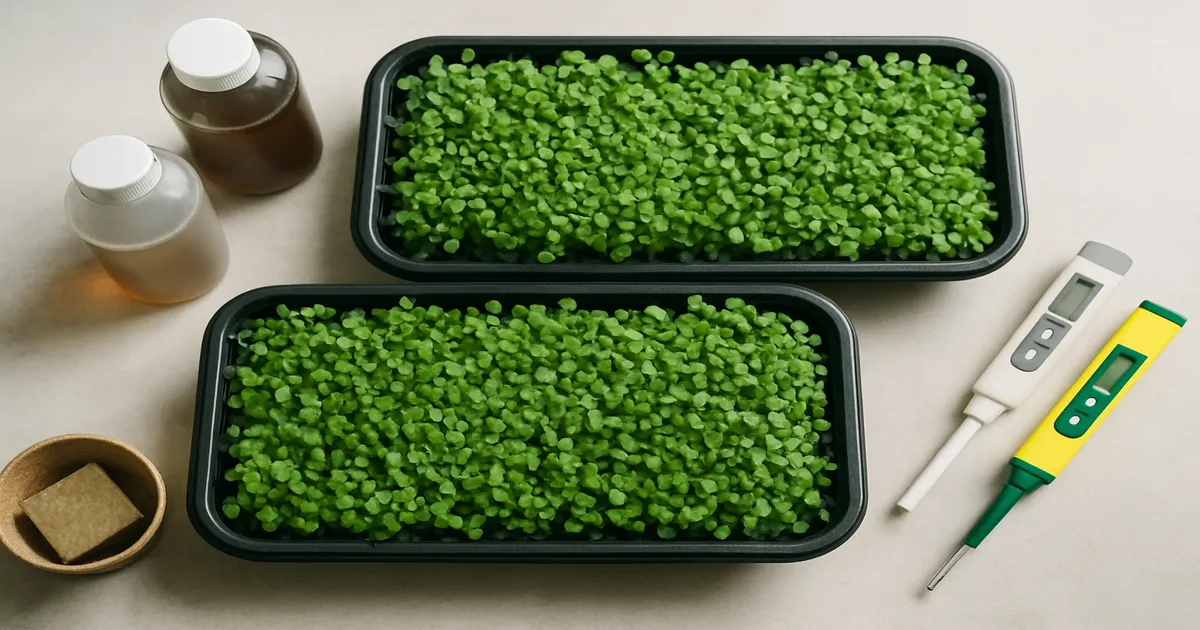
Quick Answer: For most serious growers, hydroponic grow pads (hemp or jute) are the top pick — they deliver cleaner harvests, lower mold risk, and easy scalability. If you’re just starting out or want maximum flavor complexity, a quality potting or seed-starting mix is more forgiving, costs less upfront, and produces excellent results. Read on to see how every major growing medium stacks up.
When people debate microgreens hydroponics vs soil, the conversation gets muddled fast — because “hydroponics” means something different in the microgreens world. We’re not talking about deep water culture or NFT channels. We’re talking about shallow-tray soilless media: hemp pads, jute mats, coco coir. That distinction matters, because it changes the cost, complexity, and day-to-day management of your grow entirely.
This guide breaks down every major growing medium — from standard potting mix to rockwool slabs — so you can pick the right method for your setup, budget, and goals.
Microgreens Hydroponics vs Soil: How to Choose
Before committing to a medium, run through these six criteria. They’ll tell you more about which method fits your situation than any blanket recommendation can.
Harvest Cleanliness and Presentation
Soil clings to roots. If you’re selling to restaurants or at farmers markets, muddy roots are a real problem — chefs notice. Hydroponic pads produce root systems that stay white and clean, making trimming faster and presentation sharper. For home use, it matters less.
Mold and Contamination Risk
Mold is the number-one frustration for microgreens growers, and your growing medium is a major variable. Dense, moist potting mix creates more surface area for fungal growth — especially during the blackout germination phase. Soilless pads dry more evenly between waterings, which reduces that risk. That said, airflow and watering discipline matter more than medium choice alone.
Upfront Cost and Ongoing Expenses
Potting mix runs roughly $0.10–$0.30 per tray when bought in bulk. Quality hemp or jute grow pads cost $0.50–$1.50 per tray depending on brand and quantity. That gap adds up fast at commercial scale. For home growers running a few trays a week, the difference is negligible.
Scalability for Multi-Tray or Commercial Growing
Soil-filled trays are heavy. A standard 10×20 flat with an inch of potting mix can weigh 3–5 lbs when wet. Grow pads bring that down to under a pound. For vertical rack systems, that weight difference is significant — both structurally and in terms of daily handling.
Flavor Profile
Soil-grown microgreens often have a slightly more complex, mineral-forward flavor. The organic matter in quality mixes interacts with root development in ways inert pads can’t replicate. The difference is subtle — most people won’t notice it in a smoothie — but chefs and flavor-focused growers often prefer soil-grown product.
Ease of Use
Soil is more forgiving. It buffers pH naturally, retains moisture without much precision, and doesn’t require you to think about water chemistry. Hydroponic pads reward growers who understand pH management and watering cadence. If you’re new, start with soil and transition to pads once you understand your environment.
At-a-Glance Comparison: Microgreens Hydroponics vs Soil
| Medium | Cost Per Tray | Mold Risk | Harvest Cleanliness | Nutrients Needed | pH Buffering | Best Varieties | Difficulty |
|---|---|---|---|---|---|---|---|
| Standard Potting Mix | $ | Medium–High | Low (soil on roots) | No | Strong | Beets, cilantro, sunflower | Beginner |
| Seed-Starting Mix | $ | Medium | Low | No | Strong | Most varieties | Beginner |
| Loose Coco Coir | $ | Medium | Medium | Cal-Mag | Moderate (must buffer) | Most varieties | Beginner–Intermediate |
| Coco Coir Mat | $$ | Low–Medium | High | Cal-Mag | Moderate | Most varieties | Intermediate |
| Hemp/Jute Grow Pad | $$ | Low | Very High | Optional | None | Radish, mustard, peas, wheatgrass | Intermediate |
| Rockwool Slab | $$$ | Low | High | Yes | None (pre-soak required) | Broccoli, kale, radish | Intermediate–Advanced |
| Perlite/Vermiculite | $ | Medium | Medium | Yes | None | Limited — niche use | Advanced |
Hemp and Jute Hydroponic Grow Pads
Hemp and jute grow pads are the most popular soilless option in the microgreens world. They’re pre-cut to fit standard 10×20 trays, fully sterile, pH-neutral, and biodegradable — a rare combination. Commercial vertical farms have adopted them heavily because they’re lightweight, consistent, and produce the cleanest harvests of any substrate. Bootstrap Farmer Hemp Grow Pads are a widely used option that fits standard trays without trimming.
Key specs:
- Pre-cut for standard 10×20 trays
- pH-neutral, no nutrients added
- Sterile and biodegradable
- Holds moisture without waterlogging
Pros
- Cleanest harvest of any medium — roots stay white and soil-free
- Significantly lighter than soil-filled trays; ideal for vertical stacking
- Low mold risk with proper airflow and watering discipline
- Compostable after use
Cons
- Higher per-tray cost than soil or loose coco coir
- No pH buffering — requires pH-adjusted water every time
- Beets and cilantro often underperform compared to soil, where larger seeds benefit from better hull-lifting support
Best for: Serious hobbyists and commercial growers who prioritize harvest cleanliness, consistency, and scalability.
Coco Coir Mats and Loose Coco Coir
Coco coir is the best middle-ground option for growers who want soilless results without fully committing to grow pads. Derived from coconut husks, it’s renewable, widely available, and inert enough to give you control over nutrient inputs while still behaving somewhat like soil in texture and moisture retention. Pre-cut coco mats work similarly to hemp pads; loose coco coir fills trays the traditional way. Canna Coco Natural Board is a reliable pre-buffered mat option that reduces prep time.
Key specs:
- pH 5.5–6.5 when properly buffered
- Near-zero nutrient content
- Available compressed (bricks) or pre-cut as mats
- Must be pre-buffered with a Cal-Mag solution before use to prevent calcium and magnesium lockout
Pros
- Versatile — works in both pad-style and tray-fill configurations
- Excellent moisture retention without becoming waterlogged
- Sustainable and widely available
- Good stepping stone for growers transitioning from soil to soilless growing
Cons
- Must be pre-buffered with Cal-Mag before seeding — skipping this step causes nutrient deficiencies
- Loose coir can be messy to work with and compacts over time, reducing aeration
- Slightly more preparation required than ready-to-use grow pads
Best for: Growers transitioning from soil to soilless growing, or anyone who wants the cleanliness benefits of hydroponics with more familiar handling.
Standard Potting Mix and Seed-Starting Mix
Traditional potting mix is where most microgreens growers start — and plenty of experienced growers never leave it. Quality mixes like Pro-Mix BX come pre-buffered to around pH 6.0–6.5, require no pre-treatment, and are available at virtually every garden center. Fill your trays to about 1 inch deep and you’re ready to seed.
Key specs:
- Pre-buffered pH 6.0–6.5
- Light organic nutrient content
- Fill trays approximately 1 inch deep
- No pre-treatment required
Pros
- Most forgiving medium for beginners — natural pH buffering handles minor mistakes
- Lowest upfront cost per tray of any option
- Supports more complex, mineral-forward flavor profiles
- No water chemistry required — just fill and seed
Cons
- Heavier trays make vertical stacking harder and more labor-intensive
- Soil on roots means messier harvest and less marketable presentation
- Higher mold risk if you overwater or have poor airflow
Best for: Beginners, home growers, and flavor-focused growers who prioritize simplicity and cost over harvest cleanliness.
Rockwool Slabs
Rockwool is spun volcanic rock — literally. It’s fully sterile, offers an excellent air-to-water ratio, and is a staple of commercial hydroponics. For microgreens, it works well technically, but the handling requirements and disposal concerns mean most home growers are better served by grow pads. Grodan Rockwool Slabs are the industry standard if you’re already running a rockwool-based operation.
Key specs:
- Natural pH 7.0–8.0 — must be pre-soaked and adjusted to pH 5.5–6.5 before use
- Fully sterile and fully inert
- Non-biodegradable
- Available in slabs or cubes
Pros
- Sterile from the factory — no contamination risk from the medium itself
- Excellent drainage and aeration
- Consistent, repeatable results once pH management is dialed in
- Can be reused in some applications after sterilization
Cons
- Requires a pH pre-treatment soak — skipping this causes nutrient lockout
- Not biodegradable, creating ongoing disposal concerns
- Fibers are a skin and lung irritant during handling; gloves and a mask are non-negotiable
- More expensive per tray than pads, with more prep work
Best for: Commercial operations already using rockwool infrastructure, or growers who want maximum sterility and complete nutrient control. Overkill for most home setups.
Perlite and Vermiculite
Perlite and vermiculite are inorganic amendments most growers know as soil additives, but they can technically be used as standalone microgreens substrates. Perlite drains fast and stays airy; vermiculite holds more moisture. Neither is a first-choice medium, but both are worth understanding — particularly as amendments blended into potting mix. Espoma Organic Perlite is a widely available option for growers who want to improve drainage in soil-based trays.
Key specs:
- Fully inert and pH-neutral
- No nutrients whatsoever
- Typically used 1–2 inches deep in trays
- Reusable after sterilization
Pros
- Extremely lightweight — even lighter than grow pads
- Reusable after proper sterilization
- Perlite provides excellent aeration and drainage
- Vermiculite retains moisture well for slow-germinating seeds
Cons
- Seeds can shift and fall through perlite’s coarse gaps, causing uneven germination
- Vermiculite becomes anaerobic quickly if overwatered
- Harvest is messier than pads and less clean than soil
- Less consistent than any dedicated grow medium
Best for: Experimental growers testing new approaches, or as a drainage amendment blended into potting mix. Not recommended as a standalone substrate for most growers.
Our Verdict: Microgreens Hydroponics vs Soil
Best Overall: Bootstrap Farmer Hemp or Jute Grow Pads
For anyone growing more than a few trays per week, grow pads are the clear winner. Cleaner harvests, lighter trays, lower mold risk, and consistent results batch after batch. The higher per-tray cost is real, but the time saved at harvest and the quality of the final product justify it quickly.
Best for Beginners: Pro-Mix BX Potting Mix
Don’t let the hydroponics conversation push you into overcomplicating your first grow. A bag of Pro-Mix BX and a stack of 10×20 trays will get you excellent microgreens with minimal fuss. Master your watering cadence and airflow in soil first — then upgrade if you want to.
Best Budget Option: Loose Coco Coir
If you want soilless results without the per-pad cost, loose coco coir is your answer. It’s cheap in bulk, renewable, and widely available. Just buffer it with a Cal-Mag solution before seeding — skipping that step will cause problems.
Best for Commercial Scale: Hemp/Jute Pads or Pre-Cut Coco Mats
Weight, cleanliness, and consistency are everything at scale. Both hemp/jute pads and pre-cut coco mats deliver on all three. Pads edge out coco mats slightly on cleanliness; coco mats edge out pads on cost. Run a side-by-side trial with your best-selling variety and let the numbers decide.
Best for Flavor Complexity: Potting Mix with Organic Amendments
If you’re growing for a restaurant that values nuanced flavor, soil wins. A quality potting mix — or a blend of seed-starting mix with a small amount of worm castings — produces microgreens with a depth that inert pads simply can’t match.
Nutrients, pH, and Lighting: What Stays the Same Regardless of Medium
Your lighting setup doesn’t change based on growing medium. Aim for 150–250 PPFD at canopy level with a 16-hour photoperiod — that applies whether you’re growing on pads or in potting mix. Barrina T5 LED grow lights work well for shelf setups; a quantum board like the Spider Farmer SF-1000 suits open-bench multi-tray grows where you need broader coverage.
For nutrients: most microgreens harvested in 10 days or fewer don’t need supplementation in any medium. Seeds carry enough stored energy in their cotyledons to support germination and early growth through harvest. If you’re running longer-cycle crops — pea shoots, sunflowers, wheatgrass — on inert pads, a dilute solution of 300–500 PPM (0.6–1.0 EC) at a balanced 3-1-2 N-P-K ratio is plenty. Never push past 1,000 PPM (2.0 EC); microgreens are sensitive to salt stress.
In soilless systems, always check your water pH before watering. Target pH 5.8–6.2 and adjust with a phosphoric acid-based pH Down solution. A reliable digital pH pen like the Apera PH20 removes the guesswork entirely — strips and liquid test kits simply aren’t precise enough for consistent results.
Not sure which method to commit to? Grab a pack of radish seeds — they germinate in 2–3 days and harvest in 5–7 — and run one tray on a grow pad alongside one in potting mix. You’ll have a clear answer in a week.
Frequently Asked Questions
Do hydroponic microgreens taste different from soil-grown microgreens?
Yes, subtly. Soil-grown microgreens often have a more complex, mineral-forward flavor because the organic matter in quality potting mixes interacts with root development in ways inert pads can’t replicate. Hydroponic microgreens tend toward a cleaner, more neutral expression of the variety’s core flavor. The difference is most noticeable in slower-growing varieties like sunflower and peas — less so in fast crops like radish.
Do microgreens grown on pads need added nutrients?
For most crops harvested in 10 days or less, plain pH-adjusted water is all you need. Seeds carry enough stored energy in their cotyledons to fuel germination and early growth through harvest. Nutrient supplementation becomes worthwhile for longer-cycle crops — pea shoots, sunflowers, wheatgrass — where a dilute solution of 300–500 PPM (0.6–1.0 EC) can noticeably improve yield and color.
What pH should water be for hydroponic microgreens?
Target pH 5.8–6.2 for most microgreens grown on soilless media. Municipal tap water typically runs pH 7.0–8.5, so you’ll almost always need to adjust down using a pH Down solution. Test with a calibrated digital pH pen — strips and liquid test kits aren’t precise enough for consistent results. Check pH every time you mix a fresh batch of water, not just at the start of a grow.
Which microgreens grow best on hydroponic pads vs soil?
Radish, mustard, wheatgrass, broccoli, kale, and pea shoots all perform excellently on hydroponic pads — they germinate quickly, root evenly into the mat, and produce clean harvests. Beets, cilantro, sunflower, and Swiss chard tend to do better in soil, where the substrate provides better hull-lifting support and moisture distribution for their larger or more irregularly shaped seeds. When in doubt, run a side-by-side trial.
Is hydroponics or soil better for preventing mold in microgreens?
Soilless media like grow pads and coco mats reduce mold risk compared to dense potting soil, primarily because they dry more evenly between waterings and offer less organic surface area for fungal spores to colonize. That said, the medium is only one piece of the puzzle. Airflow, watering frequency, seed density, and the length of your blackout phase all matter just as much — possibly more. A well-managed soil tray will outperform a poorly managed pad setup every time.