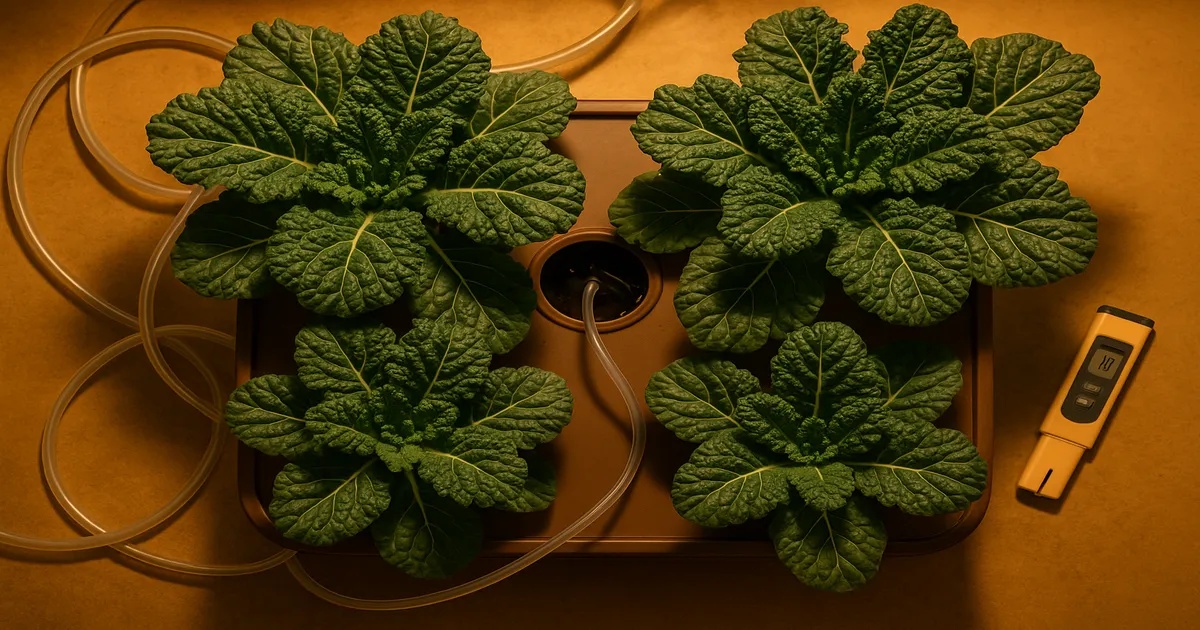
Quick Answer: To harvest hydroponic kale, use the cut-and-come-again method — remove 2–4 outer leaves every 7–14 days, always leaving 4–6 inner leaves intact. This keeps the plant producing for 8–16 weeks. For a one-time harvest, cut the whole plant at the base 4–6 weeks after transplant. Most hydroponic kale reaches first harvest in 30–50 days and yields 0.5–2 lbs per plant over its productive life.
How to Harvest Hydroponic Kale: Two Methods Compared
Cut-and-Come-Again vs. Whole-Plant Harvest
The cut-and-come-again (CCA) method is the better choice for most home growers. You remove outer leaves progressively, the plant keeps growing from the center, and you get harvests for months from a single plant. Whole-plant harvest makes more sense for commercial operations that need fast bed turnover, or when a plant has bolted and stopped producing vigorously.
| Method | First Harvest | Harvest Frequency | Total Yield | Best For |
|---|---|---|---|---|
| Cut-and-come-again | 30–45 days | Every 7–14 days | 1–2 lbs/plant | Home growers, continuous supply |
| Whole-plant | 35–50 days | Once | 0.5–1 lb/plant | Commercial turnover, bolted plants |
Time to First Harvest by System Type
| System | Days to First Harvest | Notes |
|---|---|---|
| DWC | 28–35 days | Fastest growth; ideal for CCA |
| NFT | 30–40 days | Consistent; great for commercial CCA |
| Kratky | 35–50 days | Slightly slower; excellent for home use |
| Ebb and Flow | 35–45 days | Versatile; suits larger plants |
| Dutch Bucket | 40–50 days | Best for full-size plants |
| Vertical Tower | 35–45 days | Space-efficient; suits compact varieties |
Step-by-Step: How to Harvest Hydroponic Kale
When Is Hydroponic Kale Ready to Harvest?
Outer leaves are ready when they reach 8–12 inches long, are deep green, and feel firm. Pale or thin leaves haven’t fully developed their flavor or nutrition — leave them to mature. Yellow or spotted leaves should be removed regardless of size, but they don’t count as a harvest.
The Cut-and-Come-Again Method
This is the method that turns one plant into months of produce. Follow these steps:
- Wait until the plant has at least 8–10 healthy leaves before the first harvest.
- Identify the 2–4 largest outer leaves — these are your targets.
- Cut each leaf stem close to the main stalk with clean, sharp scissors or a harvest knife, leaving a short stub of about half an inch.
- Always leave at least 4–6 inner leaves intact. They drive regrowth.
- Repeat every 7–14 days as outer leaves reach harvestable size.
A well-managed plant in DWC or NFT can sustain CCA harvesting for 8–16 weeks before vigor declines. Expect 6–10 harvests per plant over that period. After that, plants tend to become woody at the base, produce smaller leaves, and bolt more readily — at that point, starting fresh will out-produce pushing an aging plant.
Whole-Plant Harvest
Wait until the plant has a full head of leaves at 4–6 weeks after transplant. Cut the main stem at the base, as close to the net pot as possible without disturbing neighboring plants. This frees up your system immediately for the next crop.
Tools and Sanitation
Always use sharp, clean scissors or a dedicated harvest knife. Dull blades crush stem tissue instead of cutting cleanly, which creates entry points for pathogens and slows regrowth. Wipe blades with isopropyl alcohol between plants — it takes seconds and prevents disease from spreading across your system.
Harvest in the morning when leaves are fully hydrated. Avoid harvesting immediately after a reservoir change or pH adjustment, when nutrient concentrations are in flux.
Best Kale Varieties for Hydroponic Harvesting
Curly Kale: Winterbor, Starbor, and Darkibor
Winterbor F1 is the commercial standard. It’s vigorous, upright, and reliable in NFT and DWC systems, reaching harvestable size in 35–45 days. If you’re starting out and want a variety that’s hard to fail with, this is it.
Starbor F1 grows more compactly and uniformly, making it the go-to for vertical towers and tight spacing. Its high disease resistance is a bonus in enclosed grow rooms where airflow can be limited.
Darkibor F1 has a deep, dark green color and an excellent nutritional profile. It’s slightly slower than Winterbor but worth it if you’re growing for maximum nutrient density.
Lacinato (Dinosaur) Kale
Lacinato — also called Tuscan or dinosaur kale — has flat, deeply textured dark blue-green leaves with a sweeter, more complex flavor than curly types. Its upright, open growth habit makes it easy to identify and remove outer leaves without disturbing the growing center, which is exactly what the CCA method needs. Growth is slightly slower than curly kale, but the flavor payoff is worth the extra week or two if you’re growing for your own kitchen.
Matching Variety to Your System
- DWC / NFT: Winterbor F1 or Darkibor F1 — they thrive with aggressive nutrient delivery
- Vertical tower: Starbor F1 — compact growth suits tight spacing
- Kratky / Ebb and Flow: Any of the above; Lacinato is a great CCA choice
- Dutch Bucket: Winterbor or Lacinato for full-size plants
Nutrient Management for High-Yield Kale Harvests
pH Range: 5.8–6.4
The sweet spot is pH 6.0–6.2, where both macro and micronutrients are available simultaneously. Below pH 5.5, you risk locking out calcium and magnesium. Above pH 6.8, iron, manganese, and zinc become unavailable — which shows up quickly as yellowing new growth.
A natural swing between 5.8 and 6.4 across a 24-hour period is fine. Don’t obsess over hitting a single number; the fluctuation actually ensures different nutrients are optimally available at different times of day.
EC and PPM Targets by Growth Stage
| Growth Stage | PPM (500 scale) | EC (mS/cm) |
|---|---|---|
| Seedling (0–2 weeks) | 350–560 | 0.7–1.1 |
| Early vegetative (2–4 weeks) | 560–840 | 1.1–1.7 |
| Mature vegetative (4–8 weeks) | 840–1260 | 1.7–2.5 |
| Peak production (8+ weeks) | 1050–1400 | 2.1–2.8 |
Macronutrients: Nitrogen, Calcium, and Potassium
Kale is a heavy nitrogen feeder — nitrogen drives the lush leaf growth you’re harvesting. Keep your nitrate-to-ammonium ratio at 90:10. Too much ammonium causes tip burn and root stress even when total nitrogen looks adequate.
Calcium is equally critical. Target 150–200 PPM Ca in your solution. Deficiency appears fast as tip burn — necrotic browning at leaf margins — which is both a quality problem and a stress signal. Potassium works alongside nitrogen during active leaf production; aim for an N:K ratio of roughly 1:1.2 to 1:1.5.
Micronutrients: Iron, Boron, and Manganese
Iron is the micronutrient most likely to cause visible problems. Use chelated iron (Fe-EDTA or Fe-DTPA) and target 2–4 PPM. Deficiency shows as yellowing of new growth while older leaves stay green.
Boron (0.3–0.5 PPM) is often overlooked, but it’s critical for calcium transport within the plant — meaning boron deficiency can cause tip burn even when reservoir calcium looks fine. Manganese (0.5–1.0 PPM) supports photosynthesis and is worth monitoring if you see interveinal chlorosis on mid-aged leaves.
Beginner Nutrient Recipes
3-Part Formula (easiest): Use a reputable 3-part system like the General Hydroponics Flora Series. For the vegetative stage, mix per gallon: FloraGro 3–4 mL, FloraMicro 2–3 mL, FloraBloom 1 mL. Always add Micro first to prevent precipitation. If you’re using RO or soft water, supplement with a cal-mag product at 2–5 mL/gallon.
Masterblend 4-18-38 (cost-effective): Per gallon — Masterblend 4-18-38 at 2.4 g, Calcium Nitrate (15.5-0-0) at 2.4 g, Magnesium Sulfate (Epsom salt) at 1.2 g. This yields approximately 700–900 PPM (1.4–1.8 EC); scale proportionally for higher stages. Dissolve Masterblend and Calcium Nitrate separately before combining.
Modified Hoagland’s (research standard): Per liter — Calcium Nitrate 945 mg, Potassium Nitrate 607 mg, Monopotassium Phosphate 136 mg, Magnesium Sulfate 493 mg, plus a standard Hoagland’s micronutrient mix. Targets approximately 1000–1200 PPM (2.0–2.4 EC) and is a reliable baseline for kale at peak production.
pH and EC Monitoring
Daily Monitoring
A digital pH meter and a TDS/EC meter are essential. (Apera Instruments PH60) Calibrate your pH meter weekly using pH 4.0 and 7.0 buffer solutions, and replace the probe every 12–18 months. Most consumer TDS meters use the 500 scale — confirm which scale yours uses so your PPM readings are comparable.
Check pH and EC daily at the same time each day. Larger setups benefit from continuous inline monitoring, which provides real-time alerts if values drift outside your target range. (Bluelab Guardian Monitor)
Adjusting pH
Use phosphoric acid (pH Down) or potassium hydroxide (pH Up) in small increments — no more than 0.5–1 mL per 5 gallons at a time. Stir, wait 15 minutes, then recheck. Never try to move pH more than 0.5 units in a single session. Overshooting and correcting in the opposite direction stresses plants and destabilizes your solution chemistry.
Potassium silicate at 10–30 PPM helps buffer pH naturally and strengthens cell walls — add it first, before any other nutrients.
Managing EC Between Reservoir Changes
EC rising means plants are consuming more water than nutrients — common in warm conditions or high light. Top off with plain pH-adjusted water. EC dropping means they’re consuming nutrients faster than water; top off with fresh solution at your target strength.
Change the reservoir completely on this schedule:
- Systems under 10 gallons: every 7–10 days
- Larger systems: every 14–21 days
- Immediately if EC drifts more than ±300 PPM from target, or if pH becomes unstable
A sudden pH drop of more than 0.5 units in 24 hours often signals microbial activity or early root rot. Don’t just adjust the pH — inspect the root zone.
Lighting for Kale Leaf Production
Spectrum and PPFD Targets
Blue light (400–500 nm) is the most important spectral range for kale. It promotes compact, dense leaf growth, higher chlorophyll content, and elevated glucosinolate levels — the compounds behind kale’s flavor and health benefits. Red light (620–700 nm) drives overall biomass and photosynthesis efficiency. A full-spectrum white LED with a blue-to-red ratio of roughly 1:3 to 1:4 hits the right balance.
| Growth Stage | PPFD (µmol/m²/s) | DLI (mol/m²/day) |
|---|---|---|
| Seedling | 100–200 | 8–12 |
| Young vegetative | 200–350 | 14–18 |
| Active production | 350–600 | 17–25 |
| Maximum (diminishing returns above) | 600–800 | 25–35 |
The practical sweet spot for home growers is a DLI of 17–22 mol/m²/day. Kale’s light saturation point sits around 800–1000 µmol/m²/s — pushing past it generates heat without boosting photosynthesis.
Photoperiod
A 16-hour on / 8-hour off schedule works reliably for most setups. Some commercial growers push to 18/6 to maximize DLI without additional fixture cost. Avoid photoperiods under 14 hours in cool conditions — the combination of short days and temperature fluctuation can trigger premature bolting.
LED Fixture Recommendations
Home/hobby scale:
- Spider Farmer SF-1000: Covers a 2×2 ft canopy at proper PPFD for kale; ~100W draw; excellent efficiency
- Spider Farmer SF-2000: Steps up to a 2×4 ft coverage area at ~200W
- Mars Hydro TS 1000: Budget-friendly full-spectrum option for a 2×2 ft space
- Barrina T5 LED Grow Lights: Excellent for shelf-style vertical setups; low heat, strong blue spectrum
Commercial scale:
- Fluence SPYDR 2i or RAY 66: Industry standard for leafy greens; >2.5 µmol/J efficiency; programmable spectrum control
- Gavita Pro 1700e LED: High-output fixture suited to large canopies; widely used in commercial leafy green production
Frequently Asked Questions
How long does hydroponic kale take to grow before the first harvest? Most varieties are ready for a first CCA harvest in 30–45 days from transplant in DWC or NFT systems. Slower systems like Kratky or Dutch Bucket may take 40–50 days. Whole-plant harvest is typically done at 35–50 days.
How many times can you harvest the same hydroponic kale plant? Expect 6–10 CCA harvests per plant over 8–16 weeks in a well-managed system. After that, plants become woody, produce smaller leaves, and are more prone to bolting. Starting fresh with new seedlings will out-produce an aging plant.
Why are my hydroponic kale leaves turning yellow? Yellowing new growth usually indicates iron deficiency — check that your pH is below 6.5 and that you’re using chelated iron (Fe-EDTA or Fe-DTPA) at 2–4 PPM. Yellowing of older leaves first points to nitrogen or magnesium deficiency. A sudden pH crash combined with yellowing may indicate root rot; inspect the root zone immediately.
Can you harvest hydroponic kale the same way as soil-grown kale? Yes — the CCA technique is identical. The main difference is that hydroponic plants often grow faster and produce more leaves per cycle, so you may be harvesting more frequently than you would with soil-grown kale.
What is the best hydroponic system for harvesting kale continuously? DWC and NFT are the top choices for continuous CCA harvesting. Both deliver nutrients efficiently, support fast growth, and make it easy to access individual leaves. Kratky is the best option for beginners who want simplicity without sacrificing too much yield.