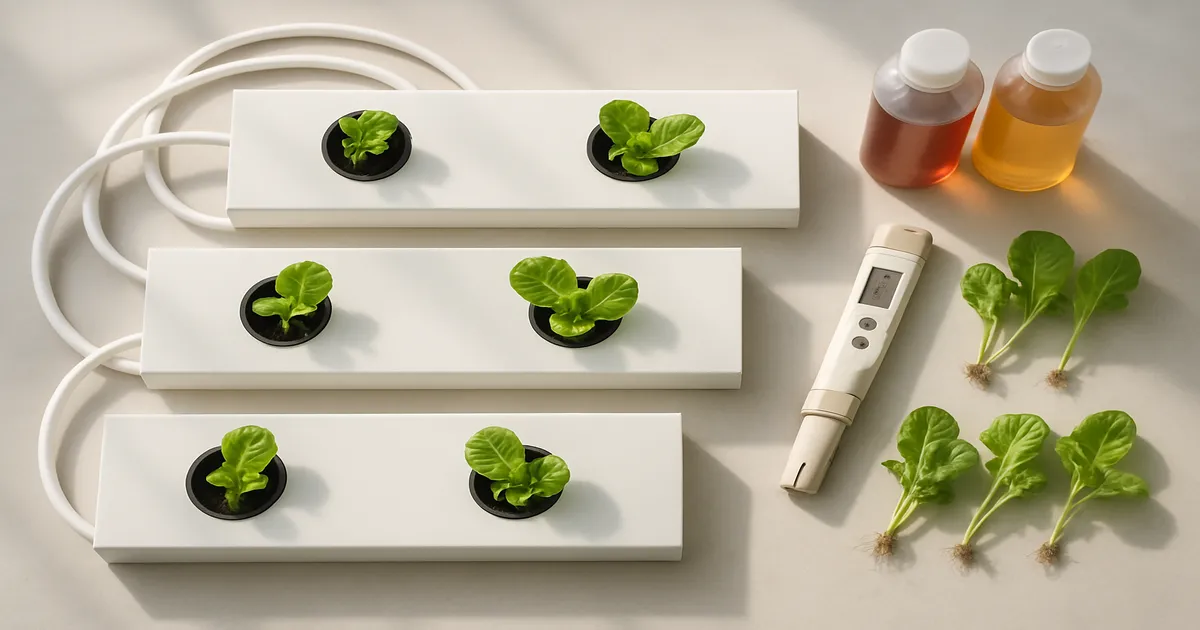
Quick Answer: NFT (Nutrient Film Technique) is a recirculating hydroponic method where a thin film of nutrient solution flows continuously through angled channels, feeding plant roots while the upper root zone stays oxygenated in air. It excels for leafy greens and herbs and is available as compact hobby kits right through to commercial-scale systems. Before you buy an NFT hydroponics system, nail down your space, crop goals, and budget — those three factors determine everything else.
What to Know Before You Buy an NFT Hydroponics System
What Is NFT Hydroponics?
Nutrient Film Technique was developed by Dr. Allen Cooper at the Glasshouse Crops Research Institute in England during the late 1960s and early 1970s. It remains one of the most widely used commercial hydroponic methods in the world. The core idea is elegantly simple: a submersible pump pushes nutrient solution from a reservoir up to the high end of slightly angled channels. A thin film — ideally 1–3 mm deep — flows by gravity across the channel floor, bathing the lower roots. The solution then drains back to the reservoir and the cycle repeats.
What makes NFT special is that dual root environment. Lower roots drink from the nutrient film; upper roots hang in air and absorb oxygen directly. This combination drives fast, efficient growth without any bulky growing medium — just small rockwool starter cubes to get seedlings established.
Who Should Buy an NFT System?
NFT is an excellent fit if you want to grow lettuce, herbs, or leafy greens at any scale. It’s far less suited to large fruiting crops or root vegetables. Home growers can start with a compact 6–12 channel kit for under $150. Serious hobbyists and market gardeners can step up to modular systems that expand as their operation grows.
Types of NFT Hydroponic Systems You Can Buy
Countertop and Hobby NFT Kits (4–12 Channels)
These compact systems are designed for grow tents, spare rooms, or kitchen counters. Most include 4–12 channels, a small reservoir, pump, and basic tubing — everything you need to get started. They’re the lowest-cost entry point into NFT and a great way to learn the method before scaling up.
Horizontal Channel Systems
The workhorse of commercial NFT. Channels run horizontally in parallel rows, typically in 2-inch, 3-inch, or 4-inch widths. Wider channels (3–4 inch) give roots more room and suit basil, bok choy, and larger lettuce varieties. Two-inch channels work fine for baby greens and smaller herbs.
Vertical NFT Tower Systems
Towers arrange channels vertically, dramatically increasing plant density per square foot. They’re popular with home growers who are short on floor space. The trade-off is more complex plumbing and a higher risk of uneven flow distribution across levels.
A-Frame NFT Systems
An A-frame mounts channels on both sides of a peaked structure, effectively doubling your canopy within the same footprint. These are common in commercial greenhouses where overhead space is available and floor space is at a premium.
Modular Commercial NFT Systems
Designed to expand. You start with a base configuration and add channel sections as production grows. These systems use food-grade PVC or UV-stabilised polyethylene and are built for continuous, year-round operation.
Key Buying Criteria at a Glance
| System Type | Best Use Case | Channels | Grower Level |
|---|---|---|---|
| Countertop/hobby kit | Home growing, small harvests | 4–12 | Beginner |
| Horizontal channel | Leafy greens, herbs at scale | 12–100+ | Beginner–Commercial |
| Vertical tower | Space-limited indoor grows | 20–60 | Intermediate |
| A-frame | Greenhouse production | 40–200+ | Intermediate–Commercial |
| Modular commercial | Scalable market growing | 50–500+ | Commercial |
Always buy food-grade plastic — channels contact your nutrient solution continuously. Confirm the system supports a 2–4% slope (roughly a 1:30–1:40 ratio); this is non-negotiable for proper flow. Too shallow and the film pools; too steep and it rushes past roots before they can absorb anything.
How to Set Up Your NFT Hydroponic System
Essential Components
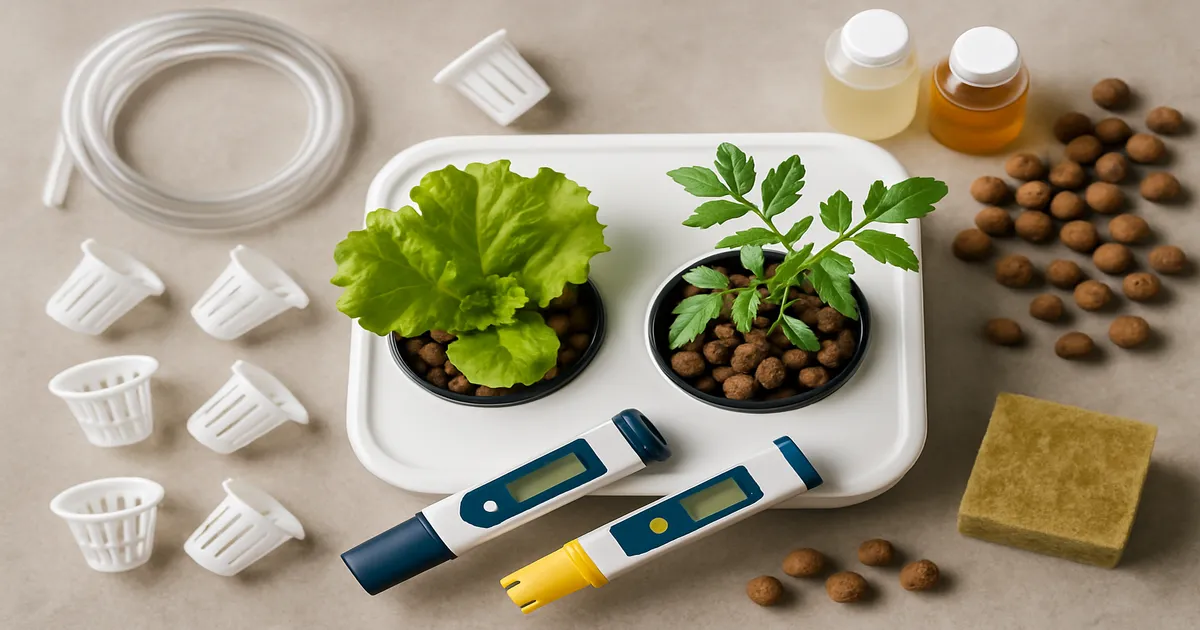
Every NFT setup needs the same core parts:
- Submersible pump — sized to your total channel count and run length
- Reservoir — opaque, food-grade; allow roughly 1–2 gallons per plant for small systems
- Angled channels — with lids pre-drilled for net pots (typically 2-inch net pots for lettuce)
- Tubing and fittings — to deliver solution to the high end of each channel and return it to the reservoir
- Controller or timer — NFT typically runs the pump continuously, but a timer adds a useful failsafe
Correct Channel Slope and Flow Rate
Set channels at a 2–4% gradient — roughly a 1-inch drop for every 25–50 inches of channel length. Confirm this with a spirit level before running water. Target a flow rate of 1–2 litres per minute per channel. Too slow and the film dries out; too fast and you lose the thin-film benefit entirely.
Starting Up and Transplanting
Mix your nutrient solution in the reservoir first, then check pH and EC before switching on the pump. Run plain water through the channels for 10–15 minutes to confirm even flow and no leaks. Once satisfied, drain, mix your nutrients, and transplant.
Start seeds in 1.5-inch rockwool cubes under a humidity dome. Once roots are visibly emerging from the cube — typically 10–14 days — they’re ready for the channel. Drop the cube into the net pot so it sits just above the channel floor. Roots will find the film within a day or two. Handle gently; disturbing early roots sets plants back noticeably.
Critical warning: NFT has almost no buffer against pump failure. If flow stops, roots begin drying out within 30–60 minutes. Keep a spare pump on hand and install a flow alarm for any system you’re relying on for income.
Nutrients for NFT Hydroponics
Choosing a Nutrient Solution
Two-part concentrates like the General Hydroponics Flora Series are reliable and widely available. For budget-conscious growers, the Masterblend 4-18-38 three-part system is hard to beat for value and consistency.
Masterblend Recipe for Leafy Greens
Per gallon of water, combine in this order:
- 2.4 g Masterblend 4-18-38
- 2.4 g Calcium Nitrate
- 1.2 g Magnesium Sulfate (Epsom salt)
This targets 800–1,000 PPM (1.6–2.0 EC) — ideal for lettuce and most leafy greens. Always add calcium nitrate and magnesium sulfate separately; mixing them in concentrate form causes precipitation.
EC and PPM Targets by Crop Stage
| Growth Stage | PPM | EC |
|---|---|---|
| Seedling/Clone | 400–600 | 0.8–1.2 |
| Vegetative (leafy greens) | 600–900 | 1.2–1.8 |
| Vegetative (fruiting crops) | 800–1,200 | 1.6–2.4 |
| Flowering/Fruiting | 1,000–1,600 | 2.0–3.2 |
| Late fruiting/ripening | 1,200–1,800 | 2.4–3.6 |
Calcium deserves special attention in NFT — target 150–200 ppm. Deficiency shows up as tip burn on lettuce, the most common nutrient problem beginners encounter. Iron deficiency (interveinal chlorosis on young leaves) is the most frequent micronutrient issue, and it’s almost always a pH problem rather than a shortage of iron in the solution.
Reservoir Management
As plants drink, water evaporates faster than nutrients are consumed, causing EC to creep upward. Top off with plain, pH-adjusted water to bring EC back down before adding more nutrient solution. Do a full reservoir change every 7–14 days to prevent salt accumulation. Always measure your source water PPM — if tap water runs above 200 PPM, factor that into your mixing calculations.
pH and EC Management in NFT Systems
Optimal pH Range
Most NFT crops thrive at pH 5.8–6.2. Leafy greens tolerate up to pH 6.5, while fruiting crops and strawberries prefer the lower end of that range, around pH 5.8–6.0. In a thin-film system, small pH swings have an outsized effect on nutrient availability, so consistency matters more than chasing a perfect number.
Meters Worth Buying
For pH, the Bluelab pH Pen and Apera PC60 are both excellent — calibrate weekly with pH 4.0 and 7.0 buffer solutions. For EC, the Bluelab Truncheon is virtually indestructible and needs no calibration. Larger setups benefit from an inline monitor like the Bluelab Guardian for continuous real-time readings.
Adjusting pH Safely
Use phosphoric acid solution (pH Down) to lower pH and potassium hydroxide solution (pH Up) to raise it. Add in small increments — about 1 ml per 10 gallons — stir thoroughly, and wait 15 minutes before rechecking. Never shift pH more than 0.5 units in a single session; larger swings stress roots.
Understanding EC Fluctuations
- EC spike — water evaporating faster than nutrients are consumed, common in hot weather. Fix: top off with plain water.
- EC crash — plants consuming nutrients faster than water during rapid growth. Fix: add fresh nutrient solution.
- pH drift upward — the most common NFT issue, caused by plant uptake of nitrate ions. Fix: small daily additions of pH Down, or incorporate some ammonium-based nitrogen into your formula.
Check pH and EC at least once daily — twice during hot weather or heavy crop loads. Keeping nutrient solution below 72°F (22°C) also reduces the biological activity that drives pH instability.
Lighting for Your NFT Hydroponics Setup
PPFD and DLI Targets by Crop
| Crop Type | PPFD (µmol/m²/s) | DLI (mol/m²/day) |
|---|---|---|
| Lettuce & leafy greens | 150–300 | 12–17 |
| Herbs (basil, mint) | 200–400 | 14–20 |
| Strawberries | 300–500 | 17–25 |
| Fruiting crops (tomato, pepper) | 400–800+ | 20–35 |
Recommended Grow Lights
For a 2×2 to 2×4 ft setup, the Mars Hydro TS1000 and Spider Farmer SF-1000 deliver solid output at a reasonable price. Hang them 18–24 inches above the canopy and adjust from there.
Mid-range growers running 3×3 to 4×4 ft systems should look at the Spider Farmer SE3000 or AC Infinity IONBOARD S33. For commercial NFT channels, the Fluence SPYDR 2p and Gavita Pro 1700e LED offer efficiency ratings of 2.6–3.0 µmol/J that justify the higher upfront cost.
Photoperiod Schedules
- Lettuce and leafy greens: 16–18 hours light / 6–8 hours dark
- Herbs: 14–18 hours light
- Fruiting crops: 12–16 hours (tomatoes tolerate up to 18 hours)
- Strawberries: 12–16 hours depending on variety
Best Plants to Grow in NFT Channels
Beginners: Butterhead and looseleaf lettuce are the textbook NFT crops — fast (21–45 days to harvest), forgiving, and productive. Spinach, arugula, and kale all perform well too, though spinach prefers cooler nutrient temperatures around 60–68°F (15–20°C). Start here and get your system dialled in before moving on to anything more demanding.
Intermediate: Basil is high-value and grows quickly in NFT, but it’s sensitive to cold and needs pH 5.8–6.2 with 800–1,200 PPM (1.6–2.4 EC). Cilantro bolts fast in heat — keep it cool. Day-neutral strawberry varieties like ‘Albion’ and ‘Seascape’ produce fruit within 60–90 days and need slightly higher EC at 1,000–1,400 PPM (2.0–2.8 EC).
Advanced: Cherry tomatoes like ‘Sungold’ and ‘Sweet 100’ are the most practical fruiting crops for NFT — lighter than beefsteaks and continuously productive. Expect 70–90 days to first harvest. You’ll need trellising, regular pruning, and manual pollination indoors. EC runs high at 1,200–2,000 PPM (2.4–4.0 EC).
Avoid: Root vegetables (carrots, beets, radishes), large vines (pumpkins, watermelons), and corn. None of these are compatible with channel-based systems.
Troubleshooting Common NFT Problems
Root Rot
Brown, slimy roots and a foul smell from the reservoir are the telltale signs of Pythium (root rot). The primary cause is nutrient solution above 72°F (22°C) combined with low dissolved oxygen. Keep solution temperature at 65–68°F (18–20°C), add an air stone to your reservoir, and use a beneficial bacteria product like Botanicare Hydroguard as a preventive. For an active infection, drain the system, flush with dilute hydrogen peroxide (3 ml of 3% H₂O₂ per gallon), then refill with fresh nutrients and Hydroguard.
Algae Growth
Algae needs light and warmth. Block both. Use opaque black channels and a solid reservoir lid with no gaps — even a small crack of light is enough to seed a bloom. If algae is already present, clean the system during your next reservoir change and introduce beneficial bacteria to outcompete it.
Nutrient Deficiencies
- Tip burn on lettuce → calcium deficiency; increase airflow, raise Ca to 150–200 ppm, confirm pH is below 6.5
- Interveinal chlorosis on young leaves → iron deficiency; lower pH to 5.8–6.2 and add chelated iron
- Interveinal yellowing on older leaves → magnesium deficiency; add Epsom salt at 1 tsp/gallon
- Uniform yellowing of older leaves → nitrogen deficiency; increase N concentration or check for pH lockout
Pump Failure
This is NFT’s Achilles heel. With no buffer medium and no moisture reserve, roots begin wilting within 30–60 minutes of flow stopping — and root death follows quickly after that. Keep a spare pump within arm’s reach and install a flow alarm or water level sensor if your system is business-critical. Check pump function every single day.
Pests
Fungus gnats are the most common pest in indoor NFT setups. Yellow sticky traps catch adults; a layer of food-grade diatomaceous earth around the base of your channels disrupts the larval cycle. Spider mites appear in hot, dry conditions — keep humidity at 50–70% and inspect the undersides of leaves weekly. Aphids and thrips respond well to neem oil spray applied during lights-off.
Frequently Asked Questions
How much does an NFT hydroponics system cost to buy? Entry-level hobby kits with 6–12 channels typically run $80–$150. Mid-range modular systems for serious home growers or small market gardens cost $300–$1,500. Commercial-scale setups with 50+ channels and full monitoring can exceed $5,000, not including lighting or climate control.
Can I build my own NFT system instead of buying one? Yes. DIY NFT systems using square PVC downpipe, a small submersible pump, and a food-grade storage tote can cost as little as $50–$80. The trade-off is time and the risk of leaks or uneven slope if you’re not precise. A bought kit is faster to set up and usually includes pre-drilled channel lids.
How often should I change the nutrient solution in an NFT system? Every 7–14 days for most setups. In hot weather or with heavy crop loads, check EC and pH daily and top off with plain water as needed between full changes. Letting the reservoir run too long causes salt buildup and nutrient imbalance.
What is the biggest mistake beginners make with NFT hydroponics? Not having a spare pump. NFT has zero buffer — if the pump fails and you don’t catch it within an hour, you can lose an entire crop. A $20 backup pump is the single best insurance you can buy.
Is NFT hydroponics better than DWC (Deep Water Culture)? Neither is universally better — they suit different situations. NFT uses less water and nutrient solution overall and is easier to harvest from. DWC is more forgiving of pump failure because roots sit in oxygenated solution rather than depending on continuous flow. For leafy greens at scale, NFT is generally preferred. For beginners growing a small number of plants, DWC is more forgiving.