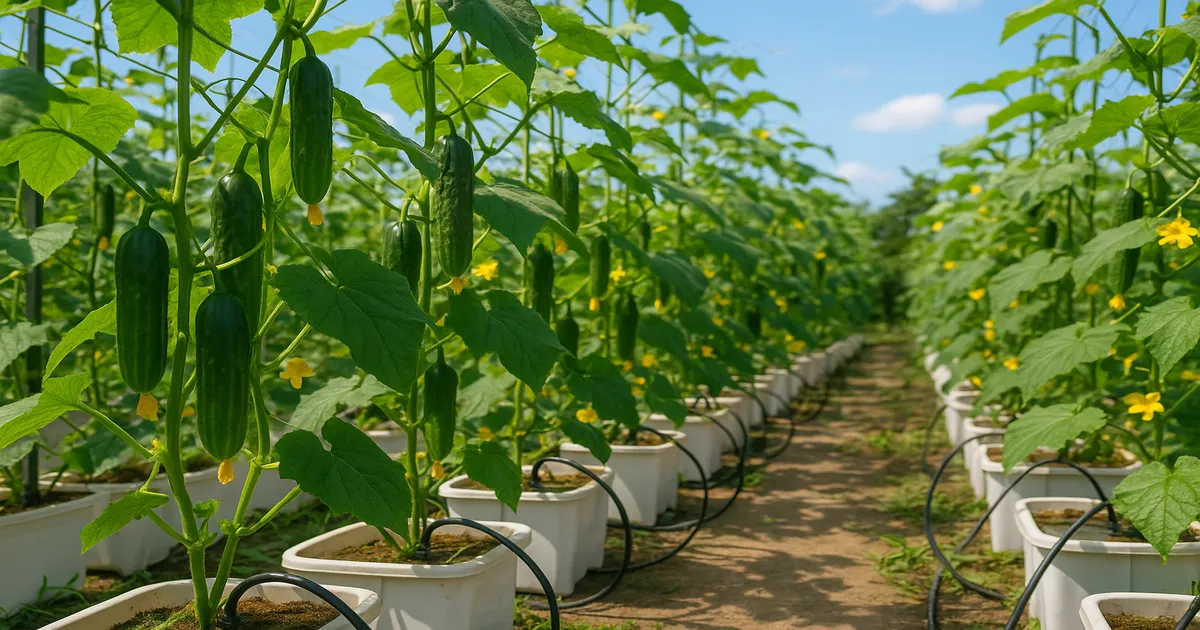
Quick Answer: You can grow hydroponic cucumbers outdoors by pairing a Dutch bucket or DWC system with natural sunlight, maintaining pH 5.8–6.2 and EC between 1.6–4.0 depending on growth stage. Choose a parthenocarpic variety, keep nutrient solution below 75°F (24°C), and expect your first harvest in 50–70 days from transplant — with yields 2–4x higher than soil growing.
Learning how to grow hydroponic cucumbers outdoors is one of the smartest moves a home grower can make. You get the precision feeding of hydroponics without paying for artificial lighting, and cucumbers are forgiving crops that give you clear visual feedback when something goes wrong. This guide covers everything from system selection and variety choice to nutrients, troubleshooting, and environmental management — so you can get your first outdoor hydroponic cucumber harvest right.
How to Grow Hydroponic Cucumbers Outdoors: Key Numbers at a Glance
| Parameter | Target |
|---|---|
| pH | 5.8–6.2 |
| EC (Seedling) | 0.8–1.2 (400–600 PPM) |
| EC (Vegetative) | 1.6–2.8 (800–1,400 PPM) |
| EC (Fruiting) | 2.8–4.0 (1,400–2,000 PPM) |
| Direct Sunlight | 8–10+ hours/day |
| Optimal Air Temp | 70–85°F (21–29°C) |
| Minimum Nighttime Temp | 55°F (13°C) before transplanting |
| Days to Harvest | 50–70 days from transplant |
Of the five main system types — Dutch bucket, DWC, Kratky, NFT, and drip — Dutch bucket is the top recommendation for outdoor vining cucumbers. It scales easily, pairs naturally with vertical trellises, and handles the variability of outdoor conditions better than most alternatives.
Choosing the Right System for Outdoor Hydroponic Cucumbers
Dutch Bucket: The Best All-Round Choice
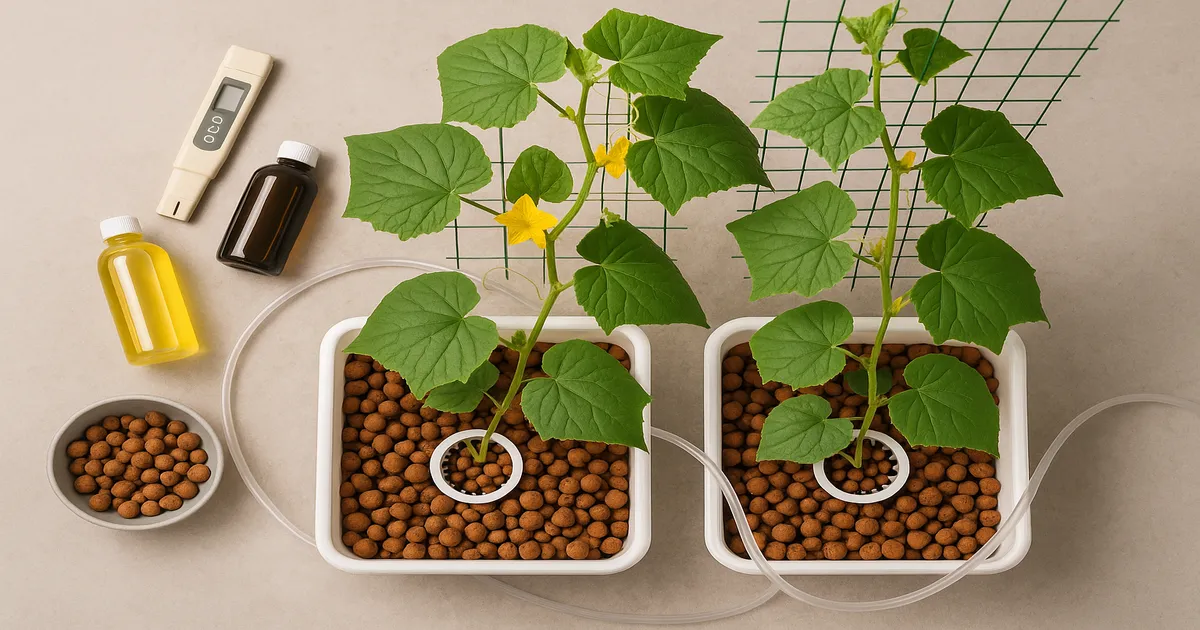
Dutch bucket wins for outdoor vining cucumbers. Each plant grows in its own bucket filled with perlite, coco coir, or rockwool, fed by drip irrigation. Runoff drains to a return line or goes to waste. The system scales from 2 buckets to 200+, and it pairs naturally with vertical trellis structures. (Autopot Easy2Grow Kit)
DWC and Kratky for Smaller Grows
DWC suspends roots directly in oxygenated nutrient solution. It works well outdoors but demands careful reservoir temperature management — solution above 75°F (24°C) loses dissolved oxygen and invites root rot. Kratky (passive DWC with no air pump) is an excellent low-equipment option for bush-type cucumbers on a patio or balcony, though you’ll need to top off the reservoir more frequently in hot weather.
NFT, Drip, and Ebb-and-Flow
NFT channels work but are more vulnerable outdoors than most growers expect. Evaporation in hot weather concentrates the nutrient film quickly, and temperature swings can cause flow issues. Stick to compact bush-type varieties if you go this route.
Drip systems are highly adaptable and easy to automate with a timer — a solid choice if you’re already comfortable with irrigation. Ebb-and-flow is less common outdoors due to the complexity of managing flood cycles in variable temperatures, but it works well under a covered patio or shade house.
| System | Best Cucumber Type | Difficulty | Scalability |
|---|---|---|---|
| Dutch Bucket | Vining/English | Beginner–Intermediate | High |
| DWC | Vining/Bush | Intermediate | Medium |
| Kratky | Bush | Beginner | Low |
| NFT | Bush | Intermediate | Medium |
| Drip | Vining/Bush | Beginner–Intermediate | High |
| Ebb-and-Flow | Bush | Intermediate | Medium |
Best Varieties for Growing Hydroponic Cucumbers Outdoors
Why Parthenocarpic Varieties Are Essential
Cucumbers are either monoecious (requiring pollination) or parthenocarpic (setting fruit without pollination). For hydroponics, parthenocarpic varieties are strongly preferred — no bees needed, and no risk of seedy, bitter fruit from accidental pollination.
Top Cultivars to Try
- Tyria F1 — The commercial standard. Vigorous, high-yielding, excellent disease resistance. Fruits reach 12–14 inches. Widely used in Dutch bucket systems worldwide.
- Cumlaude F1 — Similar performance to Tyria with outstanding powdery mildew resistance. A great choice if PM is a concern in your climate.
- Corinto F1 — Compact internodes make it ideal for vertical systems with limited height.
- Diva F1 — Thin-skinned, mild-flavored, and forgiving for beginners. Performs well in smaller systems.
- Calypso F1 / Endeavor F1 — Pickling types that adapt well to Dutch bucket and drip systems. More tolerant of inconsistent conditions than long English varieties.
Setting Up Your Outdoor Hydroponic Cucumber System
Site Selection
Choose a spot that gets 8–10+ hours of direct sun, with peak exposure from 10 AM to 4 PM. Avoid areas shaded by fences, trees, or buildings during those hours. Wind protection matters too — strong wind stresses vining plants and accelerates reservoir evaporation. A nearby water source makes daily top-offs much less of a chore.
In high-intensity sun climates (Southwest U.S., Mediterranean regions), plan to use 30–40% shade cloth during peak summer. It cuts heat stress without meaningfully reducing photosynthesis.
Reservoir Temperature Management
Reservoir temperature is one of the most overlooked factors in outdoor hydroponics. Keep your solution at 65–72°F (18–22°C) by:
- Using insulated or partially buried reservoirs
- Painting containers white to reflect sunlight
- Draping shade cloth directly over the reservoir
- Adding a water chiller for large systems in hot climates
Trellis and Vertical Support
Vining cucumbers need vertical support from the start. Common options include:
- String trellis systems — Single vertical strings per plant attached to an overhead wire; the commercial standard
- Cattle panel or wire mesh — Freestanding and reusable; good for small home setups
- A-frame trellis — Maximizes airflow and makes harvesting easy from both sides
Train vines upward weekly and remove lateral shoots below the first 12–18 inches to keep airflow strong.
Germination and Transplanting
Start seeds in rockwool cubes or rapid rooter plugs indoors, 2–3 weeks before your planned outdoor transplant date. Keep germination temperatures at 75–85°F (24–29°C). Once seedlings have their first true leaves, harden them off by placing them outdoors for a few hours daily, increasing exposure over 5–7 days. Transplant when nighttime temps are reliably above 55°F (13°C).
Nutrient Management for Outdoor Hydroponic Cucumbers
EC and Macronutrient Ratios by Growth Stage
During vegetative growth, aim for a roughly equal N:K ratio (1:1). As plants begin flowering and setting fruit, shift to a higher potassium concentration — target an N:K ratio of 1:1.5–2 to drive fruit size, sugar transport, and disease resistance. Too much nitrogen during fruiting produces lush foliage at the expense of yield.
| Stage | PPM | EC |
|---|---|---|
| Seedling (0–2 weeks) | 400–600 | 0.8–1.2 |
| Early Vegetative (2–4 weeks) | 800–1,000 | 1.6–2.0 |
| Active Veg / Pre-flower | 1,000–1,400 | 2.0–2.8 |
| Flowering & Fruiting | 1,400–2,000 | 2.8–4.0 |
| Late Fruiting / Harvest | 1,200–1,800 | 2.4–3.6 |
Calcium, Magnesium, and Key Micronutrients
Calcium is non-negotiable for cucumbers. Target 150–200 PPM Ca in solution and maintain a Ca:Mg ratio of 3:1 to 4:1 to prevent the two from competing for uptake. Magnesium deficiency (interveinal chlorosis on older leaves) is common when this ratio gets out of balance.
For micronutrients, pay particular attention to:
- Iron (2–3 PPM): Use chelated Fe-EDTA or Fe-DTPA for pH stability
- Boron (0.3–0.5 PPM): Critical for fruit set; deficiency causes hollow fruit and distorted growing tips
Beginner Nutrient Recipe: Masterblend
The Masterblend 4-18-38 system offers excellent value for outdoor cucumber growers. Fruiting-stage recipe per gallon of water:
- Masterblend 4-18-38: 2.4 g/gallon
- Calcium Nitrate (15.5-0-0): 2.4 g/gallon
- Magnesium Sulfate (Epsom Salt): 1.2 g/gallon
This yields approximately 1,200–1,400 PPM (2.4–2.8 EC). Scale proportionally for higher EC targets. (Masterblend 4-18-38 Complete Combo Kit)
If you prefer a pre-formulated option, the General Hydroponics Flora Series is beginner-friendly and widely available.
Adjusting for Hot Outdoor Weather
When temperatures exceed 85°F (29°C), plants drink water faster than they consume nutrients. Reservoir EC climbs even though you haven’t added anything. On hot days, reduce your target EC by 10–15% and top off with plain pH-adjusted water whenever EC rises more than 0.3–0.5 above your target.
pH and EC Monitoring Outdoors
Optimal pH Range
The sweet spot is pH 5.8–6.2. Drop below 5.5 and you risk iron and manganese toxicity while calcium and magnesium uptake suffers. Climb above 6.5 and iron, boron, and zinc lock out — deficiency symptoms appear even when the solution is fully loaded.
Meters and Calibration
A reliable combo meter is the smartest investment for outdoor growers. The Apera PC60 and Bluelab Combo Meter both measure pH, EC, and temperature in one unit. Calibrate your pH meter weekly using pH 4.0 and 7.0 buffer solutions. Outdoor conditions cause pH to drift faster than indoors, so daily checks are essential during fruiting.
How to Raise and Lower pH
- To raise pH: Use pH Up. Potassium bicarbonate is preferred outdoors — it’s less caustic and adds beneficial potassium. Add 1–2 mL per 10 gallons, stir, wait 15 minutes, recheck.
- To lower pH: Use pH Down (phosphoric acid). Same small-increment approach applies.
Always adjust pH after mixing nutrients — nutrients themselves shift pH significantly.
Managing EC Drift and Reservoir Changes
EC drift in hot weather is predictable: water evaporates, salts stay behind, concentration rises. Check EC daily during fruiting. When it climbs more than 0.3–0.5 above your target, top off with plain pH-adjusted water.
Perform a 25–50% reservoir change every 7–10 days. Over time, certain ions accumulate while others deplete, creating imbalances that topping-off alone can’t fix. Use calcium nitrate as your primary nitrogen source — it’s more pH-stable than ammonium-based nutrients and won’t acidify the solution as rapidly in warm weather.
Environmental Management for Outdoor Hydroponic Cucumbers
Light, Shade, and Temperature
Cucumbers need a minimum of 8–10 hours of direct sun daily. Most outdoor summer locations in USDA zones 5–10 deliver a DLI of 30–60 mol/m²/day on clear days — well above the optimal target of 25–35 mol/m²/day. If your site gets good full-sun exposure, the light side of things largely takes care of itself.
Peak summer sunlight can hit 1,000–2,000 µmol/m²/s. Cucumbers max out at around 1,000 µmol/m²/s, so anything above that generates heat without adding photosynthetic benefit. In hot climates, 30–40% shade cloth prevents leaf scorch and reduces reservoir temperature without meaningfully cutting yields.
The optimal air temperature range is 70–85°F (21–29°C). Below 55°F (13°C), growth slows dramatically. Below 50°F (10°C), chilling injury becomes a real risk. Cucumbers cannot tolerate frost — even a brief dip to 32°F (0°C) will kill plants outright. If you’re pushing the season in spring or fall, keep frost cloth or row cover on hand for overnight protection.
Season Extension with Supplemental Lighting
If you’re growing in early spring, late fall, or a consistently cloudy climate, supplemental LEDs can extend your productive season. The Spider Farmer SF-2000 and Mars Hydro TSW-2000 are solid options for small to medium setups. Run them during morning and evening hours to extend the photoperiod to 16 hours without adding heat during peak sun hours.
Troubleshooting Common Problems When Growing Hydroponic Cucumbers Outdoors
Nutrient Deficiencies
- Interveinal chlorosis on older leaves → Magnesium deficiency. Raise Mg to 40–60 PPM; check Ca:Mg ratio.
- Yellowing on new growth → Iron deficiency. Switch to chelated Fe-EDTA or Fe-DTPA; verify pH isn’t above 6.5.
- Hollow fruit or distorted tips → Boron deficiency. Target 0.3–0.5 PPM boron; use a complete micronutrient blend.
- Blossom end rot → Calcium deficiency. Target 150–200 PPM Ca; ensure pH stays in range for uptake.
pH and EC Fluctuations
Rapid upward pH drift usually means plants are actively consuming nutrients and releasing hydroxide ions — a sign of healthy growth. Correct it with small additions of pH Down. Rapid downward drift can indicate microbial activity in the reservoir; check for root discoloration and increase aeration if needed.
EC spiking upward on hot days is normal — top off with plain water. EC dropping below target means plants are consuming nutrients faster than water; add a dilute nutrient solution to bring it back up.
Pests and Disease Outdoors
Outdoor hydroponic cucumbers face the same pest pressure as soil-grown plants. Inspect leaves daily for:
- Spider mites — Fine webbing on undersides of leaves; treat with neem oil or insecticidal soap
- Aphids — Clusters on new growth; blast off with water, follow with neem
- Powdery mildew — White powdery coating on leaves; improve airflow, choose resistant varieties like Cumlaude F1, and apply potassium bicarbonate spray as a preventive
FAQ: Growing Hydroponic Cucumbers Outdoors
Q: Can I use tap water for my outdoor hydroponic cucumber system? Yes, but test it first. Tap water with EC above 0.5 or pH outside 6.0–8.0 needs adjustment before use. High-alkalinity tap water will push your reservoir pH upward quickly; budget for extra pH Down if this applies to you.
Q: How often should I water Dutch bucket cucumbers outdoors? In warm weather, run drip irrigation 4–8 times per day for 2–5 minutes per cycle. The goal is to keep the medium moist but never waterlogged. Increase frequency during heat waves and reduce it on cool, overcast days.
Q: Do outdoor hydroponic cucumbers need bees for pollination? Not if you choose parthenocarpic varieties like Tyria F1, Diva F1, or Corinto F1. These set fruit without pollination. If you accidentally grow a monoecious variety outdoors, bees and other pollinators will handle it naturally.
Q: What’s the biggest mistake beginners make with outdoor hydroponic cucumbers? Ignoring reservoir temperature. Once solution temperature climbs above 75°F (24°C), dissolved oxygen drops and pythium root rot can take hold within days. Insulate your reservoir, paint it white, and check solution temperature daily during summer.
Q: How long do outdoor hydroponic cucumber plants keep producing? With proper care, a single plant can produce for 3–5 months. Yield typically peaks in the first 6–8 weeks of fruiting, then gradually declines as the plant ages. Most growers do one or two successions per season rather than running a single crop to exhaustion.