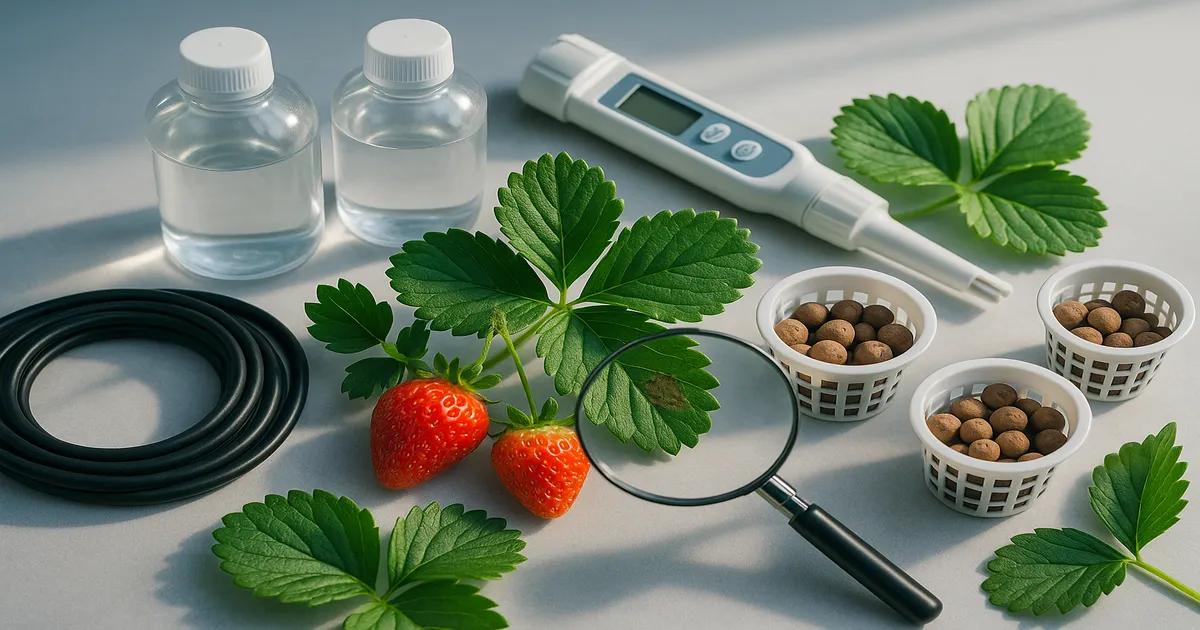
Quick Answer: Strawberry leaves turn red due to four main causes: nutritional deficiencies (especially phosphorus, nitrogen, or magnesium), environmental stress (cold temperatures or too much light), fungal disease, or natural leaf aging. The single most useful diagnostic clue is where the reddening appears — undersides, whole leaf, between the veins, or only on the oldest leaves each point to a different problem. Most cases are fixable once you identify the pattern.
If you’ve been asking yourself “why are the leaves on my strawberry plant turning red?” — you’re in good company. It’s one of the most common concerns among both soil and hydroponic growers, and the good news is that reddening is almost always a signal you can read and act on, not a death sentence for your plants.
Why Are Strawberry Leaves Turning Red? The Most Common Causes
Causes at a Glance
| Cause | Pattern | Urgency |
|---|---|---|
| Phosphorus deficiency | Undersides turn purple-red | High |
| Nitrogen deficiency | Whole leaf pale, then red | High |
| Magnesium deficiency | Interveinal red-bronze | Medium |
| Potassium deficiency | Brown edges, red-tinged older leaves | Medium |
| Cold temperatures | Whole plant reddening | Medium |
| Root rot / poor oxygen | Older leaves red + wilting | Very High |
| Fungal disease | Spots with red halos | High |
| UV/light overexposure | Upper leaf surface reddening | Low–Medium |
| Natural senescence | Oldest leaves only | Low |
How to Read the Pattern
The pattern is everything. Reddening on the undersides of leaves almost always means phosphorus deficiency. Red coloring between the veins while veins stay green points to magnesium. A whole-leaf progression from pale to red-purple, starting on older leaves, suggests nitrogen. If only the oldest few leaves at the base are turning red while everything else looks healthy, that’s just natural senescence — completely normal.
Root rot is the one you can’t afford to ignore. If older leaves are reddening and wilting at the same time, check the root zone immediately.
Nutritional Deficiencies That Turn Strawberry Leaves Red
Phosphorus Deficiency: The #1 Cause of Purple-Red Undersides
Phosphorus deficiency is the most common nutritional cause of red strawberry leaves. The telltale sign is a dark green upper surface combined with a distinctly reddish-purple underside — a contrast that’s hard to miss once you know what to look for. Target 40–50 PPM phosphorus in your nutrient solution, and keep it consistent during flowering and fruiting when demand spikes.
Nitrogen Deficiency: Whole-Leaf Pale Then Red
Nitrogen deficiency starts subtly. Older leaves lose their deep green and go pale or yellowish first, then progress to a red-purple tone as the plant pulls nitrogen from aging tissue to feed new growth. In hydroponic systems, prefer nitrate-based nitrogen over ammoniacal forms — too much ammonium can cause toxicity that triggers its own stress reddening.
Magnesium Deficiency: Interveinal Red-Bronze Discoloration
When magnesium runs short, the tissue between the leaf veins loses color and turns bronze or reddish, while the veins themselves stay green. That interveinal pattern is the key distinguishing feature. Keep your calcium-to-magnesium ratio at roughly 3:1 to 4:1 — target calcium at 150–200 PPM and magnesium at 40–60 PPM — and you’ll rarely see this problem.
Potassium Deficiency: Brown Edges With Red-Tinged Older Leaves
Potassium deficiency shows up as scorched, brown leaf margins on older leaves, often with a reddish tinge spreading inward. Demand is highest during fruiting — target 200–250 PPM. Most complete nutrient formulas cover this, but it’s worth double-checking your numbers if you’re seeing edge burn alongside reddening.
How pH Lockout Mimics Nutrient Deficiency
Here’s what most growers miss: a large percentage of apparent “nutrient deficiency” cases are actually pH lockout. Phosphorus becomes largely unavailable above pH 6.5, meaning your nutrient solution can be perfectly mixed and your plants will still show purple-red undersides if pH has drifted. In soil, keep pH at 6.0–6.5. In hydroponics, target 5.8–6.2. Fix the pH first before adding more nutrients — otherwise you’re compounding the problem.
Environmental and Physiological Causes of Red Strawberry Leaves
Cold Temperatures and Anthocyanin Production
Strawberries produce anthocyanins — the red and purple pigments — as a stress response. Think of it as the plant applying its own sunscreen when conditions get tough. Temperatures below about 50°F (10°C) commonly trigger whole-plant reddening, especially in early spring or late fall. The plants aren’t in immediate danger, but prolonged cold stress will slow growth and reduce yields.
Excess Light or UV Exposure
Too much light intensity, particularly UV, triggers the same anthocyanin response on the upper leaf surface. Indoors, pushing PPFD above 700 µmol/m²/s without gradual acclimation is a reliable way to cause stress reddening. Dial back intensity or raise your lights, then increase gradually over 7–10 days. Outdoors, shade cloth during peak summer heat can help.
Root Rot and Poor Oxygen in the Root Zone
Root rot-induced reddening demands immediate attention. When roots are suffocated — by overwatering, poor drainage, or low dissolved oxygen in a hydroponic reservoir — older leaves redden and wilt simultaneously. Pull a plant and check. Healthy roots are white and firm; rotting roots are brown, slimy, and often smell sour.
In DWC and other hydroponic systems, keep water temperature below 68°F (20°C) and run your air pump continuously. Warm, stagnant water is a direct invitation for Pythium and root rot. A quality air pump like the keeps dissolved oxygen levels where they need to be.
Natural Leaf Senescence: When Red Leaves Are Nothing to Worry About
If only the oldest, lowest leaves are turning red while everything above looks healthy and vigorous, relax — that’s normal leaf aging. Strawberry plants routinely shed older leaves as they push new growth. Remove those leaves to maintain airflow and move on.
Fungal Diseases That Cause Red or Spotted Strawberry Leaves
Spots vs. Uniform Reddening
Disease-related reddening looks different from nutritional or environmental causes. Instead of a uniform color change, you’ll see discrete spots, lesions, or irregular patches — often with a red or purple halo around a lighter center. Spotted and blotchy means think disease first.
Common Fungal Culprits
- Leaf scorch (Diplocarpon earlianum): Small, irregular dark purple spots that enlarge and merge; leaf edges look scorched.
- Common leaf spot (Mycosphaerella fragariae): Round spots with a white or gray center and a red-purple halo.
- Botrytis gray mold (Botrytis cinerea): Grayish fuzzy growth on leaves, crowns, and fruit; thrives in cool, humid, stagnant air.
All three are far more common when airflow is poor and foliage stays wet.
Treatment and Prevention
- Remove affected leaves immediately — bag and discard, don’t compost.
- Improve airflow by thinning crowded plants and removing dead foliage.
- Avoid overhead watering; water at the base or use drip irrigation.
- Apply a copper-based fungicide or neem oil as a preventive spray in humid conditions.
- Maintain adequate calcium (150–200 PPM in hydro) — strong cell walls are your first line of defense against fungal penetration.
How to Fix Red Strawberry Leaves: Nutrient and pH Correction
Step 1: Test and Correct Your pH First
Before changing anything else, test your pH. In soil, target 6.0–6.5; in hydroponics, target 5.8–6.2. Add pH Down (phosphoric acid-based) or pH Up (potassium hydroxide-based) in small increments — 1 mL per gallon, stir, wait five minutes, retest. Never dump in large amounts at once. A reliable digital meter is worth every penny here. (Apera PC60)
Step 2: Check EC/PPM by Growth Stage
Once pH is dialed in, verify your nutrient concentration matches the plant’s current stage:
| Growth Stage | Target PPM | EC |
|---|---|---|
| Seedling / Transplant | 400–600 | 0.8–1.2 |
| Vegetative | 800–1,000 | 1.6–2.0 |
| Flowering | 1,000–1,200 | 2.0–2.4 |
| Fruiting (peak) | 1,200–1,500 | 2.4–3.0 |
| Late season | 800–1,000 | 1.6–2.0 |
Regularly exceeding 1,800 PPM (3.6 EC) causes salt stress that can itself trigger reddening — more is not always better.
Step 3: Dial In Your Nutrient Solution
For hydroponic growers, here’s a solid fruiting-stage target:
| Nutrient | Target PPM |
|---|---|
| Nitrogen (N) | 150–200 |
| Phosphorus (P) | 40–50 |
| Potassium (K) | 200–250 |
| Calcium (Ca) | 150–200 |
| Magnesium (Mg) | 40–60 |
| Iron (Fe) | 2–3 |
| Manganese (Mn) | 0.5–1.0 |
The Masterblend DIY recipe is a favorite among budget-conscious hydro growers. Per gallon of RO or low-TDS water: Masterblend 4-18-38 at 2.4g, Calcium Nitrate (15.5-0-0) at 2.4g, and Epsom Salt (MgSO₄) at 1.2g. This yields approximately 900–1,100 PPM at pH 5.8–6.2 — a solid all-around solution from vegetative through early fruiting.
If you prefer a commercial option, Jack’s Nutrients 321 is reliable and cost-effective, and General Hydroponics Flora Series offers excellent flexibility for growers who want to fine-tune ratios by stage.
How to Keep Pests Away From Strawberry Plants
Most Common Strawberry Pests
- Spider mites: Tiny dots on leaf undersides; fine webbing; leaves look stippled or bronzed.
- Aphids: Clusters of soft-bodied insects on new growth; sticky honeydew residue.
- Thrips: Silver streaking or scarring on leaves; distorted new growth.
- Slugs and snails: Ragged holes in leaves and fruit; silvery slime trails.
- Fungus gnats: Tiny flies around the growing medium; larvae damage roots in hydroponic and container systems.
Physical and Cultural Prevention
Prevention is dramatically more effective than treatment. A few consistent habits go a long way:
- Row covers or fine mesh netting keep flying insects and larger pests off plants entirely.
- Yellow sticky traps catch fungus gnats, thrips, and winged aphids before populations explode.
- Copper tape around container rims deters slugs and snails.
- Remove dead and dying leaves regularly — decaying plant material is a pest and disease magnet.
- Avoid overwatering and keep the growing area clean.
Good airflow is underrated. Stagnant air around the canopy encourages both pest establishment and fungal disease.
Organic and Biological Controls
- Neem oil is a broad-spectrum organic option that disrupts pest life cycles. Apply in the evening to avoid burning foliage.
- Insecticidal soap works well on soft-bodied pests like aphids and spider mites on contact — thorough coverage is key.
- Diatomaceous earth sprinkled around the base physically damages crawling insects like slugs.
- Predatory insects: Ladybugs handle aphid infestations well. For spider mites specifically, Phytoseiulus persimilis predatory mites are remarkably effective and widely available online.
Pest Prevention in Hydroponic Systems
Hydroponic systems have unique vulnerabilities. Keep your reservoir covered — open water attracts fungus gnats and promotes algae. Adding beneficial bacteria like Botanicare Hydroguard to your reservoir protects roots from Pythium and reduces the damp conditions that attract fungus gnats. Healthy, oxygen-rich roots simply don’t attract the same problems as stressed ones.
Frequently Asked Questions About Red Strawberry Leaves and Pest Control
Is it normal for strawberry leaves to turn red?
It can be completely normal. The oldest leaves at the base of a healthy plant turning red is just natural senescence — nothing to worry about. However, if younger leaves are reddening, or the pattern is widespread, investigate pH, nutrient levels, temperature, or disease before assuming it’s harmless.
What deficiency causes strawberry leaves to turn purple or red on the underside?
Phosphorus deficiency is the primary culprit. The upper leaf surface stays dark green while the underside develops a reddish-purple color. Before adding more phosphorus, check your pH — if it’s above 6.5 in soil or 6.2 in hydroponics, phosphorus lockout is likely the real problem even if your nutrient solution is correctly mixed.
Why are the leaves on my strawberry plant turning red in winter or early spring?
Cold temperatures below 50°F (10°C) trigger anthocyanin production — the same red pigments found in autumn leaves. This is a protective stress response and is generally not harmful short-term. If temperatures warm up and the reddening fades, no action is needed. If it persists into warmer weather, reassess pH and nutrients.
How do I keep pests away from strawberry plants without chemicals?
Start with physical barriers: row covers or fine mesh netting are the most effective single intervention. Combine that with yellow sticky traps for flying insects, copper tape for slugs, and regular removal of dead foliage. Neem oil applied in the evening works well as a preventive organic spray. In hydroponic systems, keeping the reservoir covered and adding beneficial bacteria like Botanicare Hydroguard significantly reduces fungus gnat pressure.
Can red strawberry leaves recover?
Yes, in most cases. Leaves that have already turned red won’t regreen — the damage to those cells is done. But once you correct the underlying cause (pH, nutrient deficiency, temperature, or disease), new growth will come in healthy and green. Focus on the new leaves as your indicator of recovery, not the ones that already changed color.