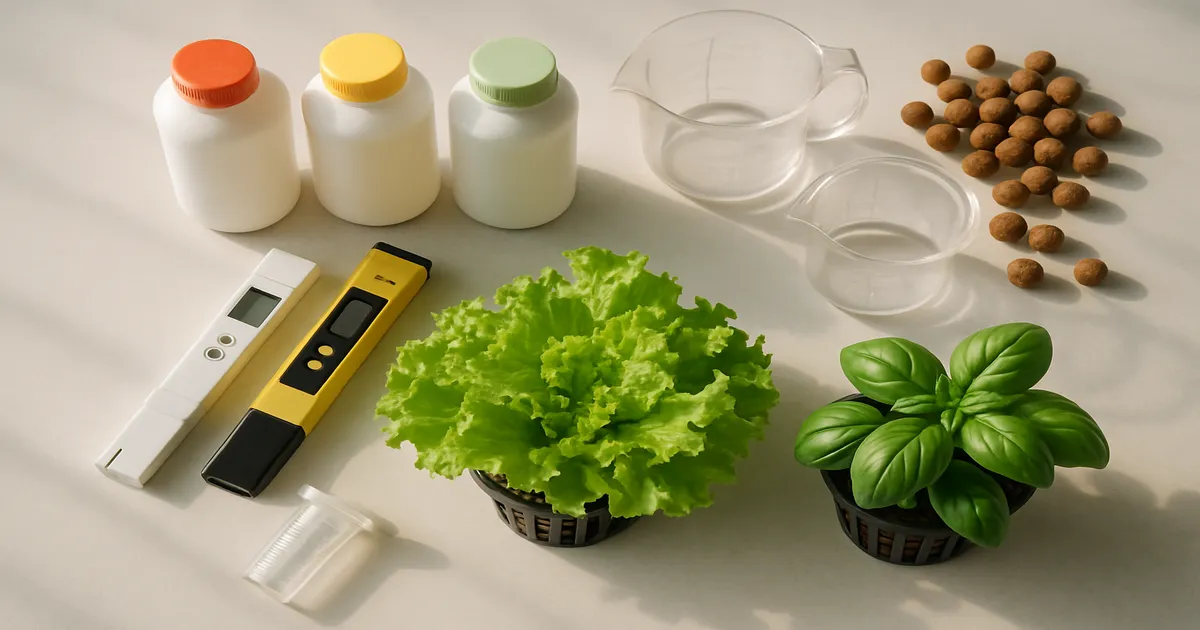
Quick Answer: The best hydroponic nutrients for lettuce and herbs are Masterblend 4-18-38 (paired with calcium nitrate and Epsom salt), Jack’s Nutrients 5-12-26, or General Hydroponics MaxiGro — all deliver reliable results at reasonable cost. Keep pH at 5.8–6.2, EC below 1.6 for lettuce (up to 2.2 for most herbs), and remember that leafy greens are light feeders — less is almost always more.
Quick Reference: Top Nutrients for Lettuce and Herbs
| Product | Type | Best Use Case | Cost Tier |
|---|---|---|---|
| Masterblend 4-18-38 | Dry salt (3-part DIY) | All systems, budget growers | $ |
| Jack’s Nutrients 5-12-26 | Dry salt | All systems, scalable | $ |
| GH MaxiGro | Dry, 1-part | Beginners, DWC/NFT | $$ |
| GH FloraNova Grow | Liquid, 1-part | Beginners, convenience | $$ |
| Botanicare Pure Blend Pro Grow | Hybrid organic | Herb flavor, NFT/DWC | $$ |
| Athena Blended Line | 2-part synthetic | Commercial, serious hobbyists | $$$ |
| Advanced Nutrients Sensi Grow A+B | 2-part, pH-buffered | DWC, intermediate growers | $$$ |
Key Numbers Every Grower Needs
- pH target: 5.8–6.2 (never let it drift outside 5.5–6.5)
- Lettuce EC: 1.1–1.6 (550–800 PPM on the 500 scale)
- Herb EC: 1.4–2.2 (700–1,100 PPM), depending on species
- Reservoir change: Every 7–14 days
- Ammoniacal nitrogen: Keep below 10–15% of total nitrogen
Why Nutrient Choice Matters in Hydroponics
In soil, minerals, organic matter, and microbes act as a buffer — releasing nutrients slowly and correcting imbalances automatically. Hydroponics has none of that. Every element your lettuce or basil needs must be dissolved in your reservoir at the right concentration and the right pH, or the plant simply can’t access it.
This is why a cheap, incomplete fertilizer that works fine in a garden bed can cause serious deficiencies in a hydroponic system within days. Precision matters here in a way it just doesn’t in soil.
Lettuce and most culinary herbs thrive at EC levels of 1.1–2.2 — well below the 3.0–5.0 EC that fruiting crops like tomatoes and peppers need. Push the concentration too high and you’ll see tip burn, crispy leaf margins, and stunted growth before harvest. Their short growth cycles (21–45 days for lettuce, 30–60 days for most herbs) also mean problems develop fast. A nutrient imbalance that might take weeks to show up in a tomato plant can devastate a lettuce crop in under a week.
Synthetic vs. Organic Nutrients
Synthetic (mineral) nutrients are the right choice for most hydroponic setups. They’re immediately plant-available in ionic form, pH-stable when properly formulated, and won’t clog drip lines or promote harmful bacterial blooms.
Organic nutrients — fish emulsion, kelp, worm casting teas — require microbial breakdown before plants can absorb them. Without a soil microbiome to do that work, they’re largely ineffective in standard hydroponic systems and can foul your reservoir quickly. They’re better suited to aquaponics or bioponics, where beneficial microbial communities are deliberately cultivated.
Hybrid products like Botanicare Pure Blend Pro Grow use partially processed organic compounds that do work in hydroponic environments. Adding small amounts of humic or fulvic acid to a synthetic solution can also improve uptake efficiency and root health — without the downsides of going fully organic.
Understanding Nutrients for Lettuce and Herbs
Nitrogen, Phosphorus, and Potassium
Nitrogen drives vegetative growth and chlorophyll production — it’s the most critical nutrient for leafy crops. For lettuce and herbs, use a high-nitrogen formula, but pay attention to the form of nitrogen. Keep ammoniacal nitrogen (NH₄⁺) below 10–15% of total N. Too much ammonium destabilizes pH, can be directly toxic at higher concentrations, and promotes soft, disease-prone growth. Nitrate-nitrogen (NO₃⁻) should make up the bulk of your nitrogen supply.
Phosphorus supports root development and energy transfer. Lettuce and herbs need moderate phosphorus — excess P can lock out zinc and iron. Potassium works alongside nitrogen at roughly a 1:1 to 1:1.5 (N:K) ratio, regulating water uptake, stomatal function, and disease resistance.
Calcium and Magnesium
Tip burn — that brown, papery damage on inner lettuce leaves — is the most common problem in hydroponic lettuce production, and calcium is almost always at the root of it. The tricky part: tip burn usually isn’t caused by a lack of calcium in your reservoir. It’s caused by poor delivery to fast-growing leaf margins due to low transpiration. Adequate calcium in solution (100–150 ppm), combined with good airflow and gentle air circulation directly over the canopy, is your best defense.
Magnesium sits at the center of every chlorophyll molecule, so a deficiency shows up fast as interveinal yellowing on older leaves. Target a Ca:Mg ratio of 3:1 to 4:1 — most well-formulated nutrient solutions hit this automatically.
Micronutrients: Iron, Manganese, Zinc, and More
Iron is the micronutrient most likely to cause problems in hydroponics. Supply it as chelated iron — Fe-EDTA or Fe-DTPA — at 2–3 ppm. Above pH 6.0, Fe-DTPA holds up better, making it the smarter choice for growers who run on the higher end of the pH range.
Other key micronutrient targets:
- Manganese (Mn): 0.5–1.0 ppm
- Zinc (Zn): 0.1–0.5 ppm
- Boron (B): 0.3–0.5 ppm (deficiency causes distorted new growth)
- Copper (Cu): 0.05–0.1 ppm — don’t exceed 0.5 ppm; copper becomes toxic quickly
- Molybdenum (Mo): 0.05–0.1 ppm
Ideal Elemental Targets for Lettuce
| Nutrient | Target Range |
|---|---|
| Nitrogen (N) | 150–200 ppm |
| Phosphorus (P) | 40–60 ppm |
| Potassium (K) | 150–250 ppm |
| Calcium (Ca) | 100–150 ppm |
| Magnesium (Mg) | 30–50 ppm |
| Sulfur (S) | 50–80 ppm |
| Iron (Fe) | 2–3 ppm (chelated) |
EC and PPM: Dialing In the Right Nutrient Strength
EC vs. PPM — Know Your Scale
EC (electrical conductivity) measures how well your solution conducts electricity, which correlates directly to dissolved nutrient concentration. PPM converts that EC reading into a number — but two different conversion scales exist.
The 500 scale (most common in North America) reads 1.0 EC as 500 PPM. The 700 scale (used by some European and commercial meters) reads 1.0 EC as 700 PPM. Always confirm which scale your meter uses before comparing numbers with another grower or following a commercial recipe. A reliable EC/pH combo meter takes the guesswork out of this entirely.
Nutrient Strength by Growth Stage
| Growth Stage | PPM (500 scale) | EC |
|---|---|---|
| Seedling / Germination | 100–250 PPM | 0.2–0.5 |
| Early Vegetative | 400–600 PPM | 0.8–1.2 |
| Full Vegetative (Lettuce) | 550–800 PPM | 1.1–1.6 |
| Full Vegetative (Herbs) | 700–1,100 PPM | 1.4–2.2 |
| Pre-Harvest Flush (optional) | 0–100 PPM | 0.0–0.2 |
Start seedlings at the low end and ramp up gradually. Pushing concentration too early stunts root development.
Crop-Specific EC Targets
- Lettuce: ≤1.6 EC — above this, expect tip burn and bitterness
- Basil: 1.4–2.1 EC at peak growth
- Cilantro, dill, parsley: 1.1–1.9 EC
- Mint: 2.0–2.4 EC — a heavier feeder than most herbs, but the 2.8–3.4 range cited in some sources risks salt stress; stay conservative until you know your cultivar
- Chives: 1.8–2.4 EC
Note on mint EC: Some sources list mint as high as 2.8–3.4 EC, but in practice most growers see tip scorch above 2.4 EC in recirculating systems. Start at 2.0 and adjust based on plant response.
Managing EC Day to Day
As plants drink water, EC rises because nutrients concentrate. When that happens, top off with plain pH-adjusted water — not fresh nutrient solution. If EC drops, plants are consuming nutrients faster than water, so top off with dilute nutrient solution.
Change the entire reservoir every 7–14 days in home systems regardless of EC readings. Old solution accumulates sodium, unused nutrient ratios drift, and pathogen risk climbs. If you’re using tap water, measure its baseline EC before mixing — municipal water can run 0.2–0.8 EC, and that counts toward your target. RO water starts at 0, giving you complete control but requiring full micronutrient supplementation from scratch.
pH Management: The Hidden Key to Nutrient Availability
Optimal pH for Lettuce and Herbs
Even a perfectly formulated nutrient solution fails if pH is off. Target pH 5.8–6.2 as your daily operating range for lettuce and most herbs. Basil prefers the slightly higher end — pH 6.0–6.5. Mint is more forgiving and tolerates a wider range, but 6.0 remains the sweet spot.
Each nutrient has a pH window where it stays soluble and plant-available:
- Iron, manganese, zinc, copper: Best at pH 5.5–6.5; rapidly lock out above 7.0
- Calcium, magnesium: Best at pH 6.0–7.5; can precipitate below 5.5
- Phosphorus: Best at pH 6.0–7.0; locks out at both extremes
This is why growers chasing a specific deficiency sometimes make it worse — they adjust nutrients without checking pH first.
Measuring and Adjusting pH
A quality digital pH pen is non-negotiable. The Apera PC60, Bluelab pH Pen, and Milwaukee MW102 are all accurate to ±0.01–0.05 pH. Calibrate weekly using fresh pH 4.0 and 7.0 buffer solutions, and store the electrode in proper storage solution between uses — never plain water, never dry. Replace electrodes every 12–18 months.
pH test drops and strips work as a backup but carry ±0.2–0.5 pH uncertainty — not tight enough to catch early drift.
For adjustments:
- pH Up: Potassium hydroxide (KOH) is standard. Add a few drops at a time, mix thoroughly, and retest after 15 minutes.
- pH Down: Phosphoric acid is most common for hydroponic use. Citric acid works in organic systems but causes EC fluctuations.
- In a 5-gallon reservoir, 1 mL of either solution typically shifts pH by 0.5–1.0 units. Always add to water, never concentrate to concentrate.
- Never correct more than 0.5–1.0 pH units per session — large rapid swings stress roots.
Diagnosing pH Drift
| Symptom | Likely Cause | Fix |
|---|---|---|
| pH rising over 24–48 hours | Plants consuming nitrate; algae growth | Add pH Down; eliminate light leaks |
| pH dropping rapidly | High ammonium uptake; microbial activity | Add pH Up; switch to nitrate-dominant formula |
| pH crashing below 5.0 | Bacterial bloom; organic decomposition | Full reservoir change; sanitize system |
| pH stable but plants show deficiency | Nutrient imbalance or lockout | Check individual element levels; rebalance formula |
Best Hydroponic Nutrients for Lettuce and Herbs: Product Reviews
Best for Beginners: GH MaxiGro and FloraNova Grow
**GH MaxiGro** is one of the best entry points for new growers. It's a dry, one-part formula that mixes easily in DWC or NFT systems, covers macro and micronutrients, and is widely available. Measure, dissolve, adjust pH — done.GH FloraNova Grow is the liquid equivalent — slightly more expensive per gallon but even simpler since there’s no dissolving step. Both are forgiving enough for beginners but precise enough to get real results.
Best Budget Option: Masterblend 4-18-38 and Jack’s Nutrients 5-12-26
The Masterblend recipe is the gold standard for cost-conscious growers. The three-part formula:
- Dissolve 2.4 g/gal (0.6 g/L) Masterblend 4-18-38 in water
- Add 2.4 g/gal (0.6 g/L) calcium nitrate — always dissolve this separately first to avoid precipitation
- Add 1.2 g/gal (0.3 g/L) Epsom salt (magnesium sulfate)
**Jack's Nutrients 5-12-26** follows a similar two-part approach (paired with Jack's calcium nitrate) and is especially cost-effective when buying in bulk. Both products deliver professional-grade results at a fraction of the cost of premium liquid nutrients.Correction note: The original 1 g/L ratio is a common shorthand but produces approximately 1.2–1.4 EC — on the high end for lettuce seedlings. The 0.6 g/L ratio above targets ~0.8–1.0 EC, better for early stages. Scale up to 1 g/L for full vegetative lettuce and 1.2–1.5 g/L for herbs.
Best Premium Option: Athena and Advanced Nutrients
**Athena Blended Line** has earned a strong reputation in commercial and serious hobby settings for its consistency — no residue, no clogged lines, predictable results batch after batch.Advanced Nutrients Sensi Grow A+B includes pH-buffering technology that helps keep solution pH more stable between adjustments — a genuine advantage for growers who can’t monitor daily. It’s pricier, but the reduced pH management overhead is worth it for some setups.
Best for Herb Flavor: Botanicare Pure Blend Pro Grow
If you’re growing culinary herbs and flavor matters — and it should — Pure Blend Pro Grow stands out. Its organic-hybrid formula supports the sulfur-containing compounds responsible for the characteristic aroma and taste of basil, cilantro, and chives. It’s compatible with DWC and NFT systems and works well when you want a more natural approach without the mess of fully organic nutrients.
DIY Option: The Hoagland’s Solution
The modified Hoagland’s solution is the classic research formula, still used in university labs:
- Calcium nitrate: 236 mg/L
- Potassium nitrate: 101 mg/L
- Monopotassium phosphate: 27 mg/L
- Magnesium sulfate: 123 mg/L
- Micronutrient stock solution per manufacturer spec
This produces approximately 1.8–2.2 EC at full strength — better suited for herbs than lettuce. Dilute to 50–75% for lettuce.
Matching Nutrients to Your Hydroponic System
DWC and Kratky
DWC and Kratky systems have static or semi-static reservoirs, so you want a stable formula that doesn’t drift dramatically between checks. Masterblend and Jack’s Nutrients are ideal — they’re clean, fully soluble, and don’t break down in still water. For Kratky specifically, mix at the lower end of the EC range since you can’t easily top off without disturbing the air gap.
NFT Systems
NFT channels are narrow and continuous-flow, which means any particulate matter or organic residue will accumulate and eventually clog. Stick to fully synthetic, clean-dissolving formulas — MaxiGro, Jack’s, or Athena. Avoid heavy organic or hybrid products in NFT unless you’re running a regular flushing schedule.
Ebb and Flow
Ebb and flow suits larger-rooted woody herbs — rosemary, thyme, oregano — that need more root zone volume and benefit from the wet/dry cycle. Any of the recommended nutrients work here, but the periodic flooding and draining means residue buildup is less of a concern than in NFT. Use a slightly higher EC (1.6–2.2) for woody herbs in this system, and ensure your flood table and net pots are sized appropriately for the root mass.
Frequently Asked Questions
Can I use regular plant fertilizer for hydroponics? Most soil fertilizers are incomplete for hydroponics. They often lack the full micronutrient profile and may contain slow-release coatings that don’t dissolve properly in water. Use a fertilizer specifically formulated for hydroponic use, or a well-tested DIY recipe like Masterblend.
How often should I change my nutrient solution? Every 7–14 days for most home systems. Even if EC and pH look fine, old solution accumulates sodium and unused nutrient ratios drift out of balance. Smaller reservoirs (under 10 gallons) should be changed closer to every 7 days.
Why are my lettuce leaves turning yellow? Yellowing in hydroponics usually points to nitrogen deficiency, iron lockout from high pH, or magnesium deficiency. Check pH first — if it’s above 6.5, iron and manganese become unavailable regardless of how much is in your solution. Correct pH before adding more nutrients.
What’s the difference between one-part and two-part nutrients? One-part formulas (like MaxiGro) contain everything in a single product — convenient but less flexible. Two-part formulas (like Sensi Grow A+B or the Masterblend recipe) keep calcium separate from phosphate and sulfate to prevent precipitation in the concentrate. Two-part systems give you more control and are generally more cost-effective at scale.
Do I need a separate Cal-Mag supplement? If you’re using a well-formulated complete nutrient like Masterblend (which includes calcium nitrate) or Jack’s, you typically don’t need a separate Cal-Mag product. If you’re using a one-part formula with soft or RO water, a Cal-Mag supplement may be necessary — check the calcium and magnesium levels in your mixed solution against the target ranges above.